
Mix3R: Solving the 3D Alignment Puzzle by Bridging Generation and Reconstruction
Mix3R: Mixing Feed-forward Reconstruction and Generative 3D Priors for Joint Multi-view Aligned 3D Reconstruction and Pose Estimation
Mix3R is a novel 3D reconstruction framework that unifies feed-forward reconstruction (aligned point maps) and generative 3D priors (complete geometry) into a single system using a Mixture-of-Transformers (MoT) architecture. It achieves SOTA performance in joint multi-view 3D reconstruction and pose estimation, significantly improving input alignment and geometric accuracy (e.g., Chamfer Distance reduction vs. TRELLIS).
Executive Summary
TL;DR: Mix3R is a dual-stage framework that solves a fundamental conflict in 3D computer vision: the trade-off between the completeness of generative models and the alignment of feed-forward reconstruction. By weaving together the strengths of TRELLIS (a generative flow-based model) and (a pixel-aligned reconstruction model) through a Mixture-of-Transformers (MoT) architecture, Mix3R produces 3D assets that are both geometrically whole and precisely matched to input camera views.
Strategic Impact: This work represents a shift from "generation as a look-alike" to "generation as a precise reconstruction tool." It establishes a new SOTA in sparse-view reconstruction where camera poses are unknown, outperforming existing pipelines in both geometric fidelity and pose accuracy.
The Core Conflict: Completeness vs. Fidelity
In the current 3D landscape, you typically have to choose your poison:
- Feed-forward Reconstruction (e.g., DUSt3R, VGGT): These methods are great at "sticking" objects to pixels. However, they only see what the camera sees. As a result, they produce "2.5D shells" rather than watertight 3D models.
- Generative Reconstruction (e.g., TRELLIS): These leverage massive priors to imagine the back of an object. The problem? They often ignore the fine-grained details of the front, leading to models that look like the input but don't match the input.
Mix3R addresses this "chicken-and-egg" problem: To reconstruct well, you need poses; to estimate poses, you need a geometry to align to.
Methodology: The Mixture-of-Transformers (MoT) Bridge
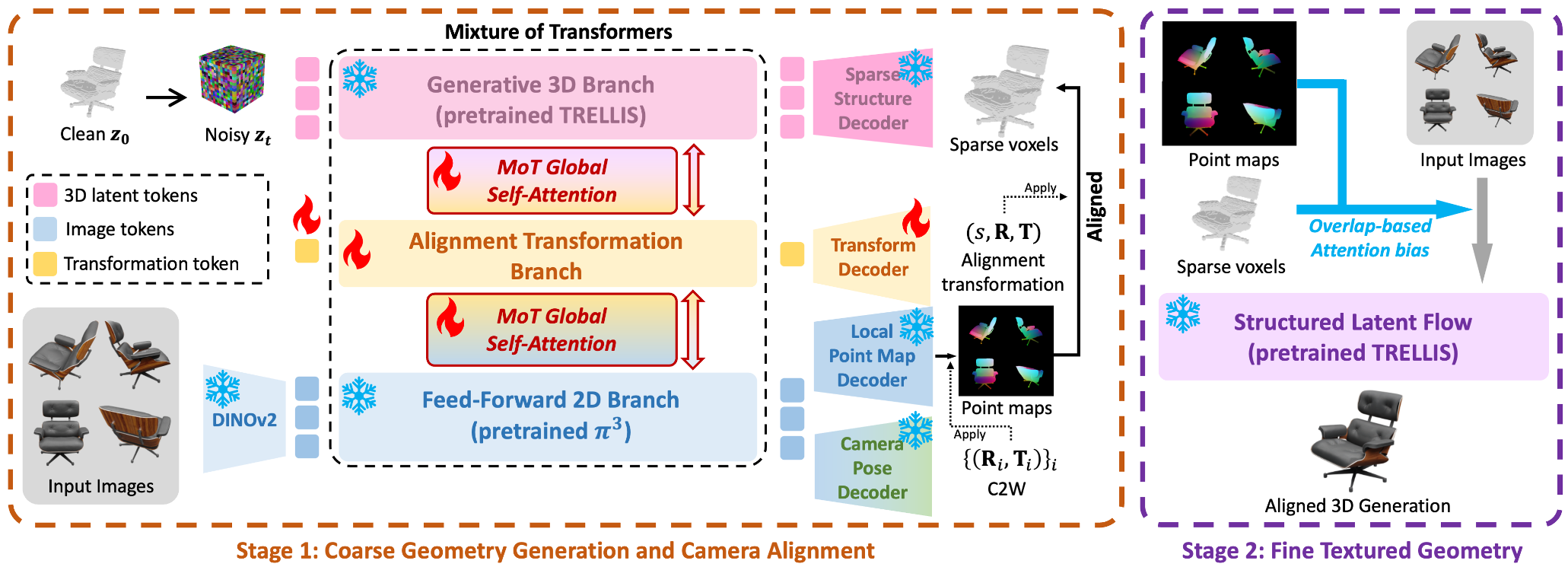
The technical breakthrough of Mix3R lies in its Stage-1 MoT Architecture. Instead of treating the two models as black boxes, the authors surgically fused 24 TRELLIS blocks with 36 blocks.
1. The MoT Architecture
By inserting global self-attention layers that span across 3D voxel tokens and 2D image tokens, the model allows:
- The 2D Branch to ground its point map predictions in a 3D generative prior.
- The 3D Branch to be conditioned on geometrically informative features derived directly from the pixels.
2. Training-Free Texture Alignment
In Stage 2, the model generates high-resolution textured geometry. To ensure the texture "lands" in the right place, Mix3R introduces an Overlap-based Attention Bias.
By calculating which 3D voxels () overlap with specific 2D image patches () using the point maps from Stage 1, the system adds a bias matrix to the cross-attention scores. This forces the generator to "look" at the correct part of the photo when painting the 3D model, requiring zero additional training.
Experimental Results: A New Benchmark
Mix3R was evaluated on Toys4k and Google Scanned Objects (GSO), yielding dominant results across all metrics.
Quantitative Superiority
| Metric | Method | Toys4k (PSNR ) | GSO (CD ) |
|---|---|---|---|
| Generative Baseline | TRELLIS | 23.93 | 4.56 |
| Fusion Baseline | ReconViaGen | 24.49 | 1.00 |
| Ours | Mix3R | 27.17 | 0.79 |
Visual Evidence
As shown in the reprojection results, Mix3R successfully aligns complex, asymmetric textures (like text on a bottle or specific patterns on a toy) that pure generative models typically hallucinate or misplace.

Critical Insights & Limitations
Why does it work? The MoT design is the "secret sauce." Unlike simple feature concatenation, MoT allows the modalities to maintain their specialized query/key/value matrices while still communicating in a shared latent space. This preserves the "intelligence" of the pretrained priors while enabling the cross-talk necessary for alignment.
The Boundaries:
- View Sensitivity: The performance can degrade if input views are extremely unusual (e.g., extreme roll angles) relative to the training distribution.
- Dataset Bias: Because the model was trained on TRELLIS-generated data, it may struggle with real-world complexities like specular highlights or harsh shadows not present in the synthetic training set.
Conclusion
Mix3R is a significant step toward faithful 3D asset acquisition. By successfully mixing "the imagination" of generative models with "the facts" of feed-forward reconstruction, it provides a blueprint for the next generation of 3D foundation models.
For a deeper dive into the specific block-matching strategies and camera refinement math, refer to the full paper at Mix3R Project Page.