
Precise Timing: The Breakthrough in Mixed-Precision Distributed Training Prediction
Training Time Prediction for Mixed Precision-based Distributed Training
The paper introduces a precision-aware distributed training time predictor designed for large-scale deep learning models. By partitioning the computation graph and identifying operator-level precision (FP32, FP16, or Mixed Precision), the method achieves a high prediction accuracy with an average Mean Absolute Percentage Error (MAPE) of 9.8% on LLaMA 3.1-8B.
TL;DR
Training large language models (LLMs) is a monumental investment in time and money. While distributed training is the standard, predicting how long a job will take has been notoriously difficult—until now. This paper introduces a precision-aware predictor that cuts prediction error from a staggering 147% down to just 9.8% by accounting for how different floating-point precisions (FP16, FP32, Mixed) change hardware performance.
Background: The Infrastructure Blind Spot
In the world of High-Performance Computing (HPC), time is literally money. Accurate training time prediction is the backbone of job scheduling and budget estimation. However, most current predictors have a "blind spot": they assume the model runs in a single, static precision.
As models like LLaMA and GPT transition to Mixed Precision (using FP16 for speed and FP32 for stability), the actual execution time can vary by 2.4x. Current tools like NeuSight and vTrain ignore these shifts, leading to wildly inaccurate estimates that can derail resource allocation.
Why Static Predictions Fail
The authors identify that the core issue lies in the Computation Graph. Prevailing methods treat the model as a fixed set of math operations. In reality, modern training frameworks (like PyTorch AMP) dynamically "cast" different operators to different precisions.
- FP16 is used for compute-heavy layers (Conv, MatMul) to leverage Tensor Cores.
- FP32 is retained for sensitive operations (Softmax, Reductions) to prevent numerical instability.
If your predictor doesn't know which operator shifted to which precision, it cannot calculate the correct latency or the resulting communication volume (gradient size) across the network.
Methodology: The Precision-Aware Framework
The proposed solution follows a rigorous four-step process to bridge the gap between abstract graphs and physical hardware reality.
1. GPU-Specific Graph Partitioning
The tool first takes the global model and "slices" it according to the selected parallelism strategy (Data, Tensor, and Pipeline parallelism). This creates subgraphs tailored to what each specific GPU in the cluster will actually execute.
2. Precision Identification & Profiling
By hooking into torch.amp (Automatic Mixed Precision), the predictor identifies the casted precision for every single operator. It then performs a high-fidelity profile of these operators across both forward and backward passes.
3. Communication Overhead Modeling
The team modeled the three main bottlenecks of distributed training:
- DP (Data Parallelism): Calculated via gradient synchronized volume.
- TP (Tensor Parallelism): Analyzed based on intra-layer partition sizes.
- PP (Pipeline Parallelism): Accounted for via the "Pipeline Bubble" formula: .
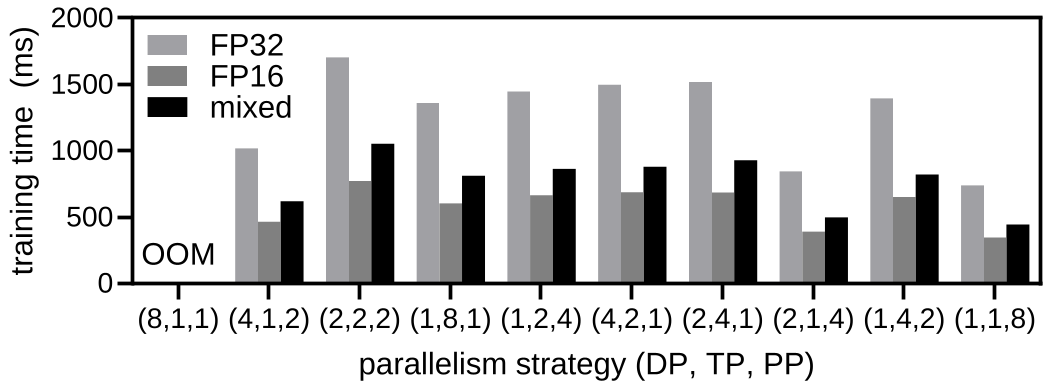 Fig 1: The dramatic impact of precision on training time. Note how OOM (Out of Memory) errors occur at higher precisions, emphasizing the need for precision-aware resource planning.
Experimental Results: A 15x Leap in Accuracy
The researchers tested their framework using the LLaMA 3.1-8B model on a cluster of NVIDIA H100 GPUs.
The performance jump was categorical:
- Standard Predictors: Errors soared to 130%—147% because they couldn't "see" the FP16 optimizations.
- This Work: Achieved a 9.8% MAPE. It successfully generalized to mixed precision and even unseen precision settings like pure FP16.
(Placeholder: Refer to the paper's comparison charts showing the reduction in MAPE from 147% to 9.8%)
Critical Insight & Conclusion
The industry is moving toward increasingly complex training regimes (FP8, Quantized training, etc.). This paper proves that precision is a first-class citizen in performance modeling. We can no longer treat software-level model definitions and hardware-level execution as separate silos.
Limitations & Future Work
While highly accurate, the current method relies on profiling operators for the specific job configuration. Future developments aim to extend this to Heterogeneous GPU environments (clusters with different GPU types like A100s and H100s mixed together), which will require even more sophisticated transfer-learning models to predict operator speeds without native profiling.
Final Takeaway: If you are managing a GPU cluster for LLM training, ignoring precision in your scheduler is a recipe for catastrophic underestimation of costs and time.