
MPFM: Capturing Multi-modal Normality with Mixture Prototype Flow Matching
Mixture Prototype Flow Matching for Open-Set Supervised Anomaly Detection
This paper introduces Mixture Prototype Flow Matching (MPFM), a novel framework for Open-set Supervised Anomaly Detection (OSAD). It replaces traditional unimodal Gaussian priors with a structured Gaussian Mixture Model (GMM) combined with conditional flow matching, achieving SOTA results across nine benchmarks, including a 5.5% AUC improvement on AITEX.
TL;DR
Anomaly detection in the "open-set supervised" (OSAD) context requires a model to learn from limited known anomalies but generalize to completely unseen ones. Mixture Prototype Flow Matching (MPFM) achieves this by abandoning the one-size-fits-all "single Gaussian" assumption for normal data. Instead, it uses a Gaussian Mixture Model (GMM) integrated with Flow Matching to map complex data into a structured, multi-modal latent space, resulting in significantly sharper decision boundaries and SOTA performance across industrial and medical datasets.
Problem & Motivation: The "Single Mode" Trap
Traditional prototype-based AD methods suffer from a lack of expressiveness. They usually treat the "normal" class as a single cluster (unimodal Gaussian). However, real-world data is rarely that simple. A "normal" industrial part might have several valid appearances based on lighting, texture variations, or sub-types.
When we force these diverse normal patterns into a single Gaussian prior:
- Rare normal patterns are pushed to the low-probability tails, causing False Positives.
- Decision boundaries become fuzzy, allowing subtle anomalies to slip through the gaps.
MPFM's core insight is that we need to model the intrinsic multi-modality of normal data to build a "compact yet comprehensive" defense against the unknown.
Methodology: The Core of MPFM
MPFM redefines the distribution transport problem by moving away from single-velocity-vector flow matching.
1. Mixture Prototype Flow Learning (MPFL)
Technically, the model learns a flow function that maps feature distributions to a target GMM prior. Unlike standard Flow Matching that predicts a single velocity , MPFM models the velocity field itself as a GMM:
This allows the model to "transport" different semantic parts of the input features to their respective normal prototypes in an organized, mode-aware fashion.
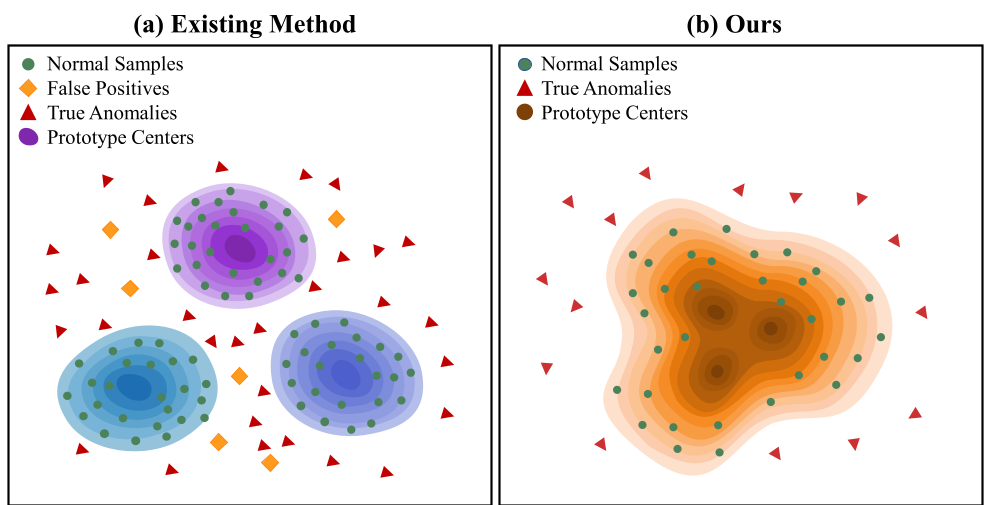 Figure 1: Contrast between unimodal (a) and MPFM's multi-modal (b) approach.
2. Mutual Information Maximization Regularizer (MIMR)
To prevent "Prototype Collapse"—where the model gets lazy and maps all data to just one or two components—the authors introduce MIMR. This objective maximizes the mutual information between features and prototype indices, ensuring:
- Confident Assignments: Each normal sample clearly belongs to a specific prototype.
- Balanced Usage: The model uses the full capacity of the available Gaussian components.
Experiments & Results: Dominance in Scarcity
The authors tested MPFM against baselines like DRA, AHL, and DPDL on 9 real-world datasets. The performance gains are particularly striking in "Few-shot" settings ( or anomaly examples).
Key Performance Highlights:
- AITEX (Textile Defects): Built-in texture complexity makes this hard. MPFM improved AUC by 5.5% over the previous SOTA.
- Medical Imaging (BrainMRI/HeadCT): In high-stakes medical domains, MPFM achieved near-perfect scores (0.999 AUC on HeadCT), which is vital for clinical reliability.
- Hard Settings: When the model is tested on anomaly types it never saw during training, the AUC gains reached up to 6.3% (Mastcam), proving that a better model of "normal" is the best way to detect the "abnormal."
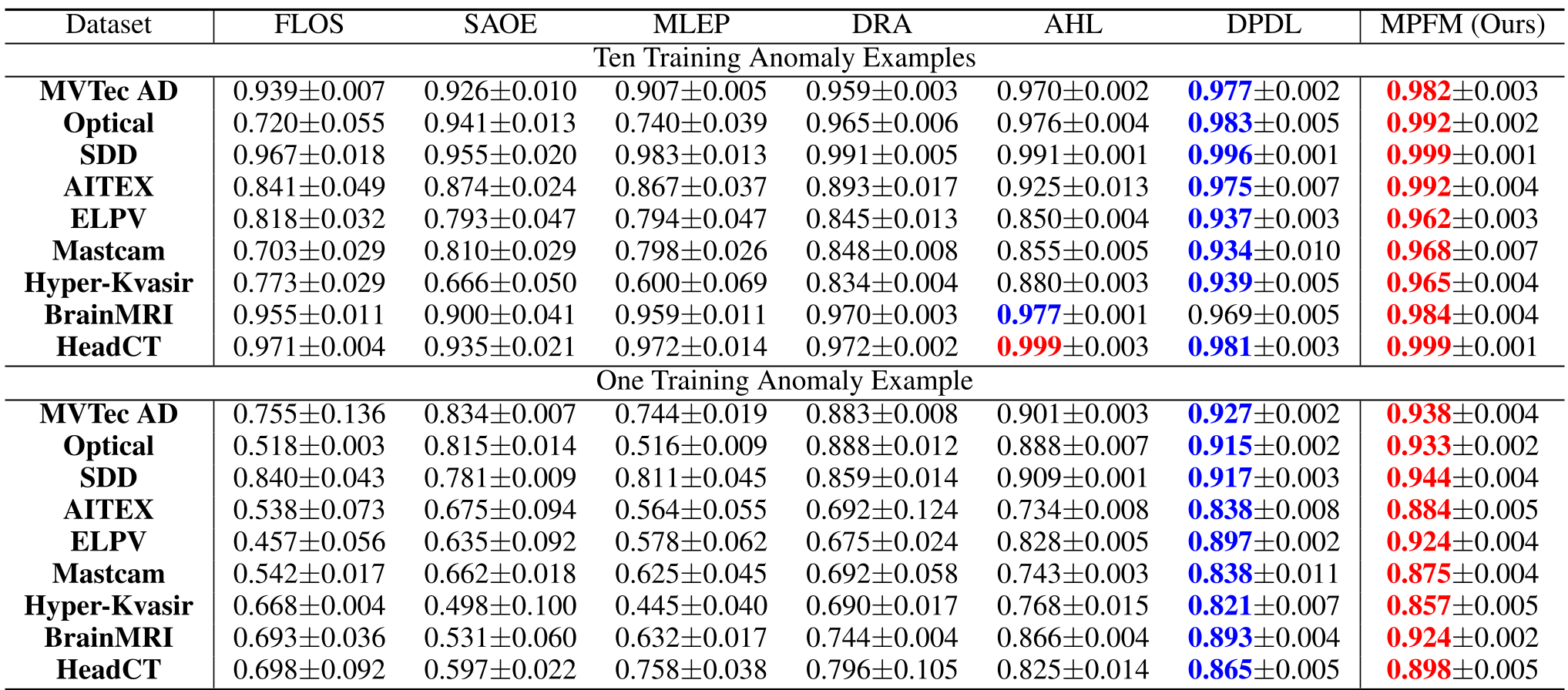 Experimental results showing MPFM's consistency across various "Shot" settings.
Critical Analysis & Conclusion
Takeaways
The marriage of GMMs and Flow Matching is a natural fit for OSAD. By providing a structured, multi-centered target for the flow, MPFM ensures that the latent space isn't just a "void" where anomalies live, but a "map" where normal data occupies well-defined territory.
Limitations & Future Work
- Hyperparameter Sensitivity: The choice of (number of components) matters. If is too high, the semantic patterns fragment; if too low, it regresses to unimodality.
- Computational Cost: While flow matching is faster than diffusion, jointly training four scoring modules and a flow network requires careful optimization.
Future research could look into automatically determining or applying this mixture-flow architecture to multi-modal LLMs to detect hallucinations or out-of-distribution prompts.
Final Verdict: MPFM is a robust, mathematically sound advancement that shifts the focus from "finding anomalies" to "mastering normality."