
[CVPR 2026] MolmoWeb: Building the SOTA Open Visual Web Agent from Screenshots
MolmoWeb: Open Visual Web Agent and Open Data for the Open Web
MolmoWeb is a family of open-source multimodal visual web agents (4B and 8B) that navigate the web using only screenshots as input. By training on MolmoWebMix—a massive 100K+ trajectory dataset of human and synthetic demonstrations—MolmoWeb-8B achieves SOTA results on WebVoyager and Online-Mind2Web, outperforming much larger closed models like GPT-4o.
Executive Summary
TL;DR: MolmoWeb is a new family of fully open-source multimodal web agents (4B and 8B parameters) that navigate the internet just like humans do—by looking at screenshots. By eschewing brittle HTML/DOM parsing in favor of a pure visual-language policy, and training on the massive MolmoWebMix dataset, these models outperform proprietary giants like GPT-4o on standard web-use benchmarks.
Background: Within the "computer-use" paradigm, most agents rely on structured data (AxTree) which is often messy and computationally expensive. MolmoWeb represents a significant shift toward vision-centric autonomy, proving that smaller, well-trained models can dominate the leaderboard if they possess superior spatial grounding and reasoning capabilities.
Problem & Motivation: The Brittle Web
Most existing web agents are "blind" in the sense that they read the underlying code (HTML/AxTree) rather than seeing the page. While this provides text-rich data, it suffers from several fatal flaws:
- Complexity: AxTree inputs can consume tens of thousands of tokens per page, leading to high latency and cost.
- Brittleness: DOM structures vary wildly across frameworks and break whenever a site is updated.
- Incompleteness: Dynamically rendered content often doesn't show up correctly in the Accessibility Tree.
The authors argue that a truly robust agent must use the same perceptual modality as humans: Vision.
Methodology: MolmoWebMix and The Visual Policy
The core innovation lies in MolmoWebMix, a diverse data cocktail designed to teach a model not just how to click, but why.
1. Data Composition
The dataset includes four distinct pillars:
- Human Demonstrations: High-quality trajectories with natural language "thoughts."
- Synthetic Trajectories: Generated by larger "teacher" models (like Gemini-3-Flash) that do have access to the AxTree, providing a "gold standard" for the student to imitate visually.
- Atomic Skills: Focused training on specific sub-tasks like "form filling" or "product filtering."
- GUI Perception: Over 7 million QA pairs to sharpen the model's OCR and element localization (grounding).
2. Model Architecture
Built on the Molmo2 architecture, the model functions as an action policy:
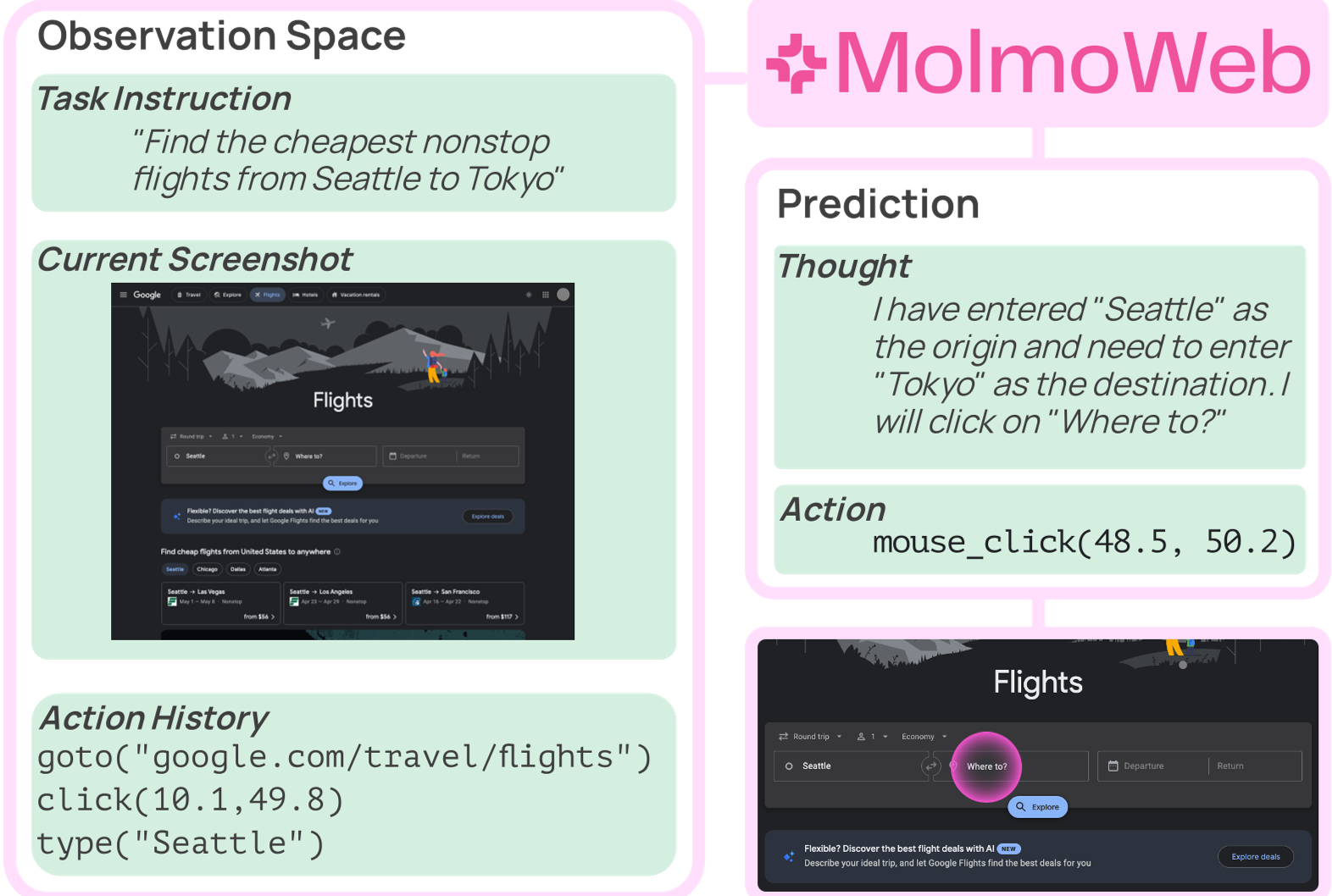 Figure 1: The MolmoWeb execution loop. The agent predicts a "Thought" (Chain of Action) before outputting a JSON-formatted browser action.
Experiments & Results
MolmoWeb establishes a new SOTA for open-weight models, but more impressively, it beats closed-model baselines that use more complex inputs.
Performance Highlights
- WebVoyager: MolmoWeb-8B reached 78.2% pass rate, surpassing OpenAI’s Computer-Use-Preview (70.9%).
- Test-Time Scaling: By running 4 parallel attempts and using a VLM to judge the best one (Pass@4), the 8B model soared to 94.7% on WebVoyager.
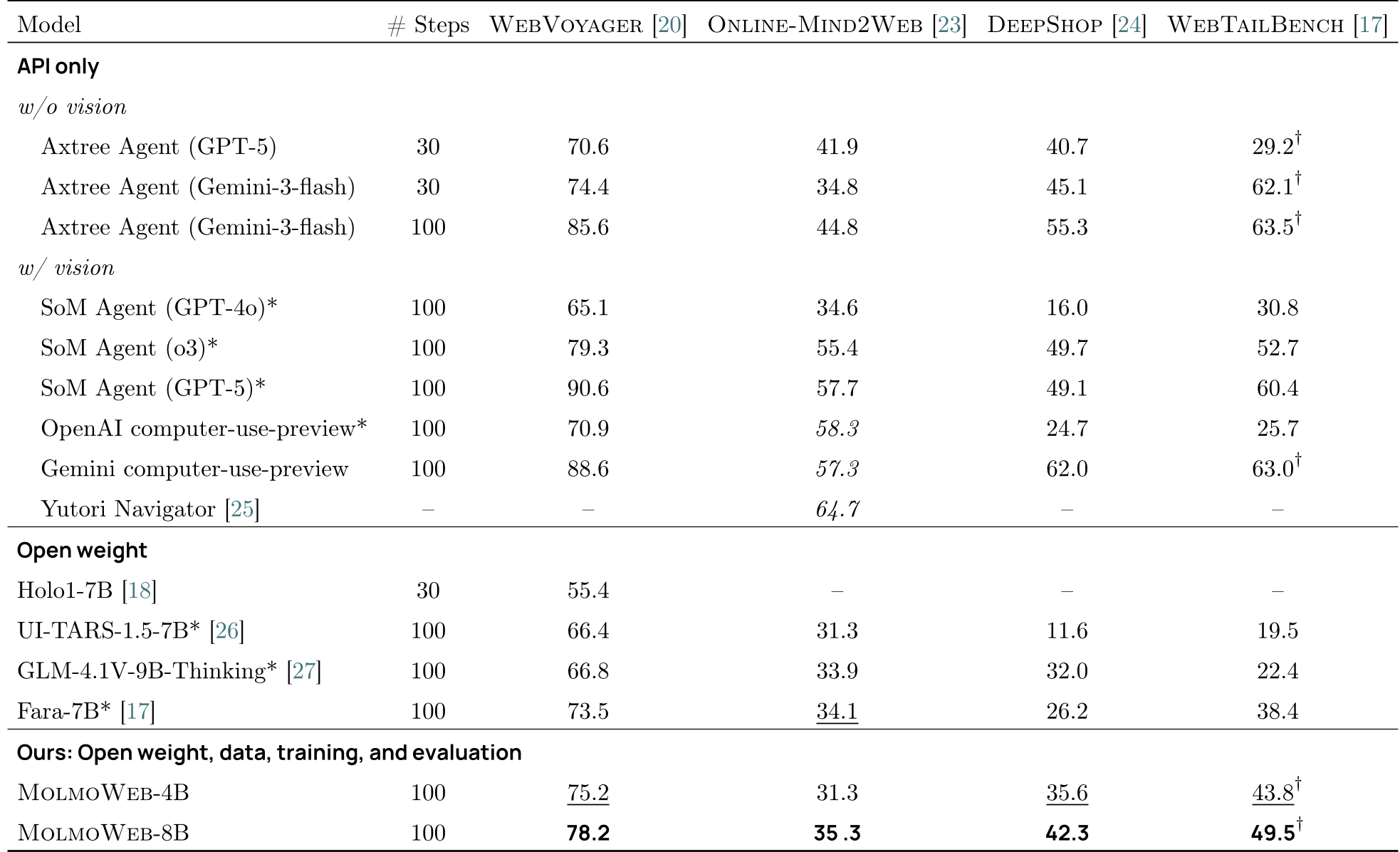 Table 1: MolmoWeb consistently outperforms comparable 7B-9B models and competes with GPT-5/o3 class models.
The "Synthetic > Human" Paradox
In a fascinating ablation, researchers found that training on synthetic trajectories actually yielded better results than training on human ones. Why? Humans often take "noisy" detours or exploratory clicks, whereas LLM-generated trajectories (using AxTree grounding) are direct and provide a cleaner signal for the model to learn spatial coordinates.
Critical Analysis & Conclusion
Takeaway: MolmoWeb proves that specialized, vision-only visual models are the future of digital agents. They are faster, cheaper, and arguably more robust than their text-heavy predecessors.
Limitations:
- Dynamic Latency: Though the model is efficient, the bottleneck remains the time it takes for a live browser to render pages.
- Exploration: The model still struggles with vague instructions that require deep multi-page exploration without a clear URL.
Future Work: The release of the full MolmoWebMix dataset is a gift to the research community. It paves the way for advanced self-distillation and Reinforcement Learning (RL) techniques that could push the Single-Rollout performance even higher.