
[CVPR 2026] MonoArt: Unifying Geometry and Kinematics for Fast Articulated 3D Reconstruction
MonoArt: Progressive Structural Reasoning for Monocular Articulated 3D Reconstruction
MonoArt is a unified end-to-end framework for monocular articulated 3D reconstruction that progressively transforms a single RGB image into a motion-ready 3D asset. By integrating a TRELLIS-based geometry generator with structured part reasoning, it achieves state-of-the-art accuracy on PartNet-Mobility while maintaining a high inference speed of ~20.5 seconds.
TL;DR
Reconstructing articulated objects (like cabinets or laptops) from a single image is a "chicken-and-egg" problem: you need the part structure to understand the motion, but motion cues are often the only evidence for part structure. MonoArt solves this by shifting away from retrieval-based or video-generation methods toward Progressive Structural Reasoning. It achieves a ~10x speedup over current VLM-based SOTA methods while setting new benchmarks in joint accuracy.
The Motivation: Moving Beyond "Retrieval" and "Templates"
Historically, if you wanted to turn a photo of a chair into a 3D model that actually moves, you had two suboptimal choices:
- Retrieval-based Assembly: Find a similar chair in a database and swap parts. This usually results in "Frankenstein" models where textures don't match.
- Generative Priors: Use a Video Diffusion model to "hallucinate" the object moving. This is computationally expensive and often physically nonsensical.
The authors of MonoArt argued that the missing link is intrinsic 3D structural understanding. They posited that by explicitly reasoning about parts in a canonical 3D space, the network could "calculate" motion parameters rather than just guessing them from pixel features.
Methodology: The Four Pillars of MonoArt
MonoArt breaks the reconstruction down into a logical pipeline that mimics how a human might analyze an object.
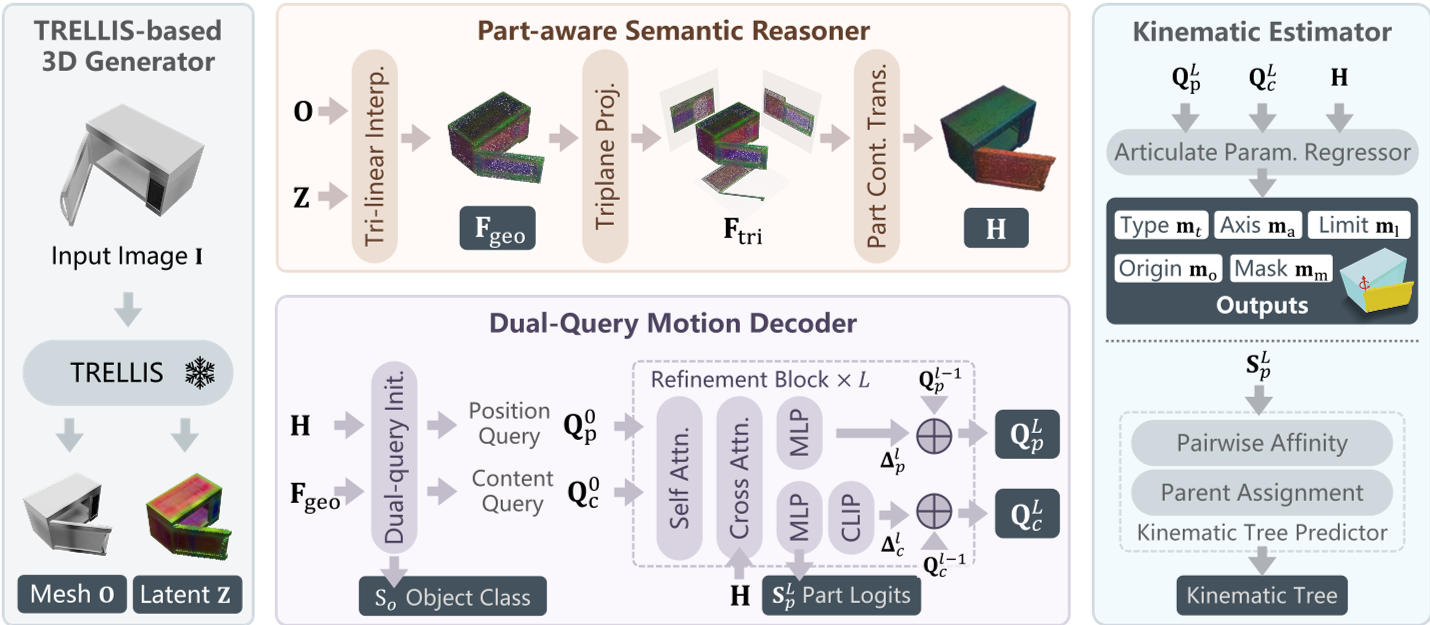
1. Geometry Foundation (TRELLIS)
The system starts with a frozen TRELLIS backbone. TRELLIS produces a structured sparse voxel latent (Z) and a mesh (O). This provides the "body" of the object but doesn't yet know which parts move.
2. Part-Aware Semantic Reasoner (PASR)
To identify parts, MonoArt samples points on the mesh and projects their features onto three orthogonal planes (Triplane Projection). A Transformer then processes these planes to capture global context. Crucially, this stage is supervised by a Triplet Loss, which pushes features of different parts (e.g., a door vs. a frame) apart in the embedding space.
3. Dual-Query Motion Decoder
This is the "brain" of the operation. Unlike standard decoders, it uses two types of queries:
- Content Queries (): "What" is this part? (Semantic meaning)
- Position Queries (): "Where" is the motion anchor? (Spatial localization) These queries interact with the point features to iteratively refine where a joint should be and what type of joint it is (revolute, prismatic, etc.).
4. Kinematic Estimator
Finally, the refined queries are decoded into physically interpretable parameters: joint axes, origins, and motion limits. A Kinematic Tree Predictor uses a compatibility matrix to determine parent-child relationships (e.g., the handle is a child of the drawer).
Experimental Results: Faster and More Precise
MonoArt was tested on PartNet-Mobility, the gold standard for articulated datasets.
Quantitative Superiority
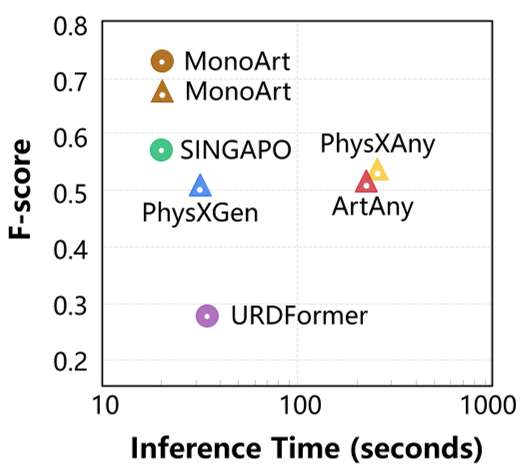
The model hits the "sweet spot" of being both the most accurate and one of the fastest.
- Pivot Error: Reduced by >40%, solving a major pain point where parts "float" incorrectly during motion.
- Inference Speed: At 20.5 seconds, it is nearly 12x faster than Articulate-Anything (~230s).
Real-to-Sim Utility
A highlight of the paper is its application in Robotic Manipulation. Because MonoArt outputs structured URDF-like parameters, the reconstructed models can be dropped directly into NVIDIA IsaacSim. A Franka robot arm can then interact with the "digital twin" created from a single photo.
Critical Analysis & Takeaways
The success of MonoArt lies in its Inductive Bias. By forcing the model to reason through 3D geometry and semantic part separation before predicting motion, it avoids the "shortcut" of simply memorizing 2D motion patterns.
Limitations:
- Scale Imbalance: Small parts (like buttons) are often missed because of the uniform point sampling strategy.
- Novel Topology: If an object has a completely unique motion structure (e.g., a complex multi-linkage mechanism), the learned priors might struggle.
Future Outlook: MonoArt represents a significant step toward "World Models" that don't just see the world but understand how it functions. Integrating this with Large Vision-Language Models (LVLMs) for better part naming and reasoning could eventually allow robots to interact with any household object after just a single glance.