
[ICLR 2025] MoRI: Escaping the "Stochastic Parrot" Trap in Scientific Ideation via Motivation-Grounded Reinforcement Learning
MoRI: Learning Motivation-Grounded Reasoning for Scientific Ideation in Large Language Models
The paper introduces MoRI (Motivation-grounded Reasoning for Scientific Ideation), a framework that enables Large Language Models to internalize the scientific discovery process. Instead of treating ideation as simple text completion, MoRI uses a "Motivation Reasoning Methodology" pipeline, optimized via Reinforcement Learning (GRPO) to achieve SFT-beating performance in novelty and technical rigor.
TL;DR
Scientific ideation is more than just mixing keywords; it is the logical deduction of a Methodology from a deep Motivation. While current AI agents rely on external "scaffolding" (loops and prompts) to look smart, MoRI (Motivation-grounded Reasoning for Scientific Ideation) internalizes this process. By training a DeepSeek-R1 distilled model with custom RL rewards focusing on technical "hard knowledge" and semantic leaps, MoRI achieves a significant jump in research quality, outperforming even GPT-4o and the famous AI-Scientist-V2.
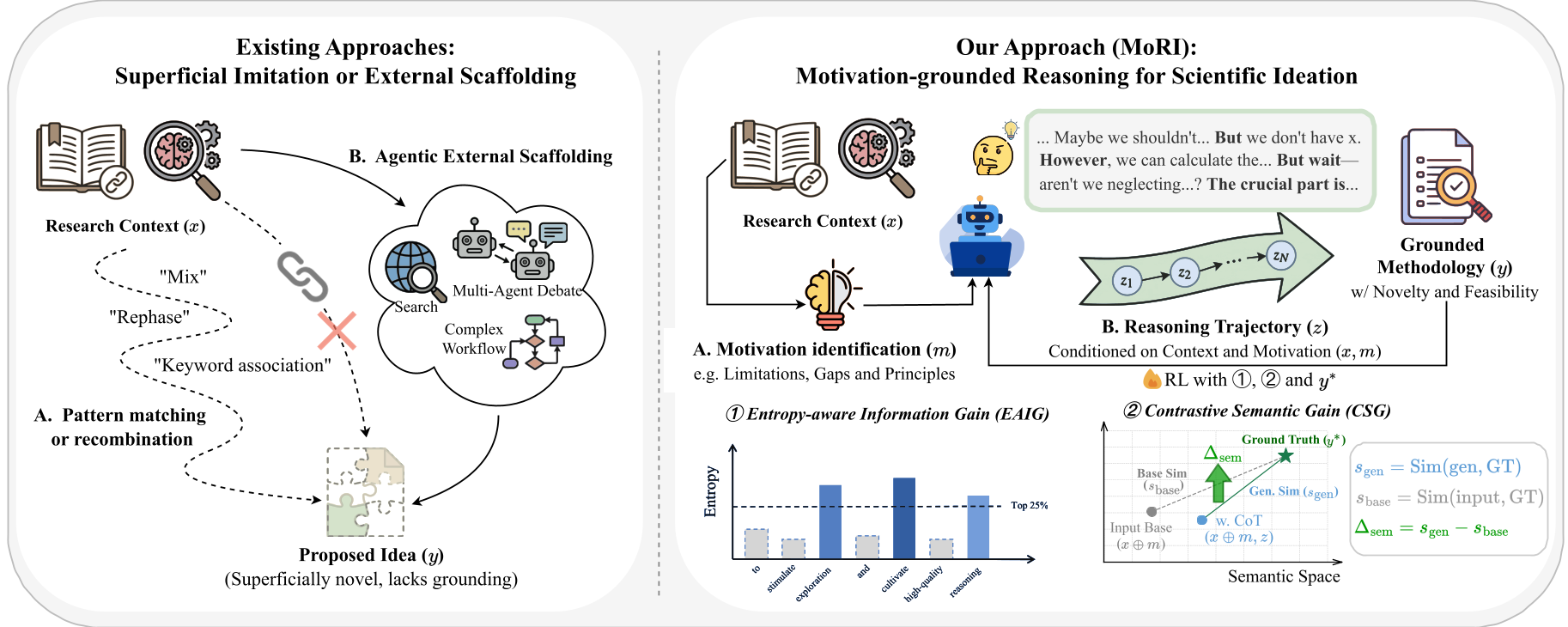 Figure 1: Comparison between traditional pattern recombination and MoRI's motivation-grounded reasoning path.
The Core Challenge: Surface-Level Innovation
Most current LLMs suffer from "combinatorial creativity"—they can suggest "Graph Neural Networks for X" but fail to explain how the specific architecture solves the why of the problem. This is a failure of internalized reasoning. Existing solutions try to fix this with complex agentic workflows (multi-agent debates, iterative reviews), but these are essentially "external crutches." As Richard Sutton’s Bitter Lesson suggests, methods that leverage internal computation and learning usually win over those relying on human-designed heuristics.
MoRI’s insight is simple: Scientific reasoning is a specific cognitive trajectory. You start with a Context (), identify a Motivation (), and then build a Reasoning Trajectory () that logically justifies the Methodology ().
Methodology: Teaching the "Why" through RL
MoRI utilizes Group Relative Policy Optimization (GRPO) but replaces standard verifiers (which don't exist for open-ended ideas) with two ingenious surrogate rewards:
1. Entropy-Aware Information Gain (EAIG) - The Microscope
Not all words in a paper are equal. "We propose" is low-entropy (predictable), while "Laplacian smoothing" is high-entropy (technical detail).
- The Mask: MoRI identifies the top 25% highest-entropy tokens in the ground-truth methodology.
- The Reward: The model is rewarded only if its reasoning () makes these "hard" technical tokens more predictable. It forces the model to actually explain the hard parts.
2. Contrastive Semantic Gain (CSG) - The Compass
A model could hallucinate technical jargon to game the entropy reward. CSG prevents this by measuring the Semantic Leap. It calculates the similarity between the generated idea and the ground truth, then subtracts the similarity between the input prompt and the ground truth. This ensures the model is actually adding intellectual value rather than just repeating the background.
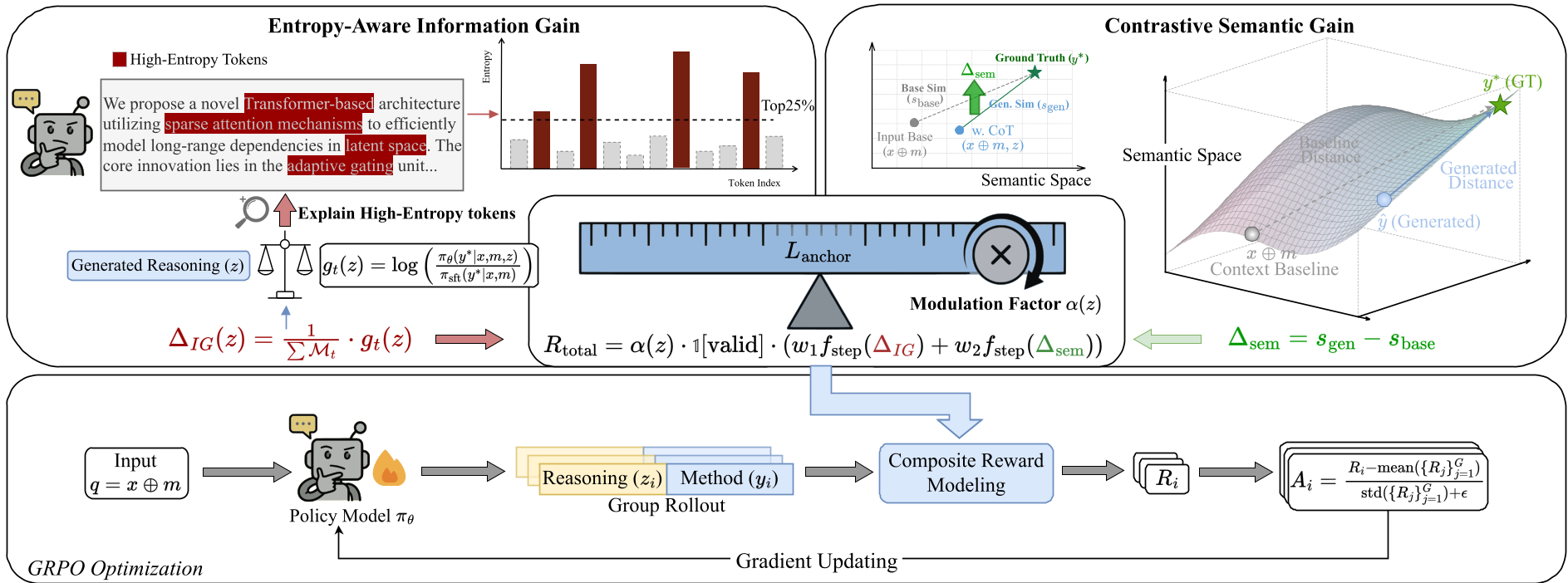 Figure 2: The MoRI Framework—Synergizing EAIG for technical depth and CSG for directional alignment.
Results: Rigorous and Feasible Discovery
MoRI was tested against a rigorous temporal split of ICLR 2024-2025 papers. The results are striking:
- Beating the Giants: MoRI scored 3.19 (Mean), significantly higher than GPT-4o (2.69) and Claude-3.5-Sonnet (3.09).
- Feasibility Breakthrough: While Claude is "novel," MoRI is feasible. It showed a 10.3% improvement in feasibility, meaning the ideas it generates are actually implementable, not just sci-fi fantasies.
- Internalization vs. Scaffolding: It outperformed AI-Scientist-V2 by 18.1%, proving that a model that "knows how to think" is better than a model that is "forced to loop."
 Table 2: Performance comparison across Novelty, Rigor, and Feasibility.
Critical Insight: The Battle Against "Reasoning Collapse"
A fascinating technical detail in the paper is Length Anchoring. During RL, models often find "shortcuts"—they realize they can get high rewards by spitting out short, safe answers. This is "Reasoning Collapse." MoRI introduces a penalty for reasoning trajectories shorter than the average SFT output, forcing the model to "show its work" and engage in deep deduction.
Conclusion & Future Outlook
MoRI represents a shift from Agentic Scaffolding to Inherent Reasoning. By framing scientific ideation as a conditioned logic task and using information theory to reward technical depth, the authors have provided a blueprint for the next generation of AI scientists.
Limitations: Currently, the model is trained on Computer Science (ML) papers. Whether this "motivation-grounded" logic transfers to more empirical fields like Biology or Physics—where the "ground truth" is an experiment rather than a PDF—remains the next great frontier.
For a deeper dive into the reward shaping and entropy masks, check out Appendix C and F of the original paper.