
MotionGRPO: Precision Alignment for Diffusion-Based Egocentric Motion Recovery
MotionGRPO: Overcoming Low Intra-Group Diversity in GRPO-Based Egocentric Motion Recovery
The paper introduces MotionGRPO, a reinforcement learning (RL) post-training framework that optimizes diffusion-based egocentric motion recovery. By leveraging Group Relative Policy Optimization (GRPO) and a hybrid reward mechanism, it achieves SOTA performance on AMASS and RICH benchmarks for reconstructing 3D human motion from HMD signals.
TL;DR
MotionGRPO is a sophisticated RL post-training framework designed to bridge the gap between "generative plausibility" and "reconstruction precision." By applying Group Relative Policy Optimization (GRPO) to motion diffusion models and introducing a noise-injection strategy to solve the "low diversity" gradient problem, it sets a new SOTA for recovering full-body 3D motion from sparse HMD signals.
Context and Motivation
Recovering a full 3D human body from just a head-mounted device (HMD) is inherently an ill-posed problem due to severe occlusions. While diffusion models are excellent at generating plausible motions, they often ignore fine-grained geometric constraints. This leads to common "visual sins" in VR/AR: foot skating, joints floating in mid-air, and the character's feet sinking through the floor.
The authors identify a critical technical bottleneck: when you try to use Reinforcement Learning (specifically GRPO) to fix these issues, the model's outputs become too similar because they are heavily "locked" by the head trajectory input. In RL terms, this low intra-group diversity causes the standard deviation in the advantage calculation to approach zero, leading to vanishing gradients and training collapse.
Methodology: The Core Innovations
1. The Hybrid Reward Mechanism
MotionGRPO doesn't just look at joint coordinates. It utilizes a two-layered reward system:
- Global Visual Reward: A trajectory-conditioned perceptual model (trained via contrastive learning with hard negatives) that acts as a "human-like" judge of motion smoothness and physical realism.
- Local Joint Reward: Explicit mathematical penalties for errors in joint rotation, position, and velocity (bi-level precision).
2. SDE-based Sampling and Noise Injection
To make GRPO work for reconstruction, the authors use Stochastic Differential Equation (SDE) sampling. To further prevent the diversity collapse, they inject Perlin noise into the head trajectory during training. This forces the model to explore a wider "uncertainty space," providing the variance needed for meaningful RL updates.
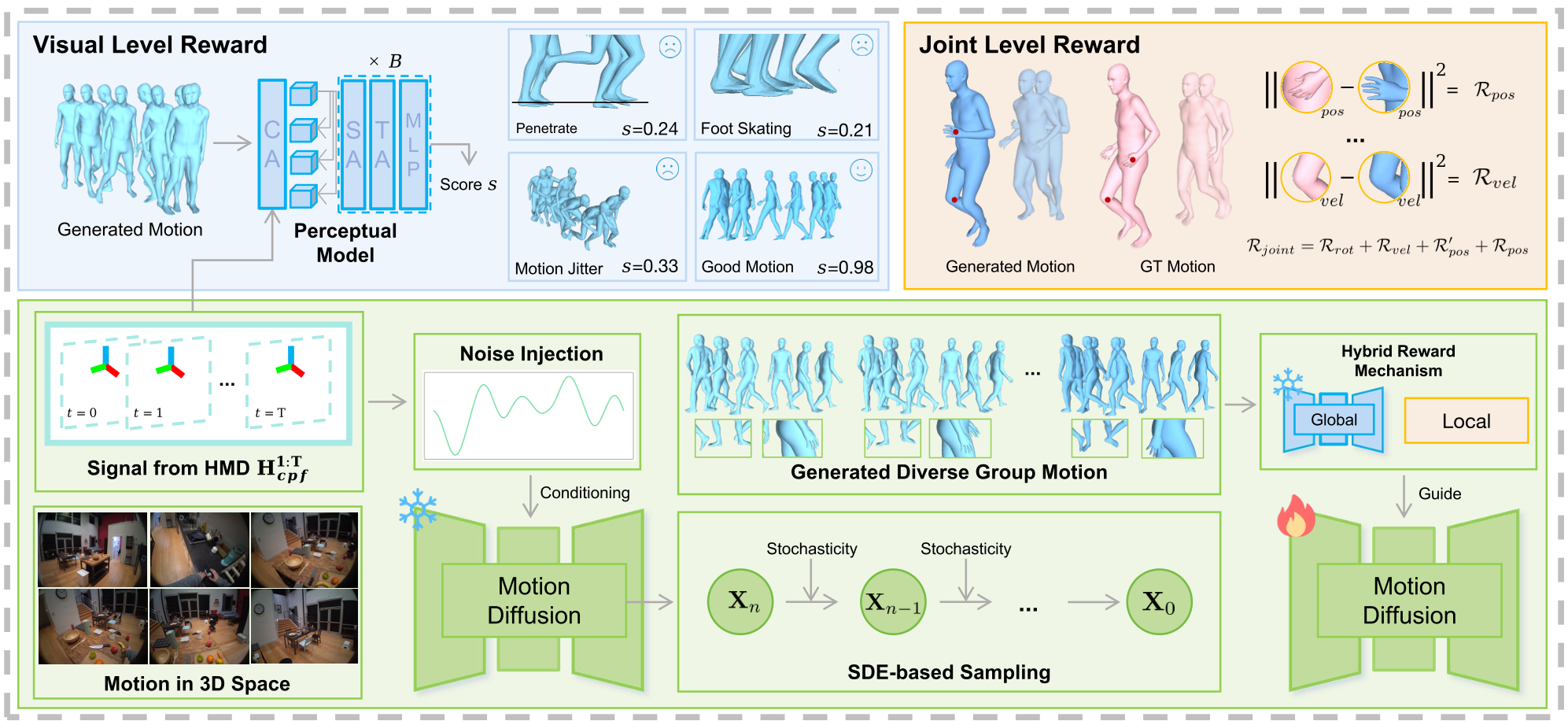 Figure 1: The MotionGRPO pipeline: conditioning diffusion with head signals, injecting noise for diversity, and optimizing via hybrid rewards.
Experimental Performance
The results show a clear win for the RL-alignment approach. MotionGRPO outperforms competitive baselines like EgoAllo across all Joint Accuracy (MPJPE) and Visual Quality (Jitter, Foot Skating) metrics.
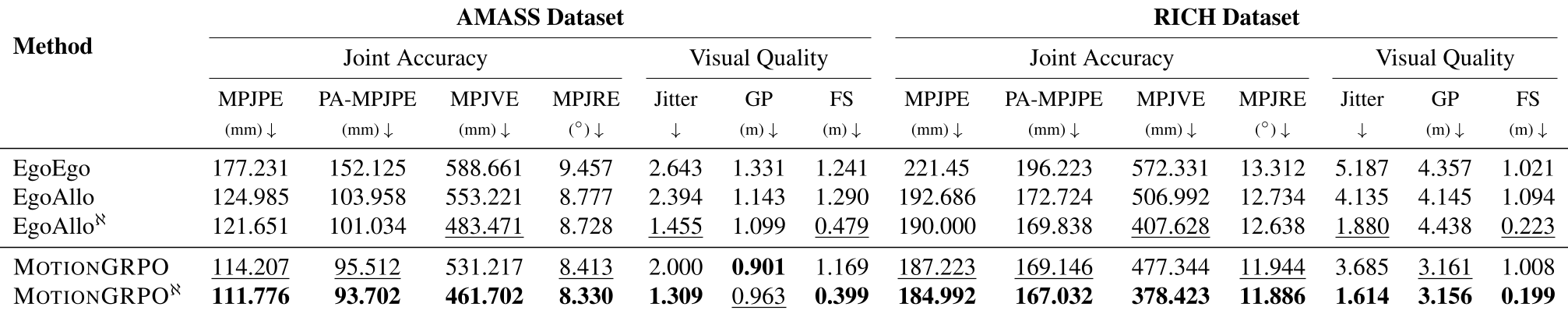 Table 1: Quantitative results on AMASS and RICH datasets showing consistent improvements in joint precision and temporal dynamics.
One of the most impressive aspects is Inference Efficiency. Because the reward models and GRPO headers are only used during training (post-training), the inference speed remains identical to the original diffusion backbone—around 1.1 seconds per sequence—making it practical for real-time applications.
Deep Insight: Why This Matters
The "Low Intra-Group Diversity" problem described here is a cautionary tale for any researcher trying to apply LLM-style RL (like DeepSeek's GRPO) to strongly conditioned tasks (like image-to-image or sensor-to-motion).
In reasoning tasks (LLMs), the model has a massive "thought space" to explore. In reconstruction (CV), the input is a "straitjacket." MotionGRPO provides a blueprint for how to "loosen" that jacket (via Perlin noise) just enough to let the model learn, without losing the grounding of the original signal.
Conclusion & Future Work
MotionGRPO proves that RL post-training is not just for LLMs; it is a powerful tool for aligning generative physical models with the laws of geometry and physics. While the current model assumes a flat ground, the path is now open for integrating complex environmental contexts (stairs, slopes, furniture) into the reward mechanism to create even more realistic digital humans.
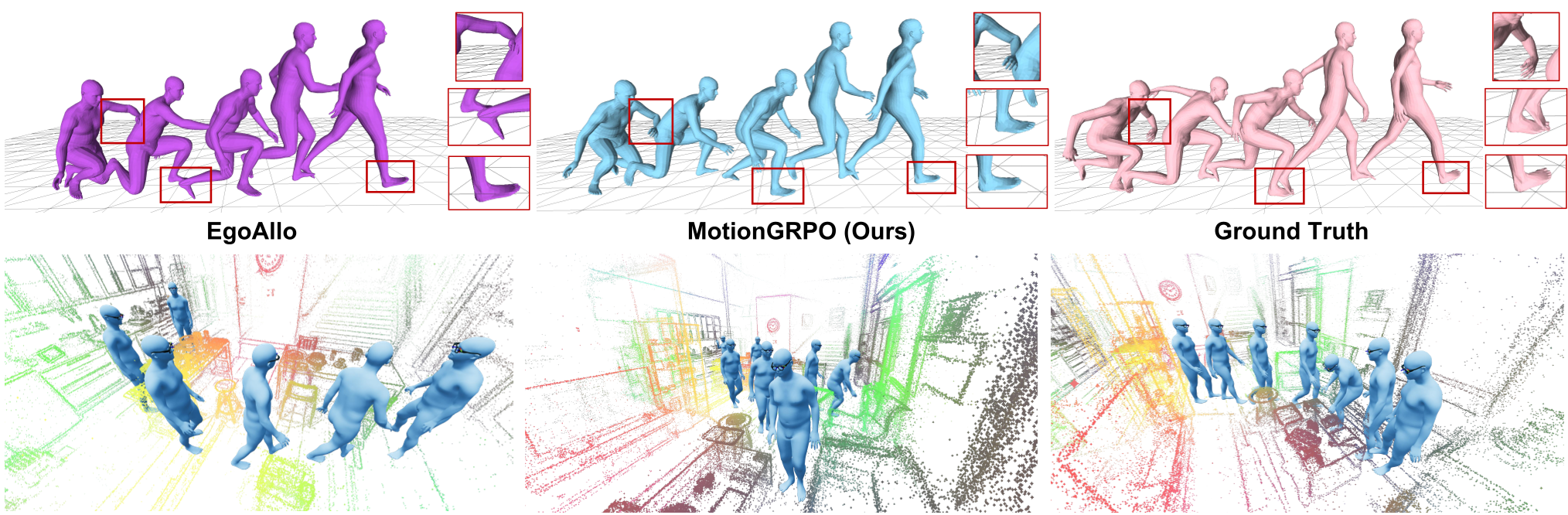 Figure 2: Qualitative comparisons: MotionGRPO (bottom) shows significantly higher fidelity and fewer ground-penetration artifacts than the baseline.