
GLMap: Bridging the Gap Between 3D Geometry and Foundation Models via Multi-Scale Gaussians
Multi-Scale Gaussian-Language Map for Zero-shot Embodied Navigation and Reasoning
This paper introduces GLMap (Multi-Scale Gaussian-Language Map), a novel mapping framework for zero-shot embodied navigation and reasoning. It leverages 3D Gaussian Splatting to store compact visual representations and integrates multi-scale semantics (instances and regions) to achieve SOTA performance across ObjectNav, InstNav, and SQA tasks.
TL;DR
GLMap (Multi-Scale Gaussian-Language Map) is a breakthrough in zero-shot embodied AI. By representing environments through a hierarchy of Instance and Region units—each containing natural language and 3D Gaussians—it enables robots to navigate and reason using off-the-shelf LLMs and MLLMs. It eliminates the need for "feature-to-token" alignment training, setting new benchmarks in Object Navigation (ObjectNav), Instance Navigation (InstNav), and Situated Question Answering (SQA).
The "Alignment" Bottleneck in Embodied AI
In the current era of Foundation Models, the bottleneck for robots isn't just "seeing" the world—it's communicating what they see to an LLM.
Previous methods typically stored semantics as:
- Category Labels: Too coarse (e.g., just "chair").
- Feature Tensors (CLIP embeddings): Dense, but unreadable by standard MLLMs (like GPT-4o or Gemma) without custom "projection layers" that require expensive training.
- Topological Graphs: Efficient for planning but lack the "visual granularity" needed for complex questions like "What is behind me to let in fresh air?"
The authors of GLMap argue that for a map to be truly useful for Large Models, it must provide an LM-friendly interface: explicit text and renderable images.
Methodology: The Gaussian-Language Synergy
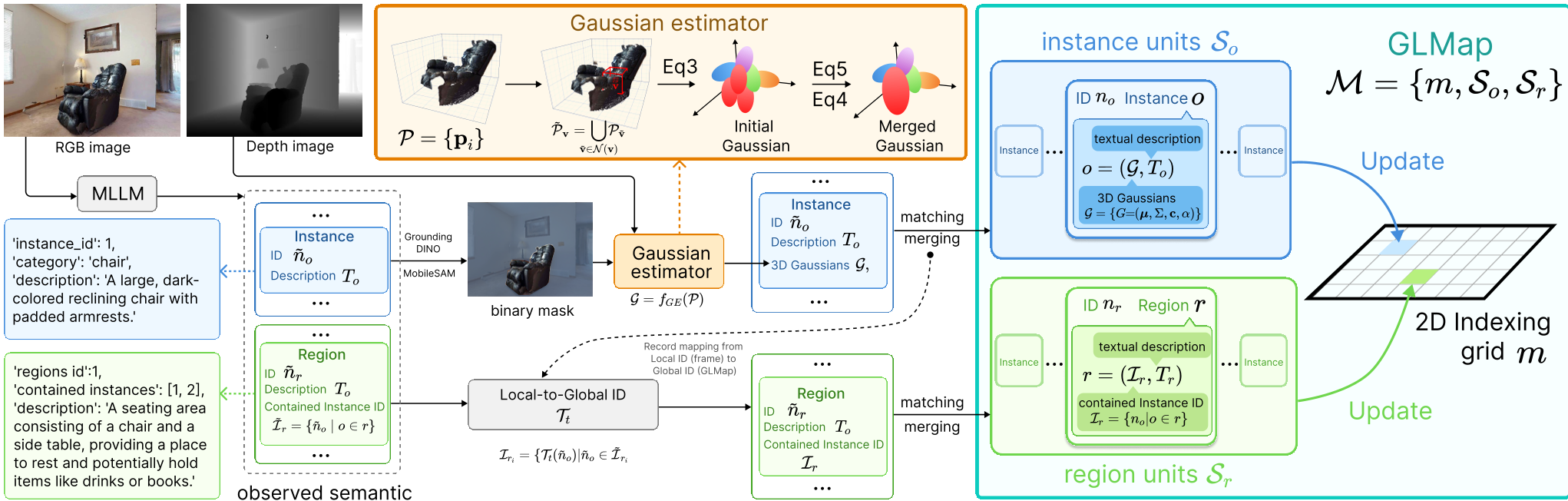
GLMap's architecture is built on three pillars: a 2D indexing grid for localization, a multi-scale semantic hierarchy, and a dual-modality interface.
1. From Point Clouds to Gaussians (The Gaussian Estimator)
Unlike standard 3D Gaussian Splatting (3DGS) which requires gradient-based optimization (slow), the authors propose a Gaussian Estimator. This tool analytically fits Gaussians into voxelized point clouds.
- The Intuition: Since robots get depth and camera intrinsics, we don't need to "solve" for geometry. We can calculate the mean and covariance of points in a neighborhood directly.
- Curvature-Aware Merging: To save memory, the system merges Gaussians in flat areas (like walls) but keeps them dense in high-curvature areas (like the legs of a chair).
2. Multi-Scale Hierarchy
Instead of a flat map, GLMap maintains:
- Instance Units: Detailed objects with 3D Gaussians + descriptions.
- Region Units: Functional areas (e.g., "Kitchen") that link multiple instances.
Navigating the World: Zero-Shot Reasoning
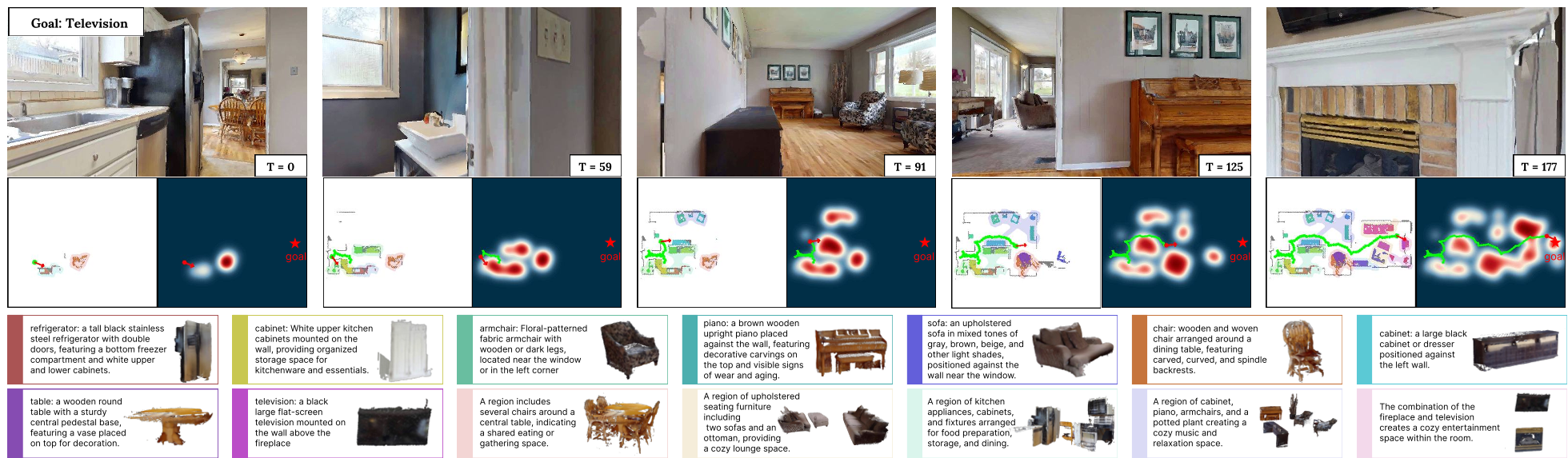
Because every unit in GLMap can produce a "photo" (via splatting) and a "label," the agent can query an MLLM: "Here is a rendered view of this frontier. Is the 'blue metal chair' likely to be here?"
For ObjectNav, the system builds a "value map" by checking the similarity between the goal (e.g., "TV") and the stored semantic units. The agent then simply moves toward the highest-value frontier.
Experimental Mastery
The results prove that explicit multi-scale semantics are a game-changer.
- ObjectNav: On the HM3D dataset, GLMap reached a 62.7% Success Rate, a significant jump over prior "training-free" champions like ApexNAV (59.6%).
- SQA (Situated QA): In the SQA3D benchmark, GLMap outperformed GPT4Scene. By rendering specific views of the "front, back, left, and right," it provides the MLLM with much clearer spatial context than a simple Bird's Eye View (BEV).
Ablation Insight: Why Multi-Scale?
As shown in the table below, using only instances or only regions limits performance. The synergy between the two allows the agent to reason about both specific objects ("the chair") and broad contexts ("in the kitchen").
| ID | Instance Unit | Region Unit | SR (%) | SPL (%) |
|---|---|---|---|---|
| 1 | - | - | 52.5 | 30.4 |
| 2 | ✓ | - | 57.4 | 31.3 |
| 4 | ✓ | ✓ | 59.1 | 32.2 |
Critical Insight & Future Outlook
The genius of GLMap lies in its modularity. It treats the "Map" as a database and the "Foundation Model" as a query engine. This decoupled approach means that as LLMs (like GPT-5 or newer Gemma versions) improve, the robot’s intelligence improves automatically without retraining the map.
Limitations: The system still relies on high-quality depth sensors and is computationally intensive for rendering in real-time on low-end hardware. Future work could look into "Dynamic GLMaps" where moving objects (humans, pets) are handled separately from the static Gaussian background.
Conclusion: GLMap proves that for Embodied AI to reach its "ChatGPT moment," we need spatial representations that Large Models can actually "talk" to. Natural language and 3D Gaussians are the bridge.