
MMDG-Bench: A Reality Check for Multimodal Domain Generalization
Are We Making Progress in Multimodal Domain Generalization? A Comprehensive Benchmark Study
The paper introduces MMDG-Bench, the first unified and comprehensive benchmark for Multimodal Domain Generalization (MMDG). It standardizes evaluation across six datasets (Action Recognition, Fault Diagnosis, Sentiment Analysis), evaluating nine representative methods against an Oracle upper bound across 95 unique cross-domain tasks.
TL;DR
Is Multimodal Domain Generalization (MMDG) actually progressing, or are we just overfitting to fragmented benchmarks? MMDG-Bench exposes a sobering reality: under fair evaluation, specialized algorithms barely beat simple Empirical Risk Minimization (ERM). With a significant performance gap relative to the "Oracle" and high vulnerability to sensor failures, the field requires a fundamental shift in focus toward robustness and trustworthiness.
The "DomainBed" Moment for Multimodal Learning
In the world of unimodal Computer Vision, the DomainBed paper famously revealed that most "advanced" domain generalization algorithms were no better than a well-tuned ERM baseline. The multimodal community has now reached its own crossroads. Until now, MMDG research was a "Wild West" of inconsistent splits, varying backbones, and selective reporting.
The authors of MMDG-Bench trained 7,402 neural networks to provide the first rigorous, standardized look at the field. They discovered that the perceived progress might be an illusion of inconsistent evaluation.
Methodology: The MMDG-Bench Framework
The benchmark spans three diverse task families, providing a much-needed departure from the field's obsession with action recognition:
- Action Recognition: EPIC-Kitchens and HAC (Video, Audio, Flow).
- Mechanical Fault Diagnosis: HUST Motor (Vibration, Acoustic).
- Sentiment Analysis: MOSI, MOSEI, CH-SIMS (Video, Audio, Text).
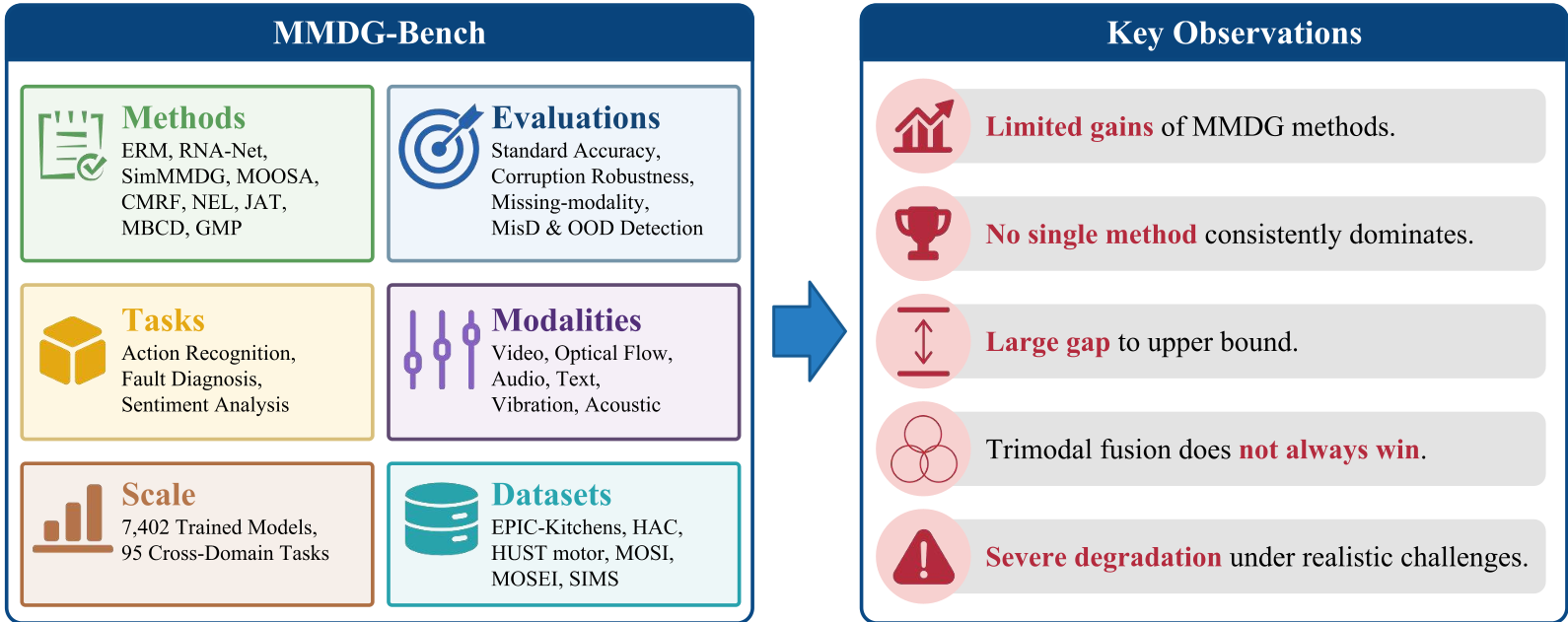
The study evaluates 9 representative algorithms, including recent heavyweights like SimMMDG, MOOSA, CMRF, and MBCD, comparing them against a standard ERM and a target-trained Oracle.
Core Revelation: ERM is Still the King to Beat
The most striking finding is that specialized MMDG methods struggle to provide consistent improvements.
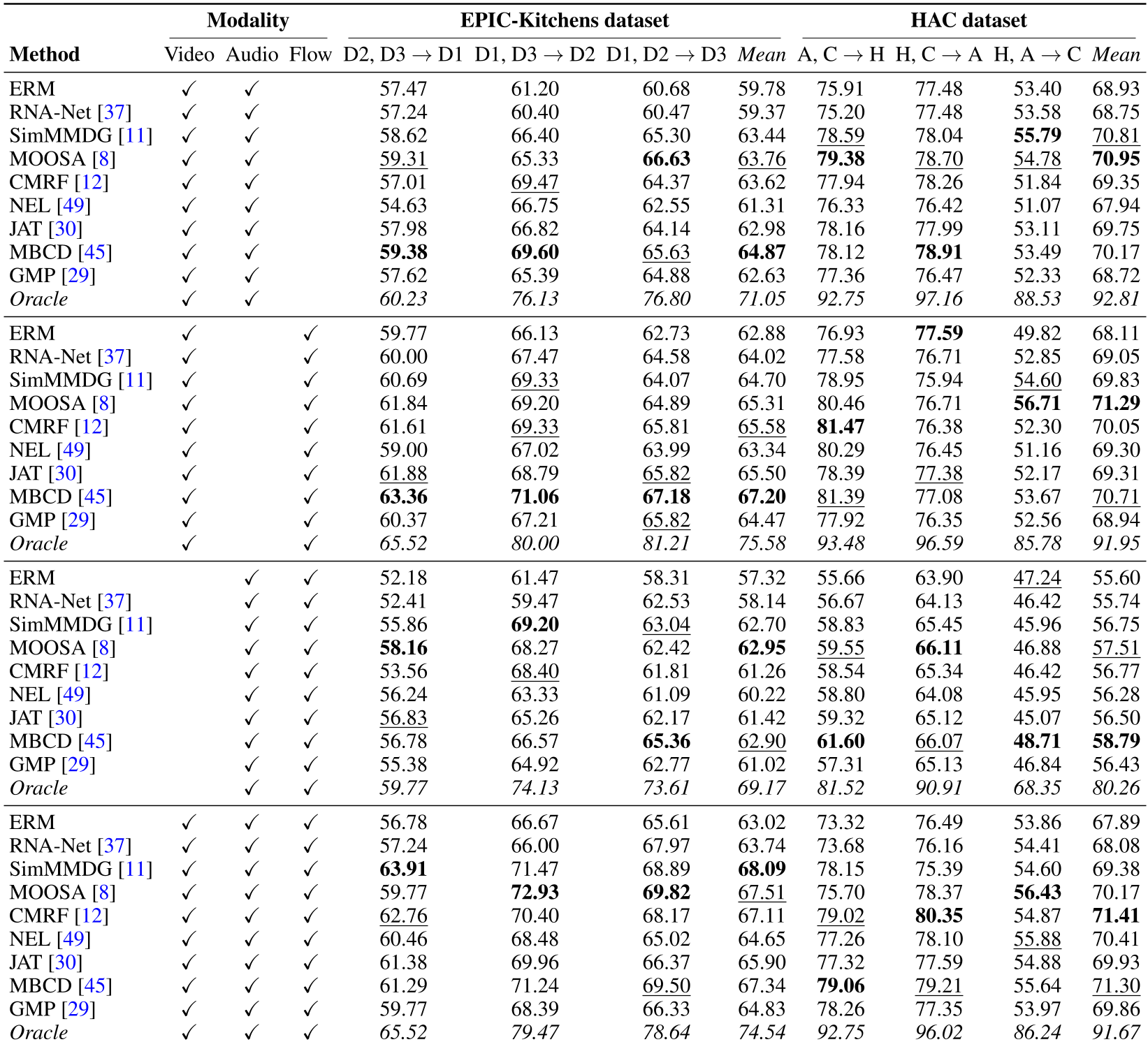
- Marginal Gains: In Sentiment Analysis, the best method (MOOSA) outperformed ERM by less than 1%.
- Inconsistency: A method that wins in EPIC-Kitchens (like MBCD) might rank dead last in Mechanical Fault Diagnosis.
- The Oracle Gap: There is still a massive (~22%) gap between current DG methods and the performance of a model trained directly on the target domain.
Beyond Accuracy: The Robustness Crisis
The authors push the boundary by testing Corruption Robustness and Missing Modalities.
The Modality Hierarchy
In action recognition, there is a clear hierarchy. Video is the dominant modality. When video is removed, performance crashes (36-43% drop). When audio is removed, the impact is negligible, and sometimes performance improves (suggesting audio can act as noise or introduce spurious correlations).
The Fragility of "Clean" Performance
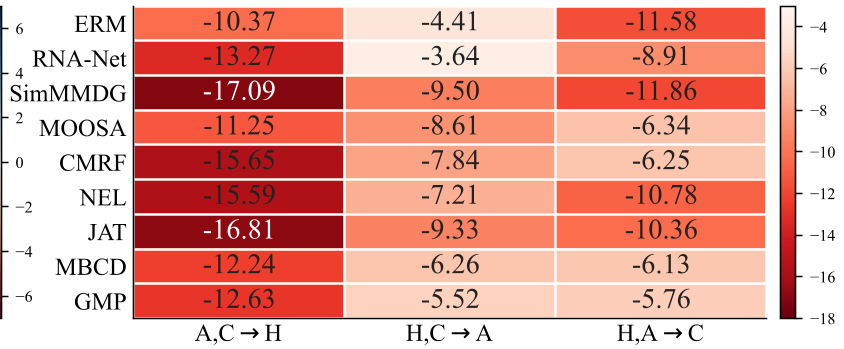
A model’s rank on a "clean" dataset is a poor predictor of its robustness. Under Defocus Blur (video corruption), the reliability rankings of almost all methods inverted. This suggests that current methods are overfitting to the specific statistics of clean modalities rather than learning truly invariant multimodal features.
Trustworthiness: Knowing What You Don't Know
The benchmark includes the first standardized evaluation of Misclassification Detection and OOD Detection in MMDG.
- Accuracy Trust: High-accuracy models (like MBCD) are often poor at uncertainty calibration.
- Non-Redundancy: Being good at detecting OOD samples does not mean a model is good at knowing when it's making an error on an in-distribution sample. SimMMDG emerged as a strong performer here due to its shared/specific feature decomposition.
Critical Insight & Future Outlook
The paper concludes that we are not yet "solving" Multimodal Domain Generalization. We are largely just building models that are slightly better at handling specific source-domain mixtures.
Key Takeaways for Future Research:
- Stop chasing accuracy on clean benchmarks: It is an incomplete metric.
- Focus on Modality Competition: Trimodal fusion often fails because modalities "compete" for gradient updates.
- Resilience as a First-Class Citizen: Models must be designed to survive sensor failures and noise from the ground up, not as an afterthought.
MMDG-Bench provides the community with a much-needed mirror, reflecting the true state of progress and pointing toward a more rigorous path forward.