
MUSE: Breaking the Zero-Sum Game of Visual Tokenization via Topological Orthogonality
MUSE: Resolving Manifold Misalignment in Visual Tokenization via Topological Orthogonality
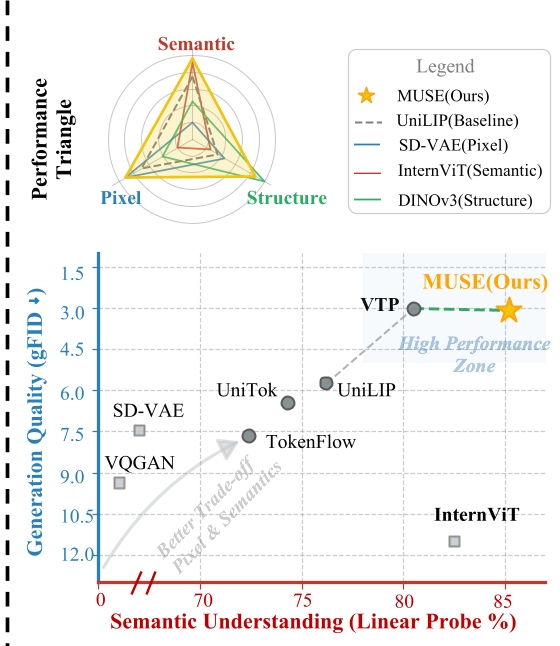
MUSE (Manifold Unification via Structural Embedding) is a unified visual tokenization framework that breaks the traditional trade-off between high-fidelity reconstruction and semantic understanding. It achieves SOTA generation (gFID 3.08) and surpasses its teacher InternViT-300M in linear probing (85.2% vs 82.5%) by employing "Topological Orthogonality."
TL;DR
Unified visual tokenizers have long been plagued by a trade-off: you can either reconstruct pixels perfectly or understand semantic concepts deeply, but rarely both. MUSE (Manifold Unification via Structural Embedding) resolves this "Manifold Misalignment." By decoupling high-level semantics into Feature Values and geometric structure into Attention Topology, MUSE transforms destructive gradient interference into mutual reinforcement, achieving SOTA results in both generation (3.08 gFID) and understanding.
The "Zero-Sum" Crisis in Tokenization
In the quest for a "Common Interface" for vision (like words for text), researchers have traditionally faced a Perceptual Polarization:
- Pixel Supervision: Favors fragmented, high-frequency details (textures) but ignores global structure.
- Semantic Supervision: Pulls for blurry abstractions to satisfy conceptual invariance.
As the authors identify, these two goals create Manifold Misalignment. Semantic alignment tries to "collapse" unnecessary variations, while reconstruction tries to "unfold" the manifold to preserve spatial layout. In a standard Transformer, these opposing gradients collide, leading to a zero-sum trade-off where one capability erodes the other.
Methodology: The Synergistic Block
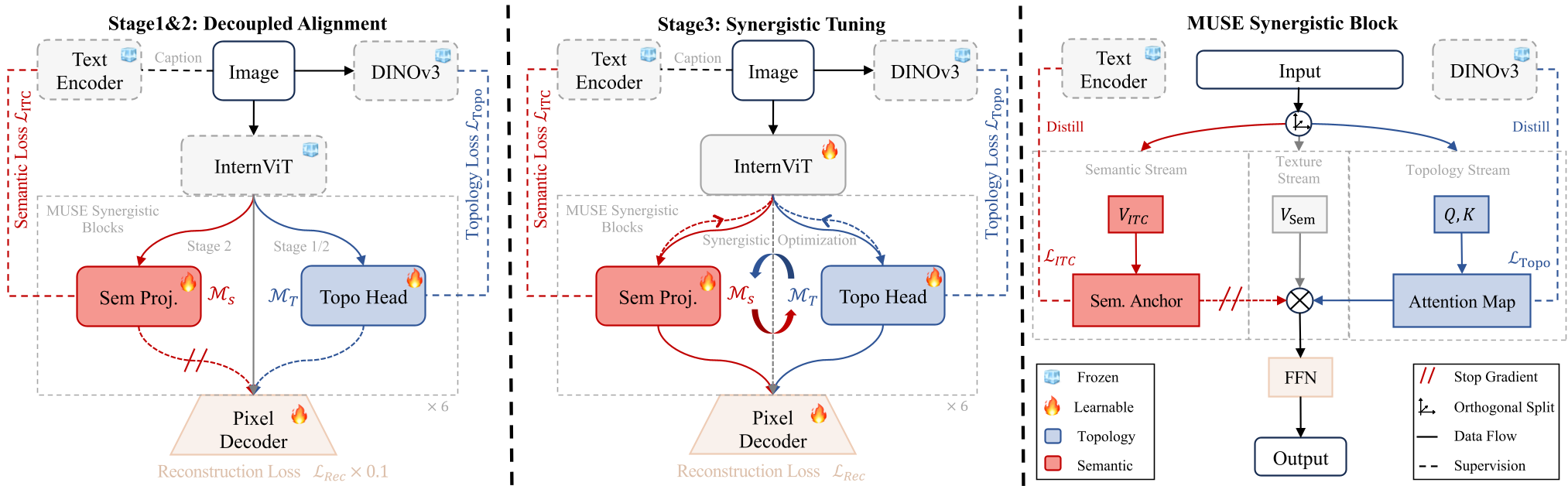
MUSE introduces the Synergistic Block, an architecture that physically instantiates the Gradient Orthogonality Hypothesis. The core insight is that structural gradients naturally prefer updating the Routing parameters (), while semantic gradients naturally concentrate in Value parameters ().
The Three-Stage Evolution
MUSE doesn't just train; it evolves through a structural-to-semantic curriculum:
- Stage 1 (Topology Alignment): Aligns the encoder's attention topology with a self-supervised teacher (DINOv3). This teaches the model "how to look" at object boundaries.
- Stage 2 (Semantic Anchoring): Injecting semantic concepts into the token values via Noise Contrastive Estimation (NCE), populating the "geometric skeleton" with meaning.
- Stage 3 (Synergistic Tuning): End-to-end integration where reconstruction and understanding finally coexist without conflict.
Experimental Prowess: Surpassing the Teacher
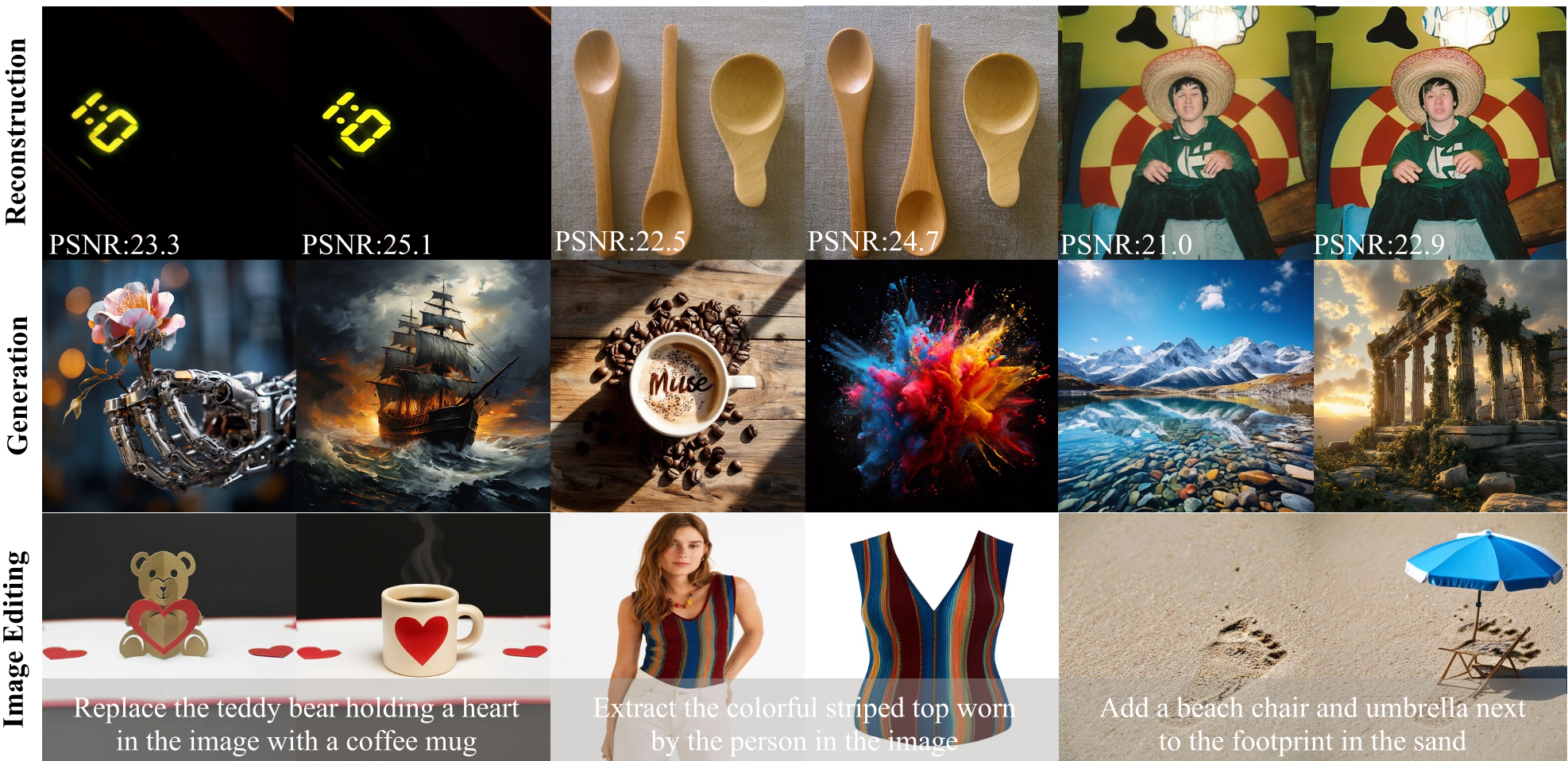
The results are striking. MUSE-3B doesn't just "balance" tasks; it excels in them.
- The Pareto Frontier: Unlike prior models like UniLIP or Janus-Pro, MUSE improves linear probing accuracy to 85.2%, actually outperforming its own teacher (InternViT-300M at 82.5%). This proves that "structurally aligned reconstruction" actually refines the model's perception.
- Spatial Control: On GenEval-Position benchmarks, MUSE achieves a score of 0.89, significantly higher than generative specialists like FLUX (0.68). This confirms that preserving explicit topology translates directly to finer spatial reasoning.
Critical Analysis: Why This Matters
The most profound takeaway from MUSE is the validation of Topological Orthogonality. The ablation studies show that simply using multiple losses (Soft Regularization) is insufficient to resolve gradient conflict (Cosine Similarity remains negative). Only physical architectural decoupling allows the model to reach the "Two-Stream" upper bound of processing while maintaining the efficiency of a single-stream model (only ~3% parameter overhead).
Limitations & Future Work
While MUSE demonstrates exceptional results at the 3B scale, the "Semantic Density" limit observed at 256 tokens suggests that simply adding more tokens doesn't always lead to better understanding. Future research may need to explore more hierarchical or dynamic tokenization schemes to capture even more complex scene graphs without introducing noise.
Conclusion
MUSE effectively ends the "Zero-Sum Game" of visual tokenization. By treating structure as an orthogonal bridge, it allows AI to "see" the world with the precision of a generator and "understand" it with the depth of a classifier. This architecture sets a new standard for building Unified Multimodal Models (UMMs) that are truly omnipotent.