
Navigating the Conceptual Multiverse: Why Your LLM Owes You a Map, Not Just an Answer
Navigating the Conceptual Multiverse
The paper introduces the "Conceptual Multiverse," an interactive system (conceptual-multiverse.onrender.com) that represents the hidden decision-making process of LLMs as a navigable tree of human-interpretable choices. It employs a verification framework to ensure structural rigor and domain-expert calibration across philosophy, AI alignment, and poetry.
TL;DR
When an LLM answers a philosophical or creative question, it makes dozens of invisible "fork-in-the-road" decisions. The Conceptual Multiverse is a new system that forced these models to show their work as a navigable tree of human-interpretable assumptions. Instead of a single brittle response, users get a "working map" of the problem, allowing them to intervene in the model's logic and explore how different philosophical framings or creative tensions change the final result.
The Problem: The "Black Box" of Open-Ended Reason
Modern AI interaction is funneled toward "premature convergence." You ask a question, and you get a single, authoritative-sounding response. But in domains like ethics, policy, or art, there is rarely one "right" answer.
The authors argue that we are currently stuck in the "Garden of Forking Paths" without a flashlight. Current LLM traces (like Chain-of-Thought) are often unfaithful to what the model is actually doing behind the scenes. We receive a "bag of uncontextualized results," never knowing how much the answer hinged on a value judgment the model made—and we didn't see.
Methodology: Engineering a Principled Multiverse
To solve this, the researchers redesigned the reasoning process to be Transparent, Intervenable, and Principled.
1. The Anatomy of a Decision
The system represents reasoning as a Python-based dependency tree.
- ⋄ States: The accumulated context of the conversation.
- ⋄ Transformations: Natural-language instructions (e.g., "Frame this through the lens of deprivation").
- ⋄ Decisions: Bundles of alternative transformations.
2. High-Stakes Verification
To prevent "hallucinated structure" (where the tree looks logical but is actually nonsense), the authors implemented six automated verification checks:
- Unambiguity: Ensures a transformation yields a predictable outcome.
- Completeness: Checks if the AI missed any major school of thought (e.g., missing "Continental Philosophy" in an ethics question).
- Faithfulness: Validates that the human-facing "Condition" matches the actual "Transformation."
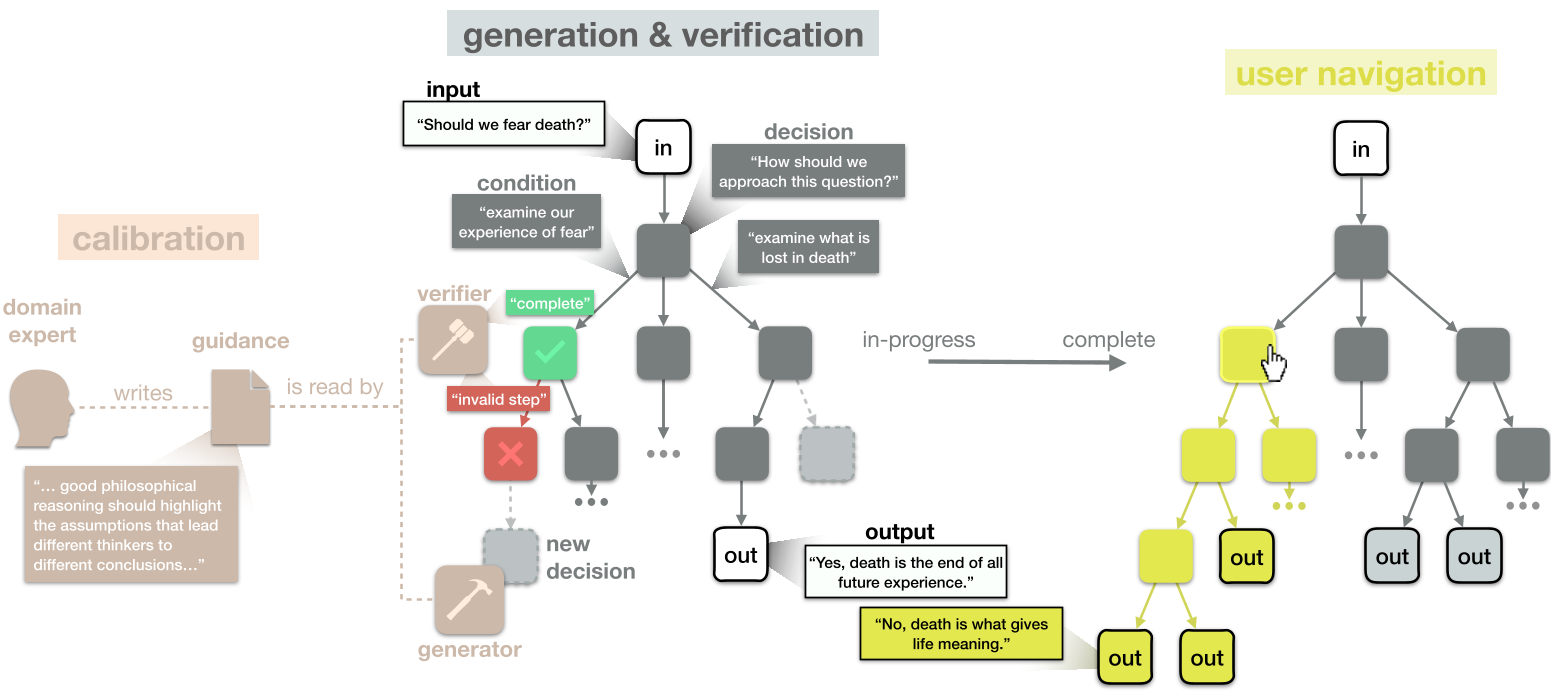 Figure: The interaction between domain experts (calibration), AI agents (generation/verification), and the end-user.
Experiments: Philosophy, Alignment, and Poetry
The Conceptual Multiverse was tested in three distinct domains to see if it changed how humans think.
Philosophy: From Google to Maps
Participants using standard ChatGPT often treated it as "glorified Google," recycling what they already knew. However, the Multiverse allowed a student (P5) to reverse their entire thesis on "Identity vs. Indistinguishability" by seeing how their computer science analogy functioned differently under different philosophical framings.
AI Alignment: Beyond Surface Preferences
In AI Safety, we often ask humans to rank outputs. The study found that ranking is too "shallow." One participant (P9), dealing with a sensitive question about religion, realized the "horrifying complexity" of the task only after seeing how many ways a response could go wrong depending on user intent.
Poetry: Naming the "Why"
For poets, the system didn't just write poems; it revealed the "craft." One participant (P11) learned to articulate precisely why they disliked certain AI poetry (e.g., overuse of the second person) by seeing those patterns repeat across different branches of the multiverse.
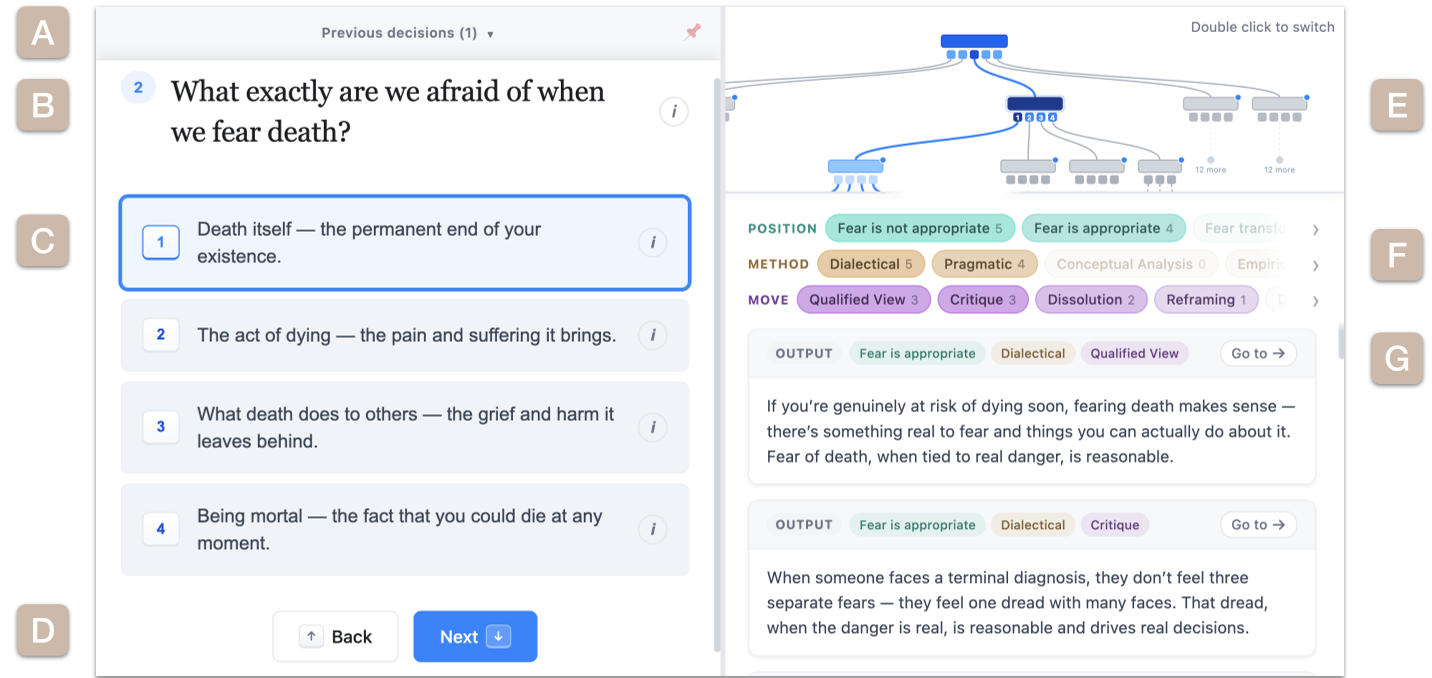 Figure: The Multiverse Interface. Users can navigate "Questions" and "Conditions" while seeing the global impact on the "Subtree" of reachable results.
Critical Insight: The "Bitter Lesson" Revisited
Rich Sutton famously argued that "general methods that leverage computation" eventually win over human-encoded knowledge. The Conceptual Multiverse doesn't fight this—it leverages it. It uses LLMs to generate the vast scale of the multiverse, but uses principled domain scaffolds to make that scale navigable.
The real value of this paper isn't just "better AI reasoning"; it's a blueprint for Human-AI Co-deliberation. It suggests that in the future, being a "prompt engineer" will be less important than being a "calibration expert"—someone who can define the standards of what makes a decision-making process valid in their specific field.
Conclusion: Toward Polyhedral Books
The paper quotes Italo Calvino: "The book was made as a polyhedron, and it has conclusions everywhere." The Conceptual Multiverse turns LLM outputs into these polyhedrons. By exposing the "joints" of reasoning, we move closer to a relationship with AI that isn't built on blind faith in a black box, but on the transparent navigation of many possible truths.
Limitations: The system is still dependent on the "prior" of the expert who calibrates it and the training data of the underlying LLM (Claude Sonnet 4.6). If a perspective isn't in the training data, it won't appear as a branch.