
NavOne: Revolutionizing VLN with One-Step Global Path Planning
NavOne: One-Step Global Planning for Vision-Language Navigation on Top-Down Maps
NavOne is a unified end-to-end framework for Vision-Language Navigation (VLN) that reformulates the task as a one-step global path planning problem on top-down maps. By predicting dense path and goal probability maps in a single forward pass, it achieves state-of-the-art performance on the new R2R-TopDown dataset, outperforming existing map-based methods.
TL;DR
The "stop-and-think" nature of tradition Vision-Language Navigation (VLN) is slow and error-prone. NavOne changes the game by treating navigation as a single-shot global planning problem. By looking at a top-down multi-modal map (RGB + Semantic + Occupancy), it predicts the entire path in one go, achieving an 80x speedup over sequential methods while reaching new SOTA levels on map-based benchmarks.
The "Step-by-Step" Bottleneck
Most embodied AI agents navigate like humans in an unfamiliar building: they take a step, look around, interpret the instruction again, and repeat. This egocentric, sequential paradigm has two fatal flaws:
- Error Accumulation: One wrong turn at the beginning of a long instruction cascades into total failure.
- High Latency: Repeatedly running heavy Vision-Transformer (ViT) or LLM cycles for every tiny action is computationally ruinous for real-time robots.
NavOne argues that if a map is available (via SLAM or pre-exploration), we should use it to plan globally, bypassing the "action-loop" entirely.
Methodology: The Path Former Architecture
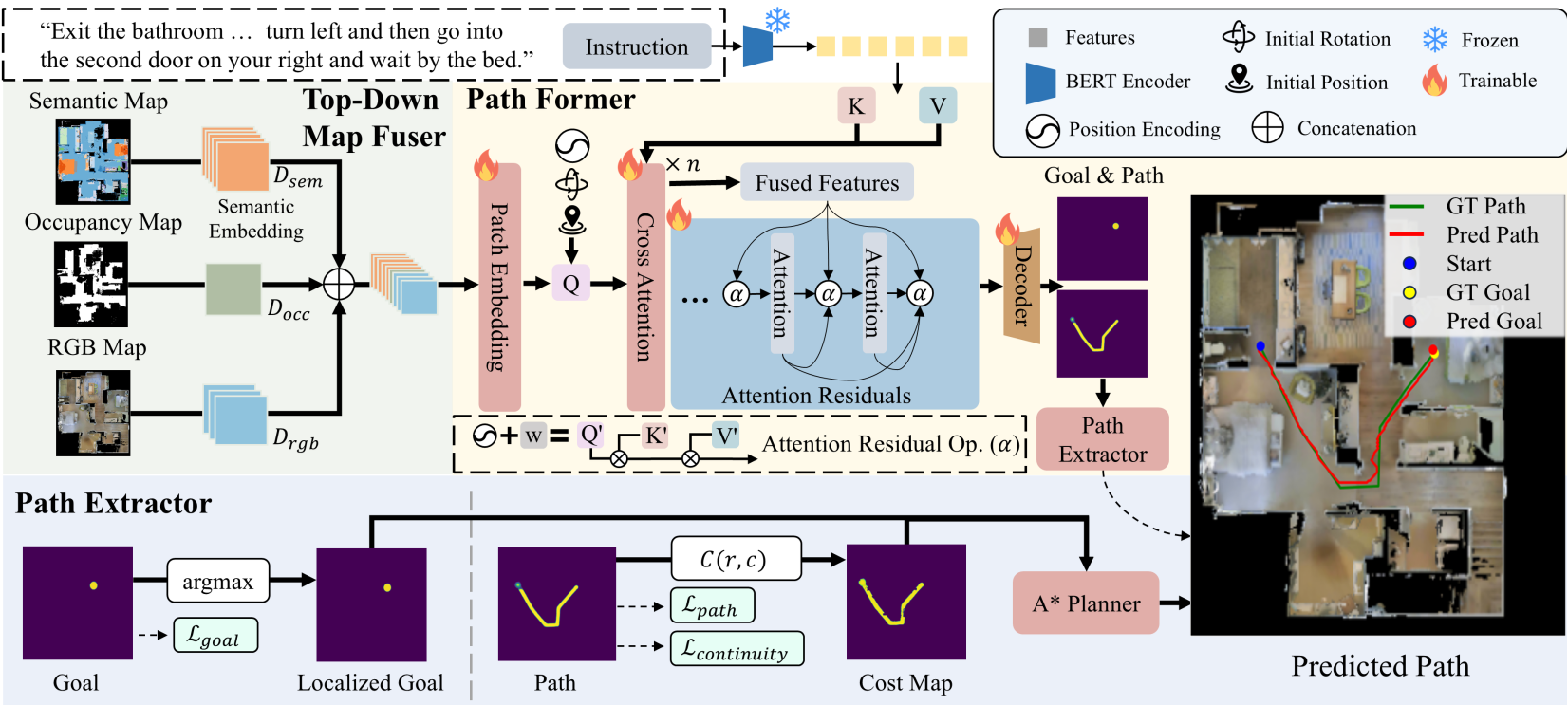
NavOne's architecture is built on three pillars: the Map Fuser, the Path Former, and the Path Extractor.
1. Multi-Modal Map Fusion
Instead of just using raw pixels, NavOne fuses three distinct layers:
- RGB: For visual context and textures.
- Occupancy: For hard geometric constraints (where are the walls?).
- Semantic: 41 categories of objects (where is the "refrigerator" or "sofa"?).
2. Spatial-Aware Attention Residuals
The "secret sauce" is in the Path Former. Standard Transformers process tokens in a fixed chain. NavOne uses Attention Residuals with Spatial-Aware Depth Queries.
- The Intuition: Different parts of a map need different levels of abstraction. A hallway might only need low-level geometric features, while a complex kitchen requires high-level semantic tokens.
- The Mechanism: Each token (spatial patch) can independently decide which layers of the network to "listen" to, allowing for position-dependent feature mixing.
Experiments: Speed Meets Precision
The researchers tested NavOne on the R2R-TopDown dataset. The results prove that global planning isn't just a gimmick—it's more robust.
Performance vs. Efficiency
Compared to ETPNav (a top-tier sequential method), NavOne isn't just slightly faster; it's 80 times faster. It generates a path in 37ms, compared to nearly 3 seconds for agents that decide step-by-step.

Visualizing the Success
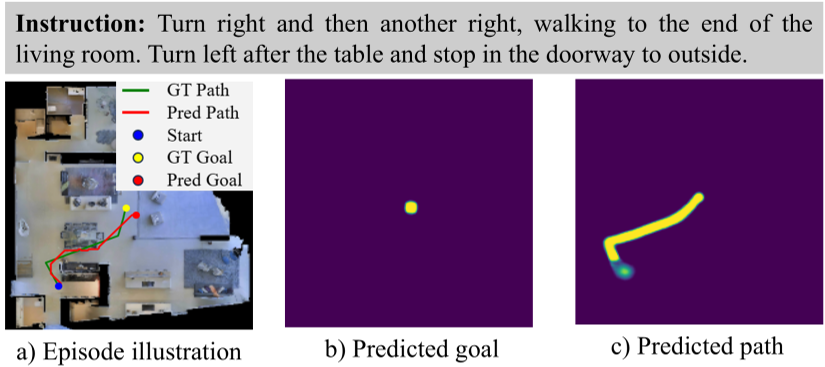
As shown in the qualitative analysis, the model produces two heatmaps: a Goal Probability Map and a Path Probability Map. An A* search then connects the dots. This makes the "black box" of the neural network highly interpretable—you can see exactly where the agent thinks it should go before it even starts moving.
Critical Insight & Future Outlook
NavOne demonstrates that Global Spatial Prior is the most powerful tool in the VLN toolkit. While the "Map-then-Navigate" paradigm assumes you have a map, the authors show this is feasible using modern monocular SLAM (like their LingBot-Map pipeline).
Limitations:
- Static Maps: It doesn't yet account for dynamic obstacles like people moving in real-time.
- Single-Floor: Currently limited to 2D projections, which fails in multi-story buildings.
Conclusion: NavOne sets a new blueprint for efficient navigation. By moving away from iterative "reactions" towards global "intent," it bridges the gap between high-level language understanding and low-level robotic control.