
NPO: Teaching Your Present Self with Your Near-Future Self
Near-Future Policy Optimization
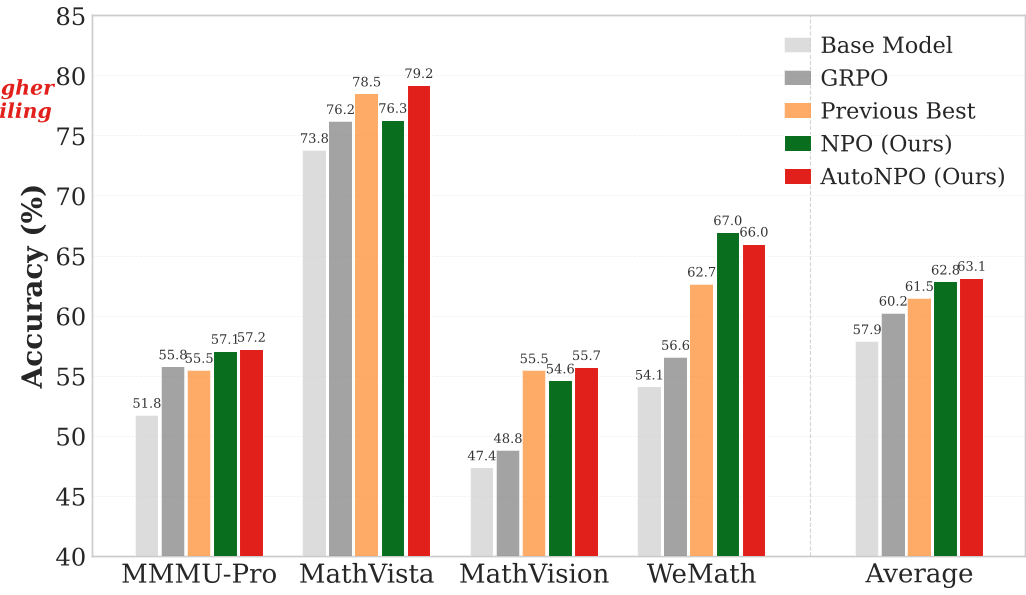
The paper introduces Near-Future Policy Optimization (NPO), a mixed-policy Reinforcement Learning with Verifiable Rewards (RLVR) scheme where a model learns from verified trajectories generated by its own "near-future" self (a later checkpoint from the same training run). On Qwen3-VL-8B, NPO and its adaptive version AutoNPO achieve state-of-the-art results, improving multimodal reasoning performance from 57.88% to 63.15%.
TL;DR
Reinforcement Learning with Verifiable Rewards (RLVR) often hits a ceiling: either the rewards are too sparse to start (Cold Start) or the model stops discovering new reasoning paths (Plateau). Near-Future Policy Optimization (NPO) tackles this by using a later checkpoint from the same training run to act as a "guide." This "near-future self" is strong enough to provide correct solutions but close enough in distribution to avoid the training instability typically caused by external teachers.
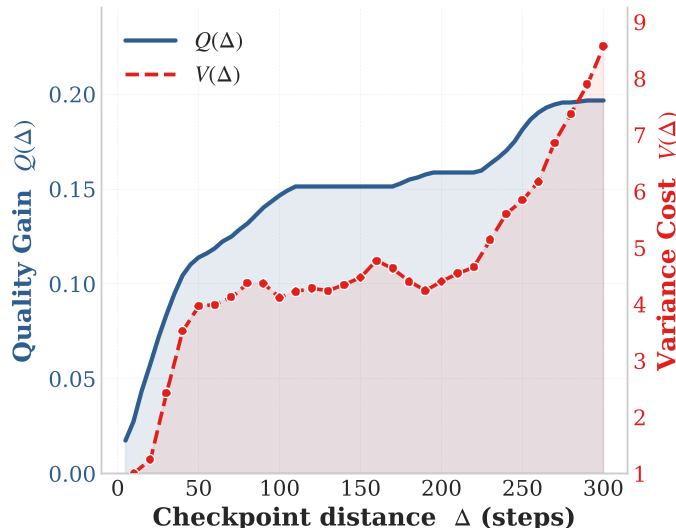
The Quality-Variance Conflict: Why More Data Isn't Always Better
In RLVR, we try to move beyond pure on-policy exploration by mixing in off-policy trajectories. However, we face a fundamental tension:
- External Teachers (High Q, High V): If you use a GPT-4 level teacher, the quality () is high, but the "style" of reasoning is so different that the importance weights explode, leading to massive variance () and training collapse.
- Experience Replay (Low Q, Low V): If you reuse your own past successful traces, the variance is low, but you are effectively learning from a "dumber" version of yourself, which doesn't help you break through plateaus.
The authors define the Effective Learning Signal as: where is the distance in training steps. NPO finds the "Sweet Spot" (the peaks in the charts below) where the guide is just far enough ahead to be smart, but close enough to be "relatable."
Methodology: Mining the Future
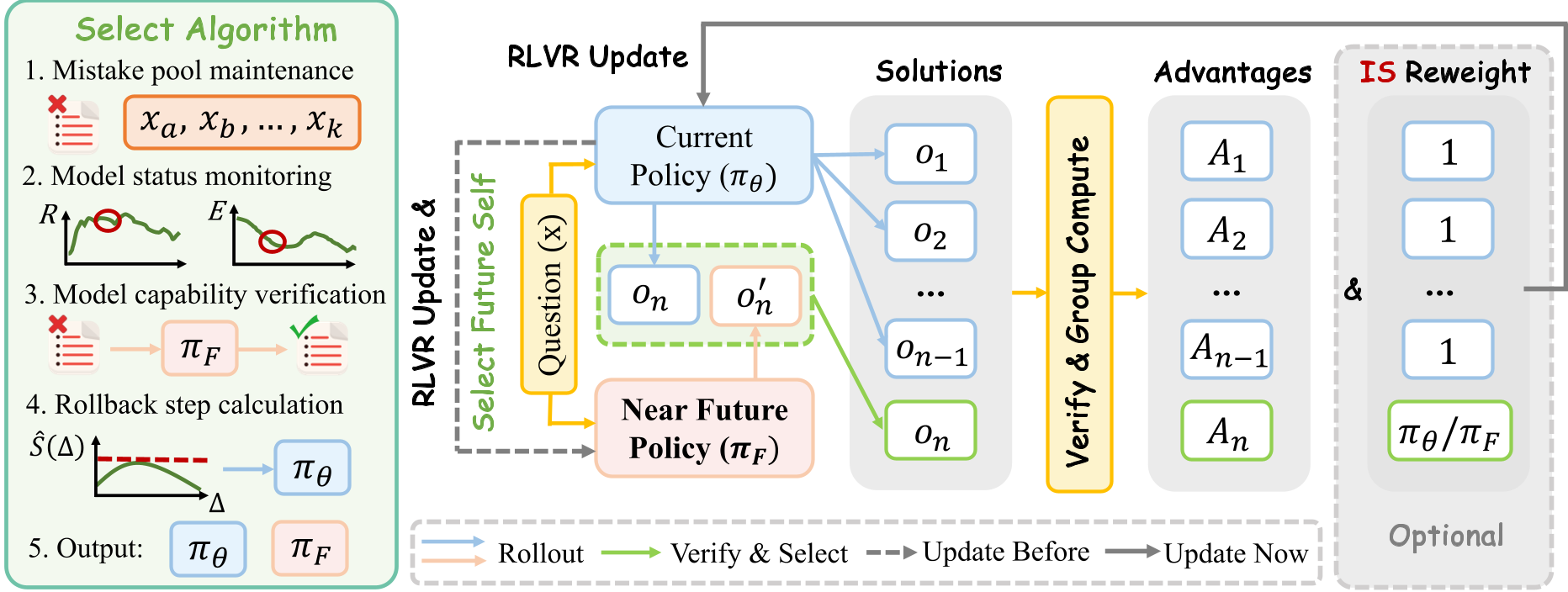
The NPO mechanism is elegantly simple. It modifies the Group Relative Policy Optimization (GRPO) rollout process:
- Identify Struggles: When the current policy fails on a prompt (pass rate below threshold ), NPO looks for a solution.
- Future Guidance: It takes a verified-correct trajectory from a near-future checkpoint .
- Slot Substitution: It replaces one slot in the -sized rollout group with this future trajectory.
- Optimization: The model treats this as an off-policy update, but because the future self is "near," the Importance Sampling (IS) weights stay close to 1, making training incredibly stable.
AutoNPO: The Adaptive Controller
Manually picking is hard. AutoNPO automates this by:
- Triggering: Monitoring logs for "Entropy Collapse" and "Reward Stagnation."
- Rollback: Automatically calculating the that maximizes the estimated and rolling the training back to re-train that segment with "Future Self" guidance.
Experiments: Breaking the Plateau
On the Qwen3-VL-8B backbone, NPO was tested against strong baselines like LUFFY (external teacher) and RLEP (far-future replay).
| Method | Avg. Accuracy (8 Benchmarks) |
|---|---|
| Qwen3-VL Base | 57.88% |
| GRPO (Pure On-Policy) | 60.25% |
| LUFFY (External Teacher) | 58.68% |
| NPO (Early + Late Stage) | 62.84% |
| AutoNPO (Adaptive) | 63.15% |
The results show that AutoNPO doesn't just speed up convergence; it raises the performance ceiling. By injecting fresh entropy and "near-future" solutions, it prevents the policy from narrowing its reasoning templates too early.
Clinical Insights: Why NPO Works
The core "secret sauce" of NPO is the "Near-Policy" property.
- Zero-Cost Stability: In their ablation study, the authors found that they could even drop the Importance Sampling (IS) correction entirely without losing performance. This is unheard of in traditional off-policy RL, but possible here because the guides are generated by a slightly more optimized version of the same weights.
- Entropy Re-expansion: Unlike pure RL which causes exploration to collapse (low entropy), NPO's interventions "restart" the discovery process, leading to more robust reasoning diversity.
Conclusion & Limitations
NPO demonstrates that the best teacher for an LLM might just be itself, a few hundred gradient steps into the future. It turns optimization time into a supervised signal.
Limitations:
- It requires "rollback" or "scout runs," which can increase total wall-clock compute time even if it improves sample efficiency.
- The method relies on Verifiable Rewards (math, code, or short-answer visual tasks). Extending this to subjective "Helpfulness" would require a future-self reward model, which is much riskier.
Future work in this "Self-Taught RLVR" paradigm (including "Parallel Selves") promises to further reduce our dependence on expensive human or GPT-4o annotations.