
[Nvidia 2025] Nemotron-Cascade 2: Achieving Olympiad Gold with 20x More Intelligence Density
Nemotron-Cascade 2: Post-Training LLMs with Cascade RL and Multi-Domain On-Policy Distillation
The paper introduces Nemotron-Cascade 2, a 30B Mixture-of-Experts (MoE) model with 3B activated parameters that achieves SOTA reasoning performance. It utilizes a refined Cascade Reinforcement Learning pipeline combined with Multi-Domain On-Policy Distillation (MOPD) to reach gold-medal level performance on IMO and IOI 2025 competitions despite its compact size.
TL;DR
Nvidia's Nemotron-Cascade 2 is a 30B MoE model (3B active) that has shattered the assumption that only frontier models like Gemini or DeepSeek-671B can solve Gold-medal level math and code problems. By evolving the "Cascade RL" paradigm and integrating Multi-Domain On-Policy Distillation (MOPD), Nvidia has created a model that rivals the giants in reasoning while maintaining elite-level instruction following.
Problem: The "Tug-of-War" in LLM Post-Training
In traditional Reinforcement Learning from Human Feedback (RLHF), researchers often face a zero-sum game: improving a model's creative writing usually degrades its mathematical precision, and enforcing strict instruction following often hurts its "reasoning" depth. This inter-domain interference makes it incredibly difficult to build a general-purpose model that excels at everything.
Joint training (mixing all data at once) is the standard fix, but it is notoriously unstable. Conflicting reward signals (e.g., a reward for "conciseness" vs. a reward for "step-by-step thinking") lead to entropy collapse or training divergence.
Methodology: The Cascade Evolution
Nemotron-Cascade 2 solves this through a two-pronged strategy:
1. Sequential Domain Optimization (Cascade RL)
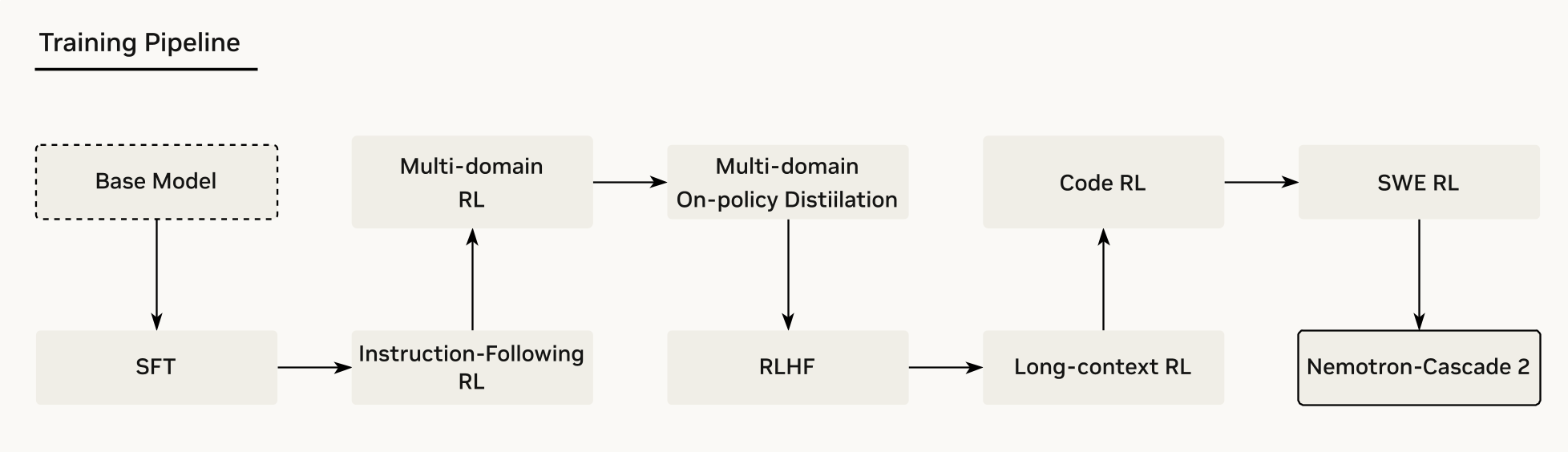
Instead of a single massive "soup" of data, the model undergoes a carefully ordered sequence of RL stages. By determining which tasks serve as foundational priors (like Instruction Following) and which are specialized refinements (like Competitive Coding), internal interference is minimized.
2. Multi-Domain On-Policy Distillation (MOPD)
This is the "special sauce" of the paper. During the cascade, the authors save the "best" version of the model for each specific domain (e.g., the best math model, the best chat model). They then use these as teachers for the final student.
Why does this work better than standard RL?
- Token-level Advantage: Traditional RL uses a sparse, sequence-level reward (e.g., "This answer is correct"). MOPD provides a dense reward for every token, making training dramatically faster.
- Self-Correction: It allows the model to "recover" benchmark regressions. If the Math RL stage hurts Chat performance, the Chat-teacher distillation restores it.
Exceptional Results: Small Model, Big Brain
The most striking achievement is the Model's performance on the International Mathematical Olympiad (IMO) 2025 and the International Olympiad in Informatics (IOI) 2025.
- IMO 2025: Solved 5 out of 6 problems, scoring 35/42 points.
- IOI 2025: Achieved a Gold-medal score of 439.28.
- Efficiency: It matches the performance of DeepSeek-V3.2-Speciale (671B) while using 20x fewer active parameters.

The ablation study on MOPD (Table 3) shows that it isn't just about final scores—it's about how you get there. MOPD reached an 85.5 score on ArenaHard in one-third of the training steps required by standard RLHF.
Deep Insight: Why Thinking Mode Matters
The model utilizes a "Thinking" mode, activated by an empty <think></think> block in the chat template. The authors found that training exclusively in thinking mode for RLHF and Math was critical. However, for agentic software engineering (SWE) tasks, a hybrid approach of thinking for localization/repair and non-thinking for tool execution yielded the best results.
Conclusion & Future Outlook
Nemotron-Cascade 2 is a masterclass in Data and Training Engineering. It proves that the "intelligence" of a model is not just a function of its size, but of how precisely its post-training trajectory is managed. By treating RL as a sequential refinement process rather than a single event, Nvidia has provided a blueprint for the next generation of highly capable, efficient reasoning agents.
Limitations: The model still struggles slightly in knowledge-intensive and constructive algorithm tasks compared to trillion-parameter models, suggesting that while reasoning can be "distilled" into smaller shells, raw knowledge storage still benefits from higher parameter counts.