
The Neptunian Ridge: How Tidal Physics Dictates the Architecture of Exoplanetary Systems
The Neptunian ridge as a natural outcome of high-eccentricity tidal migration
This study demonstrates that the "Neptunian ridge"—a recently discovered overdensity of planets at orbital periods of 3-6 days—is a natural consequence of high-eccentricity tidal migration (HEM). By incorporating empirical planet density dispersions into tidal survival models, the authors successfully reproduce the geometry of the Neptunian desert and the clustering of the ridge.
TL;DR
Atmospheric evaporation isn't the only thing shaping the "Exo-Neptune Landscape." This paper reveals that the Neptunian ridge— a mysterious pile-up of planets just outside the Neptunian desert—is the inevitable result of High-Eccentricity Tidal Migration (HEM). By factoring in the actual density variety of planets, the researchers showed that the ridge acts as a "survival band" where migrating planets either park their orbits or face total tidal destruction.
Background: The Desert, the Ridge, and the Savanna
For years, astronomers observed a "Neptunian Desert," a region close to stars where Neptune-sized planets are strangely rare. Recently, more precise data revealed that this isn't just a void; it has structure.
- The Desert: The forbidden zone.
- The Ridge: A sudden overdensity of planets at 3-6 day periods.
- The Savanna: A sparsely populated region further out.
While atmospheric escape (boiling off the planet's gas) was a popular theory, it couldn't fully explain the specific "pile-up" at the ridge. This paper argues that dynamical migration—where planets are kicked into highly elliptical orbits and then circularized by tides—is the true architect.
The Core Insight: Density is Destiny
The authors hypothesized that the boundary of the Neptunian desert is defined by the Roche limit. If a planet gets too close to its star during an eccentric swing, the star's gravity rips it apart.
The brilliance of this work lies in moving away from an "average" planet model. By using a range of observed planet densities, they transformed the theoretical "disruption line" into a "Survival Band."
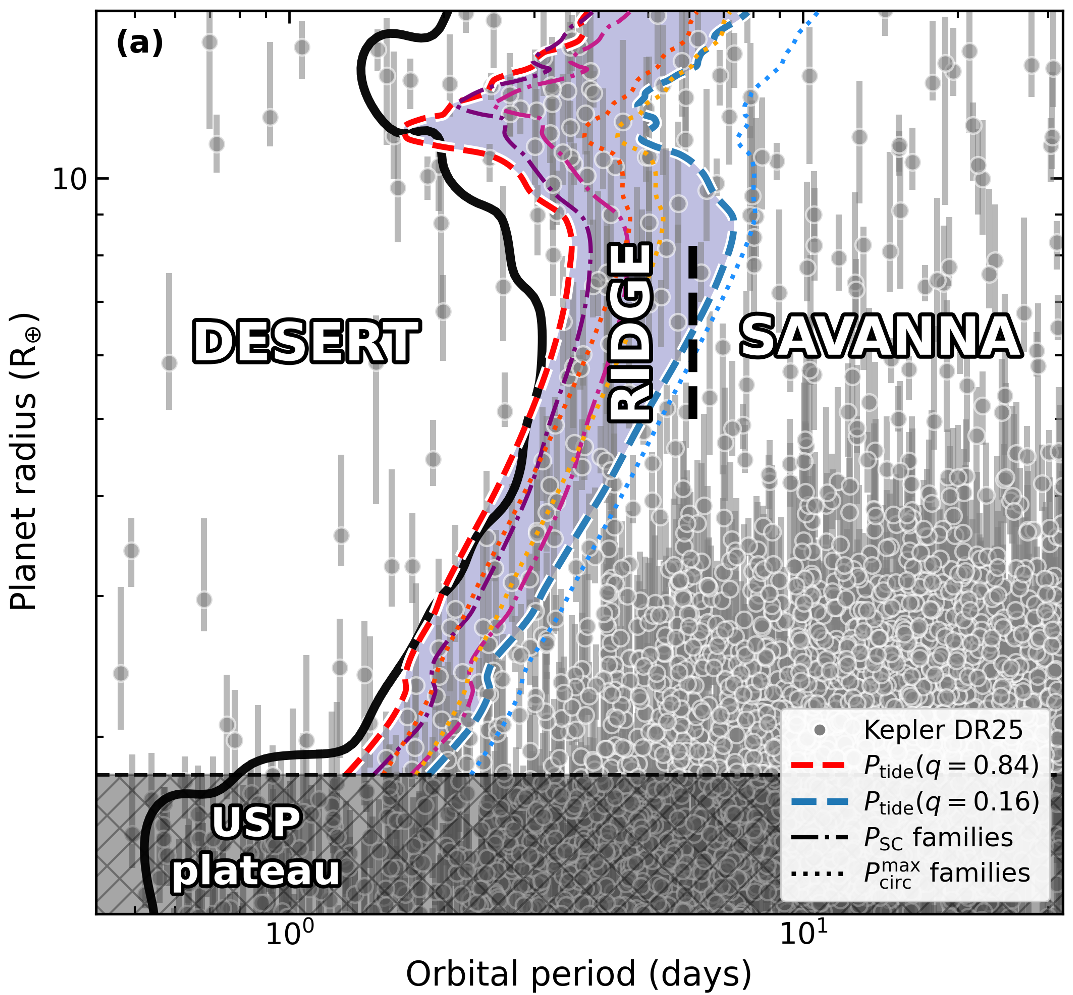 Fig 1: The model (solid lines) perfectly traces the edge of the observed desert and the location of the ridge (shaded box).
Methodology: Why the Ridge Forms
Why do planets cluster in the ridge instead of spreading out? The physics of tidal dissipation is extremely sensitive to distance.
- Late Delivery: Planets are pushed toward the star by distant companions (secular perturbations).
- Steep Circularization: If a planet's periastron (closest approach) is just outside the disruption zone, tidal forces are incredibly strong, quickly "parking" the planet into a circular orbit at that exact distance.
- The Survival Band: High-density planets can survive closer orbits; low-density planets can only survive further out. The ridge represents the interval where the most common planetary densities are forced to stop.
The "Density Brink" and the 1.7 g/cm³ Mystery
The researchers tested their theory by looking at the Period-Density plane. They found a "brink"—a clear diagonal cutoff where no low-density planets exist at short periods because they would have been tidally shredded.
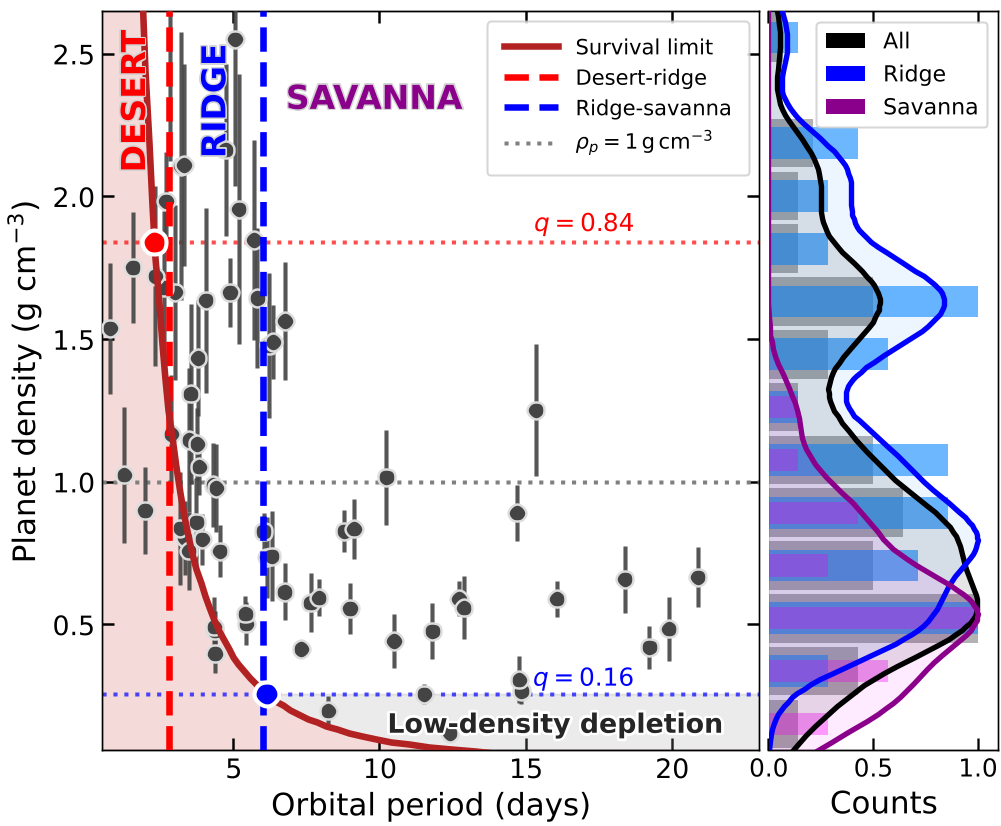 Fig 2: Notice how the lower-left corner is empty. The red line represents the tidal disruption limit for planets of different densities.
Intriguingly, the ridge planets show a distinct "secondary peak" in density at ~1.7 g/cm³. This suggests that these planets might have had their outer layers "skimmed" by the star, or they represent a unique population of cores that migrated via this violent HEM pathway.
Critical Analysis & Conclusion
Takeaway
The Neptunian ridge and desert are not separate phenomena but two sides of the same coin. The desert is where planets die; the ridge is where the survivors are forced to congregate.
Limitations
The study assumes a relatively constant tidal encounter parameter (). In reality, the internal structure of a planet (rocky core vs. gaseous envelope) might change how easily it is disrupted. Additionally, while HEM explains the ridge, it cannot explain the savanna, which likely remains the domain of "smooth" disk-driven migration.
Future Outlook
This work sets the stage for future JWST observations. If the ridge planets are indeed products of HEM, they should show signs of dynamical "bruising"—higher orbital inclinations or atmospheres that have been partially stripped by tidal heating and proximity to the star.