
Neural Computers: Turning the Model into the Machine
Neural Computers
The paper proposes Neural Computers (NCs), a novel machine form where computation, memory, and I/O are unified within a single learned latent runtime state. By instantiating NCs as action-conditioned video models (NCCLIGen and NCGUIWorld), the authors achieve SOTA results in terminal and desktop interface simulation, demonstrating that models can internalize the role of a running computer.
TL;DR
Meta AI and KAUST researchers have introduced Neural Computers (NCs), a concept that moves beyond "AI agents using computers" to "AI models being the computer." By utilizing high-capacity video generation models (like Wan2.1) as a learned runtime, they've demonstrated that a single set of weights can unified computation, memory, and I/O to simulate CLI and GUI environments with high fidelity.
Positioning: This isn't just another SOTA world model; it's a proposal for a new computing paradigm—the Completely Neural Computer (CNC)—where software development shifts from authoring code to curating differentiable configurations.
The Core Motivation: Breaking the Symbolic Wall
Conventional computers are built on the von Neumann architecture, separating memory from processing. While precise, this makes them brittle. Contemporary AI agents (like Claude's computer use) still treat the OS as an "external" black box.
The authors argue that this separation is a bottleneck. Their Insight is that if a model can learn the "physics" of an interface (how a click causes a menu to drop or how a command line scrolls), the model's latent state can serve as the executable state of the system itself.
Methodology: The Latent Runtime State
The NC framework is defined by a simple yet powerful update-and-render loop: Where:
- : The persistent runtime memory (latent state).
- : The state-update computation (Diffusion Transformer).
- : The decoder rendering the next frame.
Architectural Innovation: Internal Action Conditioning
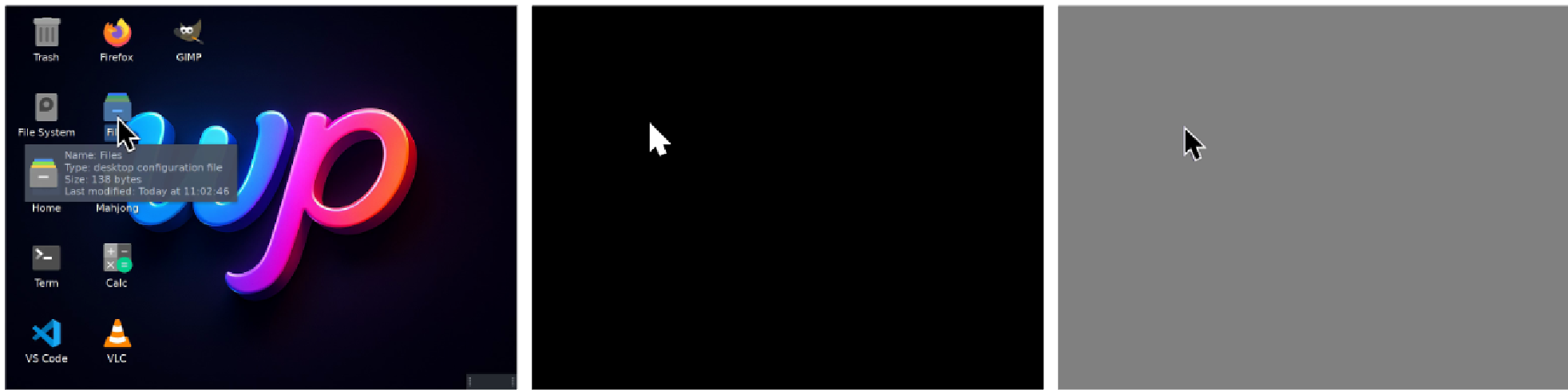
For GUI interaction, the researchers found that simply feeding actions as text prompts wasn't enough. They benchmarked four injection modes, finding that Internal Conditioning—inserting action cross-attention layers directly inside the transformer blocks—achieved the best performance.

Solving the "Floating Cursor" Problem
One of the biggest hurdles in neural GUI simulation is cursor drift. To solve this, the authors introduced Explicit Visual Supervision. Instead of abstract (x,y) coordinates, they provided the model with SVG-rendered cursor masks and reference frames.
Experiments & Key Results
The study evaluated NCs across two main benchmarks: NCCLIGen (Terminal) and NCGUIWorld (Desktop).
- Text Fidelity: At 13px font sizes, the VAE achieved a PSNR of 40.77 dB, proving that standard neural architectures can handle the high-frequency edges of terminal text.
- Control Precision: Explicit visual supervision skyrocketed cursor accuracy from a mere 8.7% to 98.7%.
- The Reasoning Gap: Interestingly, while the models could "render" math problems perfectly (83% accuracy with reprompting), they struggled with native symbolic reasoning, failing fundamental arithmetic probes.
Depth Insight: Why This Matters for the Future
The transition from NC (Prototype) to CNC (Complete Neural Computer) involves meeting four criteria: Turing completeness, universal programmability, behavior consistency, and machine-native semantics.
The authors envision a future where:
- Unified Hardware: Tensors replace heterogeneous data structures (files, sockets, pointers).
- Differentiable Configuration: "Programming" involves optimizing the computer's internal state to minimize task loss (e.g., "minimize proof error") rather than writing lines of code.
Critical Analysis & Conclusion
While the current prototypes rely on video models—a "pragmatic" choice according to the authors—the paper acknowledges that video generation is not the final form. The current bottleneck is symbolic stability. A CNC needs to be able to "install" a routine and reuse it perfectly every time, something today's stochastic diffusion models aren't yet built for.
Takeaway: Neural Computers aren't just simulating an OS; they are attempting to become the OS. By turning I/O traces into executable specifications, we are entering an era of "Software via Interaction Logs" rather than "Software via Manual Coding."
Check the full roadmap in Section 4 of the original paper for the transition from prototypes to general-purpose CNCs.