
NoiseGate: Turning Diffusion Timesteps into Information Gates for World Action Models
NoiseGate: Learning Per-Latent Timestep Schedules as Information Gating in World Action Models
NoiseGate introduces a learnable, per-latent timestep scheduling mechanism for World Action Models (WAMs). By treating denoising timesteps as information gates in a joint video-action Mixture-of-Transformers (MoT) backbone, it achieves SOTA performance on RoboTwin random-scene manipulation tasks, outperforming standard shared-scalar diffusion methods.
TL;DR
NoiseGate is a novel framework that optimizes how World Action Models (WAMs) "see" the future. Instead of denoising all future video frames at the same speed, it learns a Gating Policy Network (GPN) to adaptively control the noise level of individual frames. This allows the model to selectively ignore unreliable or ambiguous future predictions, leading to more robust robot control in complex, randomized environments.
Background: The Hidden Prior in Shared Schedules
In the burgeoning field of World Action Models, policies co-generate robot actions and future observations (video). Most existing architectures, such as Motus or Fast-WAM, use a shared scalar timestep for all tokens in a sequence.
The authors argue that this choice is fundamentally flawed. Under the Diffusion Forcing lens, noise acts as a mask. Forcing a shared implies that a frame 1.0 seconds in the future is just as "reliable" as a frame 0.1 seconds in the future. In reality, some future events (like the exact moment of a grasp) are harder to predict. A rigid schedule forces the model to rely on potentially "hallucinated" or noisy features, leading to premature failures.
Methodology: The Architecture of NoiseGate
NoiseGate reframes the per-latent timestep as a learnable information-gating policy.
1. The MoT Backbone
The system uses a Mixture-of-Transformers (MoT) where video and action tokens share self-attention layers but have modality-specific feed-forward networks.
2. Independent Timestep Sampling
To prepare the model for flexible schedules at inference, the authors train the backbone using independent per-latent timestep sampling. This ensures the model can handle any combination of noise levels across the video chunk.
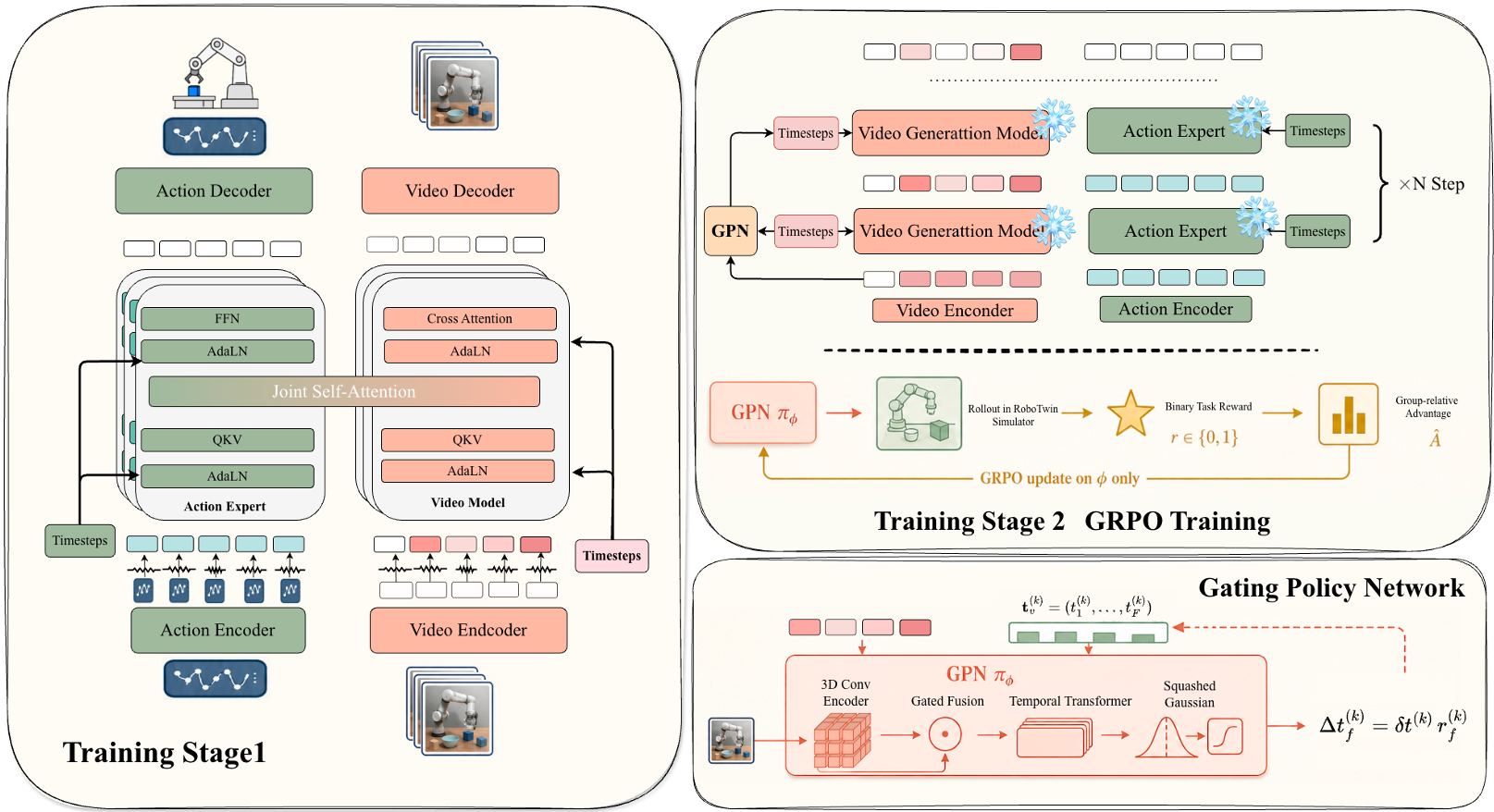 Figure 1: The NoiseGate framework. The GPN reads current latents and timesteps to emit increments (), controlling the unmasking of the future.
3. Gating Policy Network (GPN) & GRPO
The GPN isn't trained via imitation; it's trained via Reinforcement Learning (GRPO). It observes the current noisy latents and decides which frames to denoise faster. By optimizing for task success (sparse rewards), the GPN learns a strategy: "mask the frames I'm uncertain about, and unmask the ones critical for the current action."
Experimental Evidence
On the RoboTwin benchmark, NoiseGate was tested under "random-scene" conditions (randomized poses, colors, and backgrounds).
SOTA Performance
NoiseGate achieved an average success rate of 94.28%, outperforming competitive baselines like and Fast-WAM. The most telling results come from tasks where timing and precision are key:
- Hanging Mug: +9% improvement.
- Blocks Ranking Size: +7% improvement.
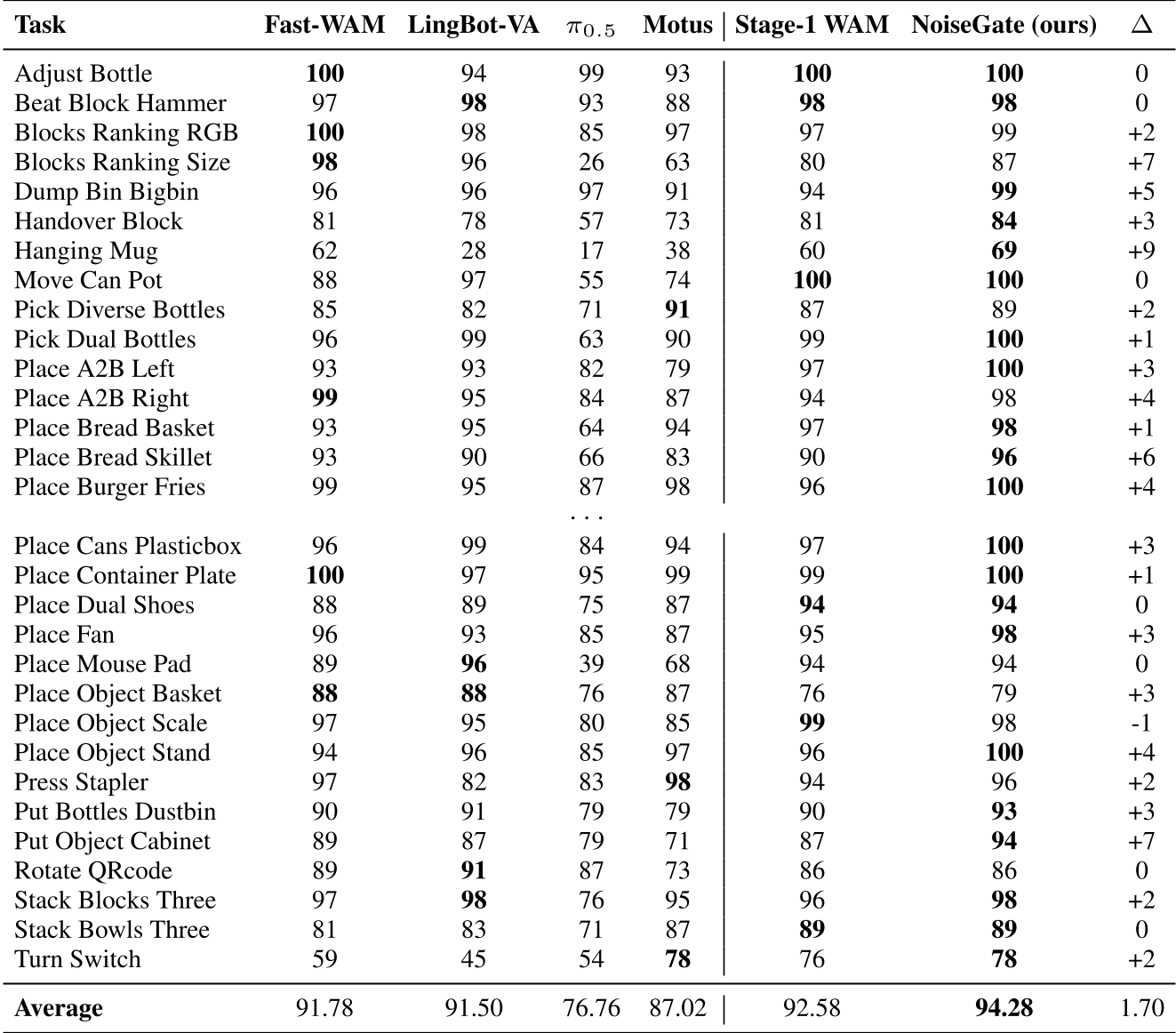 Table 1: Performance across diverse manipulation tasks.
Visualizing the "Gate"
The authors proved their "gating" hypothesis by measuring attention. As noise () increases, the attention from action tokens to that video frame decreases. This confirms that acts as a physical gate for information flow in the Transformer.
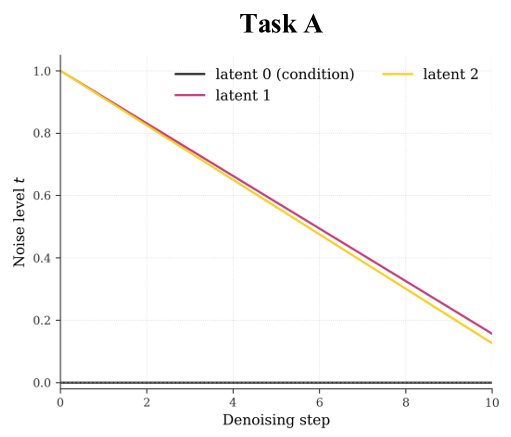 Figure 2: Task-dependent trajectories. Note how the model chooses different denoising speeds for different tasks.
Case Study: Avoiding Overconfidence
In a "grasping" test case, the baseline WAM became overconfident about a future grasp, leading to a premature (and failed) execution. NoiseGate, however, kept the "grasp frame" noisier (masked) for longer, preventing the action tokens from over-relying on a yet-to-be-confirmed future, resulting in a successful completion.
Critical Analysis & Conclusion
NoiseGate represents a shift from treatng diffusion as a "black-box" generation tool to a "white-box" controllable policy.
- Impact: It proves that the temporal structure of information is vital for embodied AI.
- Limitations: The primary bottleneck is the efficiency of RL (GRPO) in simulation, which requires significant sample collection.
- Future Work: Expanding this to cross-modal gating (e.g., gating language vs. vision) could provide even deeper insights into how VLA models prioritize information.
In conclusion, NoiseGate shows that in the world of generative robotics, when you see is just as important as what you see.