
[Physical Review B] The Field Theory of Quantum Error Correction: Why Your Decoder's Knowledge Creates New Phases of Matter
Non-linear Sigma Model for the Surface Code with Coherent Errors
This paper investigates the Pauli decoding threshold of the square-lattice surface code subjected to coherent unitary errors. By mapping the decoding problem to a 2D statistical mechanics model, the authors derive a Non-linear Sigma Model (NLsM) with target space SO(2n)/U(n) and identify distinct replica limits for optimal (n→1) and suboptimal (n→0) decoders.
TL;DR
Quantum error correction is usually viewed as a battle against stochastic noise. However, coherent errors (like unintended unitary rotations) introduce complex interference. This paper reveals that the "decodability" of a surface code is actually a phase transition in a Non-linear Sigma Model (NLsM). Crucially, it discovers that if your decoder has imperfect knowledge of the error, the system enters a "thermal metal" phase—a brand new non-decodable regime that simply doesn't exist if you decode optimally.
The Mystery of Coherent Errors
In the standard "topological quantum memory" paradigm, we measure stabilizers and use an algorithm (like Minimum Weight Perfect Matching) to find the most likely error. If the noise is Pauli (stochastic), there belongs a clear threshold.
But coherent errors are "ghostly." They create a superposition of error histories. Recent research suggested these errors relate to Anderson Localization—the physics of electrons getting stuck in dirty metals. This paper asks: Does the phase of our quantum memory depend on what the decoder thinks is happening?
The Methodology: Mapping Code to Field Theory
The authors represent the square-lattice surface code as a Chalker-Coddington network model. By treating the syndrome measurements as a "time-evolution" of Majorana fermions, they derive a continuum action:
abla Q \cdot abla Q) $$ where $Q$ is a matrix field in the target space **SO(2n)/U(n)**. ### The Replica Split: n=1 vs n=0 The "Replica Trick" is the secret sauce here: 1. **Optimal Decoder (n → 1)**: The decoder knows the exact rotation angle $ heta$. The math shows the "metallic" fixed point is **unstable**. The system naturally flows toward a decodable phase. 2. **Suboptimal Decoder (n → 0)**: The decoder uses a slightly wrong angle $ heta'$. Here, the metallic fixed point is **stable**. This creates a "Thermal Metal"—a phase where logical information is scrambled and irrecoverable. 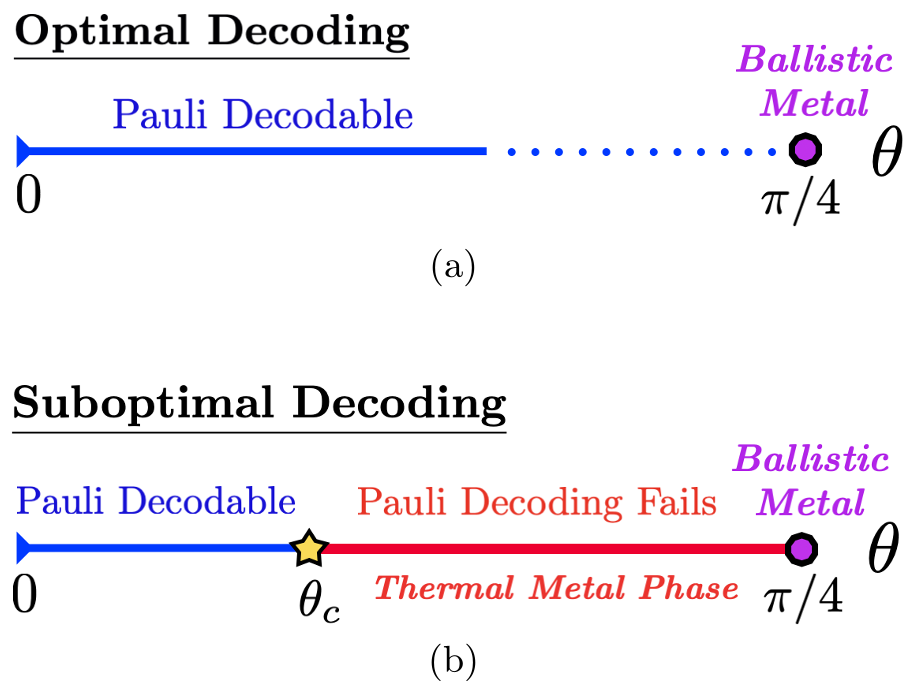 *Figure 1: The proposed phase diagram. Note the sharp distinction between the optimal and suboptimal paths as the rotation angle $ heta$ increases.* ## Experimental Results: The Death of Fidelity The authors performed large-scale numerical simulations using Majorana fermion dynamics to verify these field-theoretic predictions. * **For the Suboptimal Decoder**: As system size $L$ increases, the fidelity $F_{sub}$ drops sharply to 1/2 (total loss of info) when the rotation angle exceeds a critical value. * **For the Optimal Decoder**: The fidelity remains remarkably high, but the "approach" to the decodable phase is governed by a "marginally relevant" flow, meaning even large codes might look like they are failing when they are actually just transitioning very slowly. 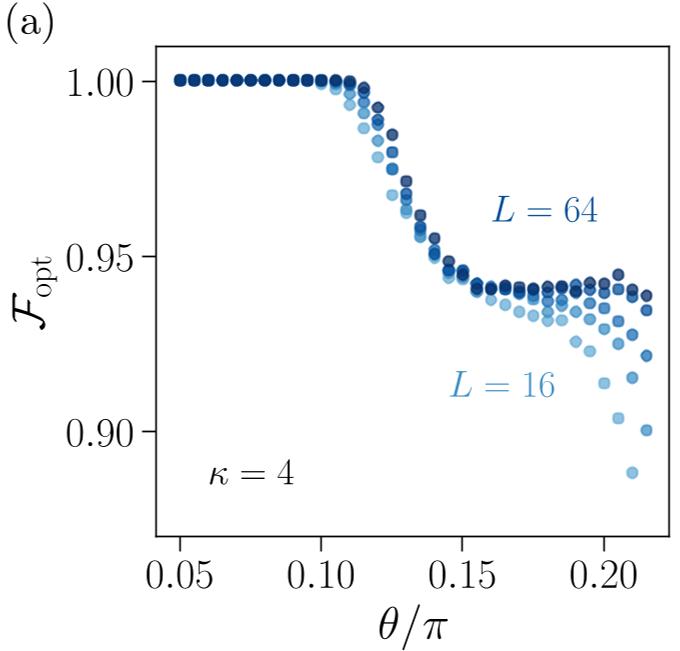 *Figure 2: Performance metrics. (a) shows the optimal decoder's fidelity increasing with size (indicating a decodable phase), while (b) and (c) highlight how aspect ratios and rotation angles drive the crossover.* ## Deep Insights: Lattice Geometry Matters One of the most profound conclusions is that these phases are "lattice-born." The **bipartite** nature of the square lattice is what yields the class D symmetry. If we moved to a **triangular lattice** (non-bipartite), the symmetry class shifts to **DIII**. In that world, the "Thermal Metal" becomes stable even for the *optimal* decoder. This means that the very shape of your qubit layout could fundamentally limit your ability to correct coherent errors. ## Conclusion & Outlook This work moves quantum error correction (QEC) from "algorithm design" into "many-body physics." It proves that a decoder is not just a tool—it's an observer that determines the physical phase of the quantum state. **Main Takeaway**: If you want to build a robust surface code, you cannot ignore the calibration of your decoder. Small miscalibrations don't just lead to slightly higher error rates; they can trigger a phase transition into a "metallic" regime where your error correction is mathematically guaranteed to fail.