
Stability of the Non-Supersymmetric Heterotic Landscape: The $AdS_4 imes S^3 imes S^3$ Puzzle
Non-supersymmetric heterotic strings on $AdS_{4}\times S^{3}\times S^{3}$
The paper investigates the stability of flux compactifications within the tachyon-free, non-supersymmetric heterotic string theory. It utilizes one-loop quantum corrections to stabilize the dilaton and identifies a regime of "inverse scale separation" where one internal sphere becomes parametrically larger than the AdS radius.
TL;DR
Researchers have identified a new class of solutions in the heterotic string theory that achieve stability through quantum effects rather than supersymmetry. By balancing two independent internal fluxes, the model avoids the "tachyonic" graveyard of non-supersymmetric theories, provided the fluxes are sufficiently different. However, non-perturbative "brane nucleation" acts as a cosmic equalizer, threatening to push the vacuum back into instability.
Background Positioning
In the quest to connect string theory to our non-supersymmetric world, physicists usually start with a supersymmetric theory and break it at low energies. This paper takes a bolder path: starting with a theory that has no spacetime supersymmetry at the string scale (). This work sits at the intersection of flux compactification and the Swampland Program, testing whether a stable non-supersymmetric AdS vacuum can truly exist.
The "Intrinsically Quantum" Insight
At the tree level (classical), the dilaton field in these theories typically "runs away," preventing stable compactification. The authors show that by including one-loop quantum corrections (the Casimir energy of the string), a potential is generated that can trap the dilaton.
 The one-loop corrected potential (Equation 14) involves the string coupling and the partition function .
Methodology: The Stability Balance
The authors dissect the stability of this background using two distinct lenses:
- Perturbative Stability: They expand the fields into spherical harmonics on the two spheres. They found that if the two fluxes and are similar in magnitude, a specific scalar mode drops below the Breitenlohner-Freedman (BF) bound, signaling an immediate linear instability.
- Inverse Scale Separation: When one flux is much larger than the other, the geometry stretches. One sphere becomes huge, the other stays small, and the perturbative tachyons vanish.
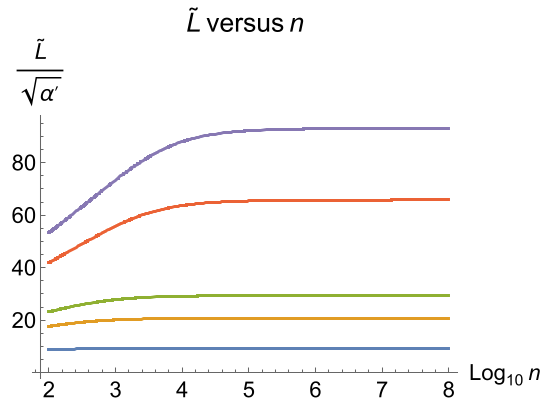 Figure 1: Evolution of internal radii and as a function of flux ratio. Note the divergence at large hierarchies.
The "Weak Gravity" Catch: Non-Perturbative Decay
Even if the vacuum is perturbatively stable, it can still decay via the "tunneling" effect. In this case, NS5-branes can spontaneously nucleate, wrapping around the internal spheres and carrying away flux.
The authors calculate the extremality ratio . If , the repulsive force between branes (charge) overcomes the gravitational attraction (tension).
- Result: They found .
- Insight: Because , the vacuum is technically unstable. The branes will inevitably discharge the larger flux, bringing and closer together until the system hits the tachyonic regime and collapses.
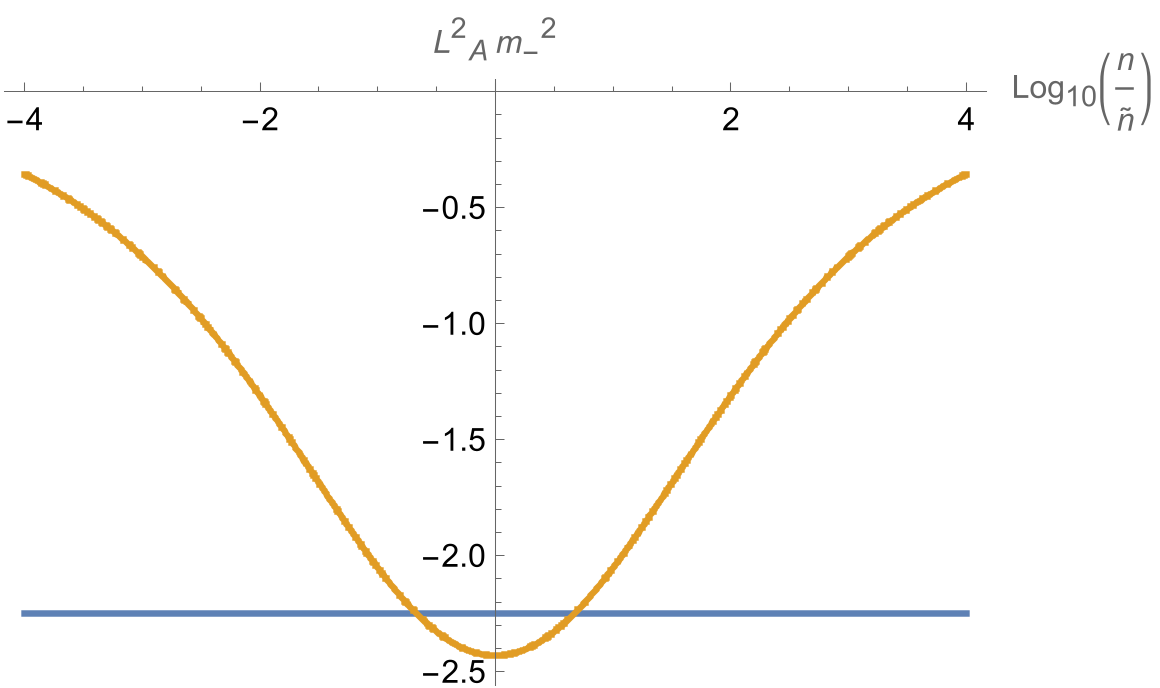 Figure 6: The mass-squared of the dangerous mode. The orange line dipping below the blue line represents the violation of the BF bound.
Critical Insight & Conclusion
This paper reveals a "richer instability phenomenon" than previous models. It suggests that while we can use geometry (like orbifolds) to kill off perturbative tachyons, the Non-supersymmetric AdS Swampland Conjecture seems to hold: non-perturbative decay channels are always available.
Takeaway for the Field: This work reinforces the idea that non-supersymmetric vacua are fundamentally transient. For a holographic dual to exist, it would likely involve a "decaying" conformal field theory, a concept that stretches our current understanding of the AdS/CFT correspondence.
Limitations
The analysis relies on the semiclassical limit (large fluxes). In the "intrinsically quantum" limit where fluxes are small, the 10D effective action may receive higher-order stringy corrections that could alter these conclusions.