
Nonsense Helps: How Lorem Ipsum Rescues LLM Reasoning from the Zero-Advantage Trap
Nonsense Helps: Prompt Space Perturbation Broadens Reasoning Exploration
The paper introduces Lorem Perturbation for Exploration (LOPE), a simple prompt-space perturbation framework designed to enhance the reasoning capabilities of Large Language Models (LLMs) during reinforcement learning. By prepending "Lorem Ipsum" (pseudo-Latin) sequences to prompts during resampling, LOPE effectively overcomes the "zero-advantage problem" in Group Relative Policy Optimization (GRPO), achieving significant SOTA gains in mathematical reasoning across 1.7B, 4B, and 7B models.
TL;DR
In the world of Reinforcement Learning with Verifiable Rewards (RLVR), the hardest questions often provide the least value because the model fails every attempt, leading to a "zero-advantage" gradient collapse. Researchers from Washington University in St. Louis have introduced LOPE (Lorem Perturbation for Exploration). By simply prepending meaningless pseudo-Latin "Lorem Ipsum" text to prompts, they force LLMs to explore "orthogonal" reasoning paths. This simple trick, combined with clever training signal shaping, results in a massive +6.2 average point gain on mathematical benchmarks.
The Core Problem: The Efficiency Wall of GRPO
Reinforcement learning via Group Relative Policy Optimization (GRPO) has become the gold standard for reasoning (powering models like DeepSeek-R1). It works by comparing multiple answers for the same question. However, GRPO has a fatal flaw: The Zero-Advantage Problem.
If an LLM samples 8 responses for a hard math problem and all 8 are wrong, the advantage is zero for every response. The model learns nothing. Naive solutions—like sampling more or turning up the "temperature"—often fail because the model is stuck in a local reasoning basin; it keeps making the same types of mistakes.
Methodology: Why "Nonsense" is the Key
The authors' insight is grounded in the physics of LLM distributions: Prompt-level changes can shift output distributions more effectively than logit-level noise (temperature).
1. The LOPE Mechanism
When a model fails all initial attempts at a question, LOPE triggers a resample. Instead of the original prompt, it uses a Lorem-perturbed prompt:
- Perturbation: A sequence of 100-300 tokens sampled from a Lorem Ipsum vocabulary.
- Intuition: Because it’s pseudo-Latin, it doesn't "contaminate" the English reasoning context with wrong facts, but it alters the key-value (KV) cache states enough to break the model's "mental loop."
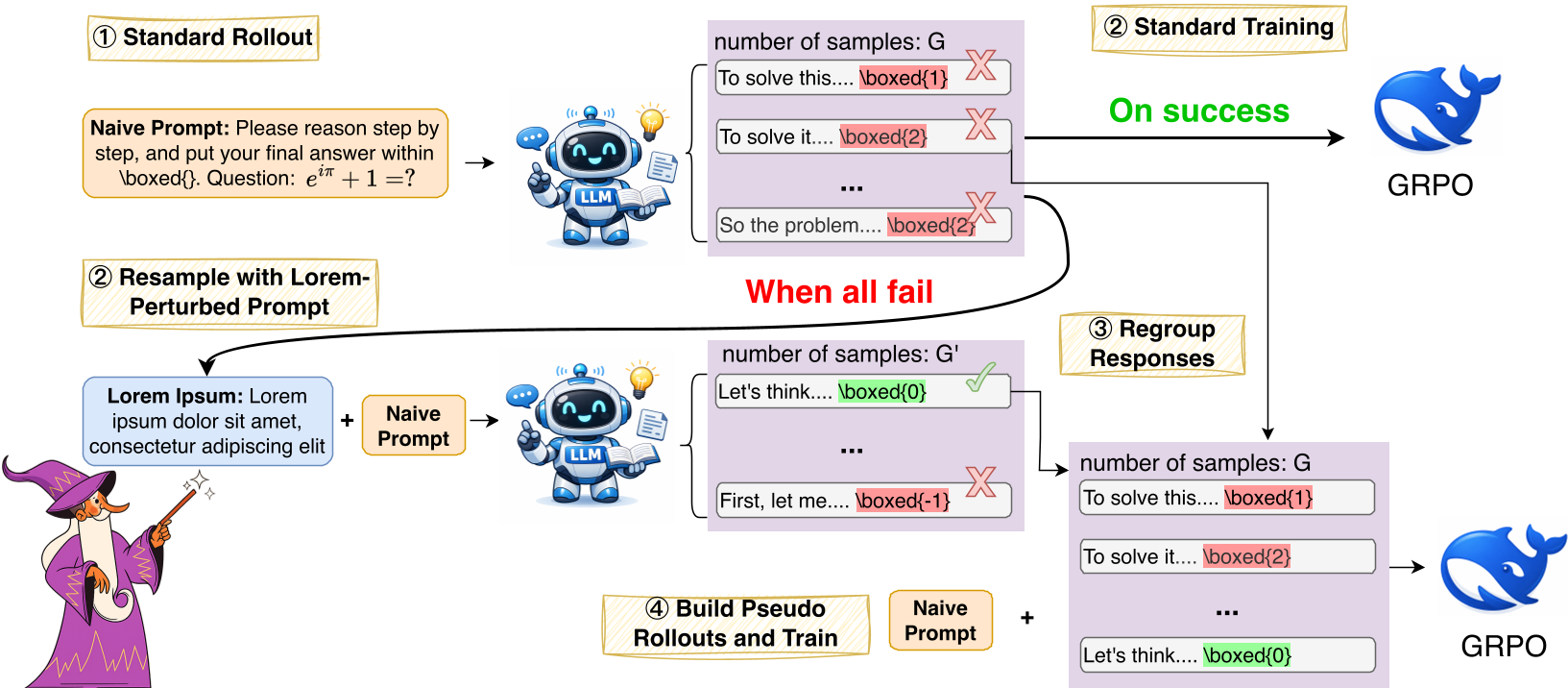 Figure 1: The LOPE workflow—resampling with perturbed prompts to recover lost training signals.
2. Training Signal Shaping
Directly training on these perturbed "nonsense" samples is tricky. Success found via a perturbation might look "rare" to the original policy. LOPE uses two major math fixes:
- Policy Shaping: A weight function that amplifies gradients for "low-probability" tokens, ensuring the model actually learns the rare, correct reasoning steps.
- Advantage Shaping: Calculating the reward mean across all samples (original + perturbed) to accurately reflect the difficulty of the question, which amplifies the reward signal of a rare success by up to 5x.
Experimental Results: Breaking the Exploration Bottleneck
The results across math benchmarks demonstrate that LOPE isn't just a gimmick; it’s an optimization breakthrough.
| Model | Baseline Avg | LOPE Avg | Gain |
|---|---|---|---|
| Qwen3-1.7B | 34.90 | 39.82 | +4.92 |
| Qwen3-4B | 39.59 | 53.99 | +14.40 |
| Qwen2.5-Math-7B | 34.90 | 53.88 | +18.98 |
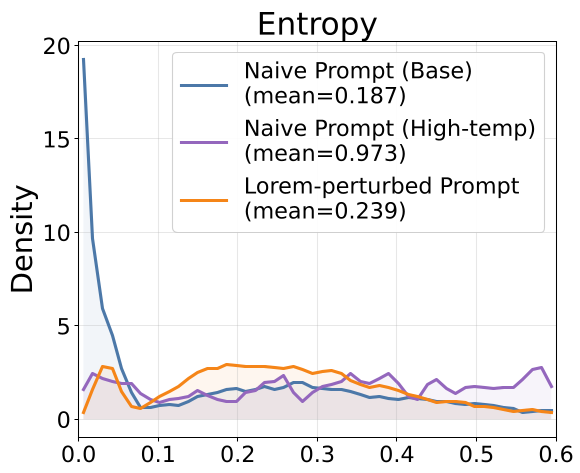 Figure 2: Venn diagrams showing that Lorem-perturbed prompts (green) find correct answers for "Hard" questions that standard and high-temperature sampling (blue/red) completely miss.
What constitutes a "Good" Perturbation?
The authors tested everything from random ASCII and fake English to natural Latin. They discovered a "Goldilocks" zone for perturbations:
- Low Perplexity: The noise must look "language-like" to the model so it doesn't break the input representation.
- Language Disjointness: Using pseudo-Latin avoids interference with the task-specific English context.
Critical Analysis: A Strong New Baseline
LOPE represents a shift from Internal Exploration (changing temperatures) to Contextual Exploration (changing inputs).
Strengths:
- Data Efficiency: It salvages "failed" training questions that would otherwise be discarded.
- Simplicity: It requires no additional model parameters or complex reward modeling.
Limitations:
- Inference Compute: Resampling requires more FLOPs during the training-rollout phase.
- Controllability: Extremely high-strength perturbations can occasionally lead the model to output gibberish, necessitating careful boundary instructions.
Conclusion
LOPE proves that in the latent space of LLMs, a little bit of structured "nonsense" is precisely what a model needs to find the signal in the noise. By broadening the exploration space during RL training, we can push models to solve reasoning tasks that were previously deemed out of reach for their parameter count.
Senior Editor's Note: This work highlights a growing trend in RLVR—the realization that exploration is not just about probability, but about the geometric variety of the input space.