
nGPT: Transforming Architecture for Native 4-Bit LLM Training
Normalized Architectures are Natively 4-Bit
The paper introduces nGPT, a normalized Transformer architecture that constrains weights and activations to a unit hypersphere, making it natively robust to 4-bit (NVFP4) precision. It demonstrates stable end-to-end 4-bit training without standard interventions like Randomized Hadamard Transforms (RHT) or per-tensor scaling, achieving SOTA performance on models up to 30B parameters.
TL;DR
Current 4-bit training methods for Large Language Models (LLMs) rely on complex "patches" to survive quantization noise. NVIDIA researchers have shown that the nGPT architecture—which constrains all representations to a unit hypersphere—is natively 4-bit ready. It requires no Randomized Hadamard Transforms (RHT) or per-tensor scaling, yet achieves a 7 dB higher Signal-to-Noise Ratio (SNR) and up to 3.6x speedup on Blackwell GPUs.
The Problem: Why 4-Bit Training is Fragile
The industry is moving toward NVFP4 (4-bit floating point) to reduce the massive memory and compute costs of LLMs. However, standard Transformers are unstable at this precision. Outliers in weight and activation distributions lead to "exploding" quantization errors.
To fix this, the current state-of-the-art (SOTA) recipe includes:
- Randomized Hadamard Transforms (RHT): To spread out outliers.
- Dynamic Per-tensor Scaling: To maximize precision.
- Mixed Precision: Reverting certain layers to higher precision (BF16).
These interventions add computational overhead and complexity. The authors of this paper asked a fundamental question: Can we design an architecture that doesn't need these patches?
The Insight: Signal Coherence over Noise Suppression
The core discovery of this paper is that nGPT's robustness doesn't come from lowering the noise, but from strengthening the signal.
In a standard dot product , quantization noise () is uncorrelated. In a standard GPT, the signal is often also poorly correlated. In nGPT, the hypersphere constraint forces the model to align many small contributions across the hidden dimension to create a strong output, rather than relying on a few large outliers.
This creates constructive signal accumulation. While noise cancels out like a random walk, the signal builds up coherently.
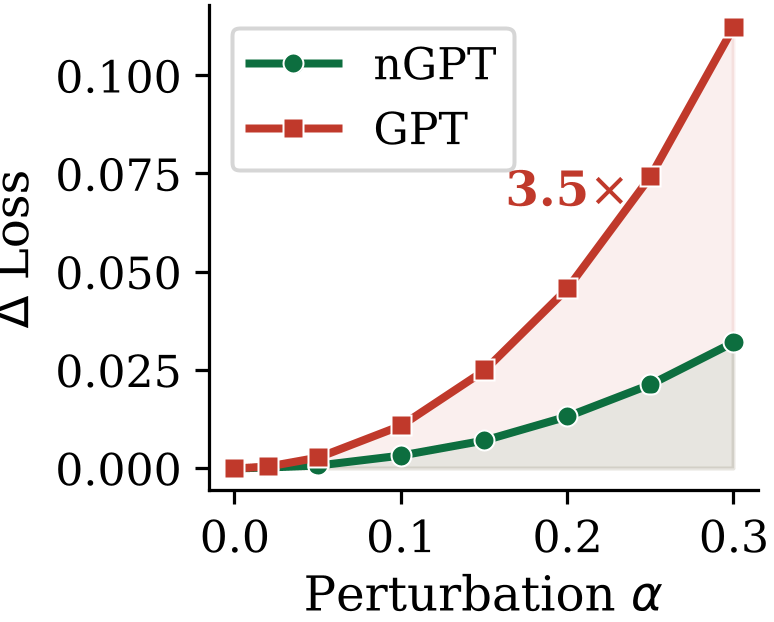 Figure 1: nGPT suppresses noise better at every layer (Left), leading to a 3.5x flatter loss landscape (Right).
Methodology: Hyperspherical Math
nGPT replaces standard layers with normalized variants:
- Weight Normalization: Weights are normalized along the embedding dimension.
- Residual Updates: Replaced with a hyperspherical interpolation (Norm()).
- Removed RMSNorm: Since the architecture is inherently normalized, standard LayerNorm/RMSNorm is redundant.
By measuring the Signal-to-Noise Ratio (SNR), the researchers found that while individual element quantization errors are similar between GPT and nGPT, the summation in nGPT is vastly superior.
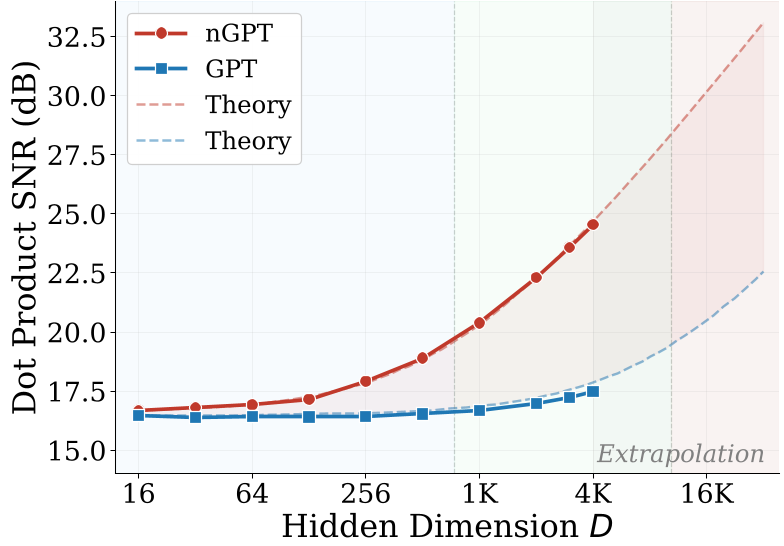 Figure 2: The SNR advantage of nGPT grows linearly with the model's hidden dimension (Width), suggesting it becomes even more effective as we scale to larger models.
Experimental Results: SOTA at Scale
The authors validated nGPT across several configurations on NVIDIA Blackwell GPUs:
- 1.2B Dense Model: Trained on 1T tokens. nGPT-NVFP4 outperformed standard GPT-NVFP4 across all downstream benchmarks (HellaSwag, PIQA, etc.) without using RHT or scaling.
- 3B/30B Hybrid MoE: Achieved ~0% relative error compared to BF16 baselines.
- Hyperparameter Robustness: nGPT is remarkably insensitive to Learning Rate (LR) changes. In standard GPT, you often need to re-tune your LR when moving to 4-bit; in nGPT, the BF16 hyperparameters "just work."
Throughput Gains
By removing the need for RHT and dynamic scaling, the nGPT path achieves a 3.3x to 3.6x speedup over the BF16 GPT baseline, fully utilizing the power of Blackwell's NVFP4 tensor cores.
Critical Analysis & Conclusion
Takeaways
- Architecture > Algorithms: Instead of designing better quantization algorithms for bad architectures, we should design architectures that are mathematically compatible with low precision.
- Scaling Dividend: nGPT gets better as the hidden dimension grows, making it a prime candidate for future "mega-models."
Limitations
- The study used up to 30B models, but production-grade models often exceed 100B+ parameters and are trained on 20T+ tokens. Whether nGPT's stability holds at the "frontier" scale remains to be seen.
- The training was limited to 500B tokens for the largest MoE; long-term drift in normalized representations is a potential area for future investigation.
The Verdict: nGPT moves us closer to a future where 4-bit training is the default, significantly lowering the barrier to entry for developing powerful AI models.