
Nora: Bridging the Gap Between Matrix Preconditioning and Training Stability
Nora: Normalized Orthogonal Row Alignment for Scalable Matrix Optimizer
Nora is a novel matrix-based optimizer (Normalized Orthogonal Row Alignment) designed for Large Language Model (LLM) training. It achieves state-of-the-art data efficiency by combining row-wise momentum projection with normalization, outperforming SOTA methods like Muon and RMNP in training speed and final loss.
TL;DR
Training Large Language Models (LLMs) requires more than just raw compute; it requires optimizers that understand the geometry of the weight space. Nora (Normalized Orthogonal Row Alignment) is a new scalable matrix optimizer that unifies three holy grails of optimization: Efficiency (Muon-like preconditioning), Stability (respecting scale invariance), and Speed ( complexity). By simply projecting gradients onto the row-tangent space before normalization, Nora outperforms Muon, RMNP, and Mano in both convergence quality and wall-clock time.
The Motivation: Why Current Matrix Optimizers Falter
Recent breakthroughs like Muon have shown that treating weights as matrices rather than flat vectors significantly boosts data efficiency. However, Muon relies on the Newton-Schulz iteration, which is computationally expensive (). Follow-up works like RMNP tried to simplify this via row-wise normalization, but they introduced a new problem: Radial Jitters.
In modern LLMs, layers are often "scale-invariant" due to LayerNorm or RMSNorm—meaning changing the magnitude (norm) of a weight matrix doesn't change the model's output. Most optimizers ignore this, allowing noise to fluctuate the weight norm, which destabilizes the "effective learning rate" and slows down training.
Methodology: The Nora Intuition
Nora’s design is elegant and grounded in the geometric structure of the Transformer Hessian.
1. Row-wise Orthogonal Projection
Instead of taking the raw momentum , Nora first projects it onto the component perpendicular to the weight row . This eliminates "radial" updates that only change the weight's magnitude without helping its learning direction.
2. Row-Normalization as Preconditioning
The authors leverage a critical insight: the Hessian of a Transformer is "row-block diagonal dominant." This means we can approximate the complex matrix preconditioning of Muon by simply performing row-wise normalization.
This operation is mathematically equivalent to a structured diagonal preconditioning but runs at the speed of a simple vector operation.

Experiments & Results
The researchers tested Nora on LLaMA-style models (60M to 135M parameters) and benchmarked its speed on 1B-scale shapes.
- Optimization Superiority: Nora achieved a validation loss of 3.079 on the 135M model, lower than Mano (3.097), RMNP (3.112), and Muon (3.142).
- Massive Speed Gains: In 1B-scale MLP layers, Nora's row-normalization was ~71-73x faster than Muon's Newton-Schulz iteration.
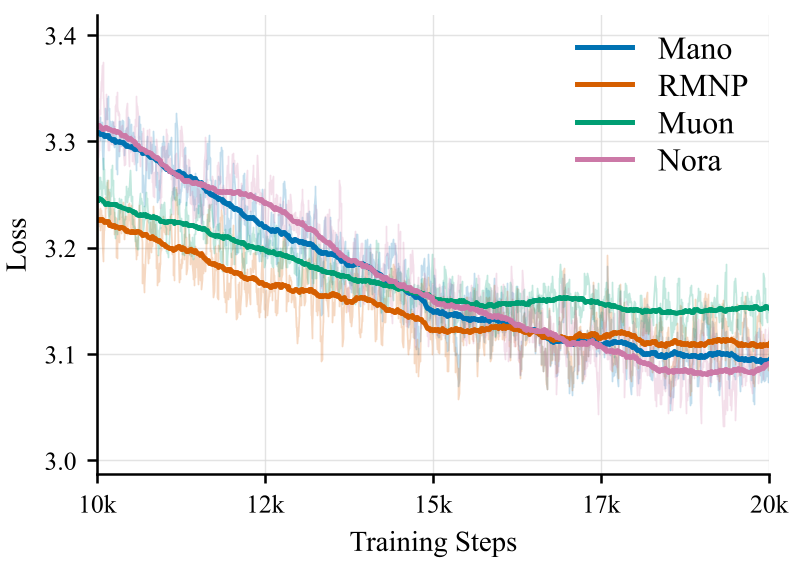 Figure: Training dynamics on 135M model. Nora (dark blue) demonstrates superior late-stage convergence.
Scaling Laws and µP Compatibility
A major contribution of this work is the proof that Nora is compatible with Maximal Update Parametrization (µP). The authors proved that to keep hidden activations stable as width grows, the Nora learning rate should scale as: This provides a principled way to transfer hyperparameters from small proxy models to massive LLMs.
Critical Analysis & Conclusion
Nora is a "plug-and-play" replacement for Adam/Muon that requires only two lines of code change. Its primary strength lies in its geometric purity—it acknowledges that LLM weights live on a manifold where only angular movement matters.
Limitations: While the paper focuses on the row-diagonal dominance of Transformers, its performance on other architectures (like CNNs or Graph Nets) remains to be proven, as their Hessian structures may differ.
Future Work: The success of Nora suggests that "manifold-aware" optimization is the future of LLM scaling. Expect to see Nora-like logic integrated into mainstream training frameworks like Megatron-LM or DeepSpeed in the near future.