
Normalizing Trajectory Models: Bridging Normalizing Flows and Diffusion for 4-Step Generation
Normalizing Trajectory Models
The paper introduces Normalizing Trajectory Models (NTM), a generative framework that models each reverse step of a diffusion trajectory as an expressive conditional normalizing flow. By replacing the traditional Gaussian assumption with an invertible transporter and a Gaussian predictor, NTM achieves state-of-the-art results in high-fidelity text-to-image generation using only 4 sampling steps.
TL;DR
Researchers from Apple and UIUC have unveiled Normalizing Trajectory Models (NTM), a new generative paradigm that breaks the "Gaussian Bottleneck" of traditional diffusion models. By modeling the reverse denoising steps as conditional normalizing flows, NTM enables high-quality image generation in just 4 steps while maintaining exact likelihood—a feat previously thought to require hundreds of steps or unstable adversarial training.
The Problem: The Gaussian Bottleneck
In standard diffusion models (like DDPM or Stable Diffusion), we assume that each small step backwards from noise to data follows a Gaussian distribution. This assumption holds up well when you take 1000 tiny steps. However, if you try to generate an image in only 4 steps, each step covers a massive "distance" in the data manifold.
At this coarse resolution, the true distribution is no longer a simple Gaussian "bell curve"—it's a complex, multimodal mess. Forcing it into a Gaussian mold results in the blurry, low-quality images typically seen in few-step traditional diffusion.
Methodology: The Transporter-Predictor Architecture
NTM solves this by learning a latent space where the distribution actually is Gaussian. It uses two key components:
- The Transporter (Shallow & Invertible): A series of lightweight, autoregressive layers that warp the data space. It acts as a "spatial translator" that simplifies the complex image manifold.
- The Predictor (Deep & Parallel): A heavy-duty Transformer that works in the simplified latent space to predict the next step's mean and variance.
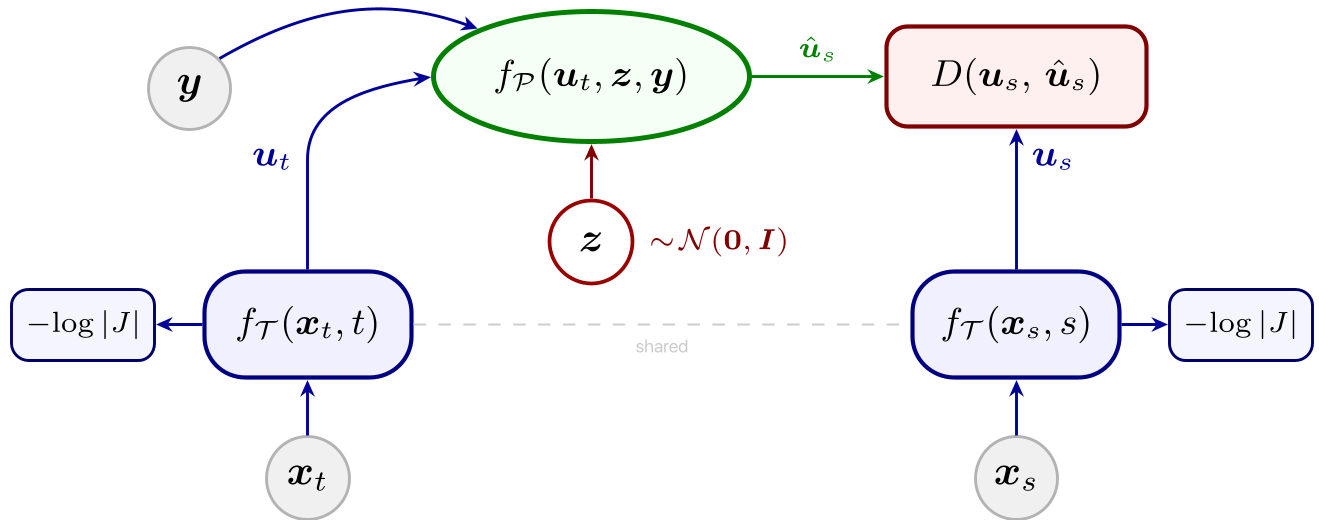
The beauty of this approach is mathematical: because the transporter is invertible and same-dimensional, the authors can use the change-of-variables formula to calculate exact log-likelihoods. This means the model can be trained with the same stability as a standard language model or a traditional Normalizing Flow.
Key Innovation: Trajectory Score Denoising
Unlike other few-step models that treat each image in a vacuum, NTM treats the entire trajectory (all 4 steps) as a single correlated sequence. By calculating the gradient of the trajectory likelihood, the model can perform "Trajectory Denoising." This allowed the researchers to distill the denoising signal into a Learned Denoiser, a lightweight network that produces the final image in a single forward pass, bypassing the expensive sequential decoding of traditional flows.
Experiments and Results
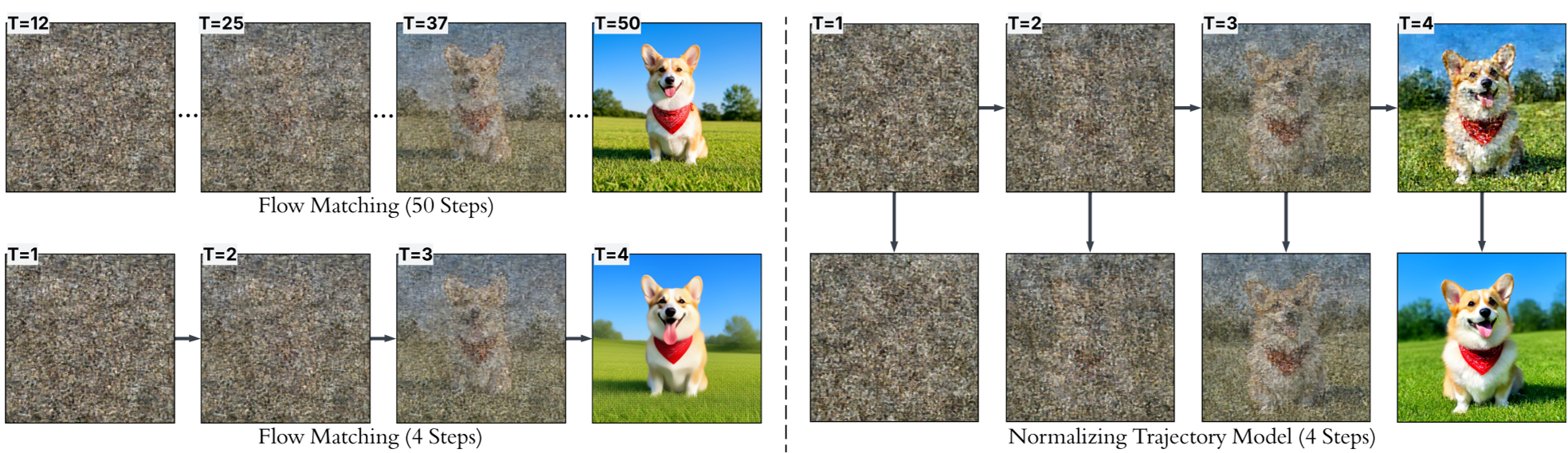
The results are striking. NTM was tested in two modes: "From Scratch" and "Finetuning."
- From Scratch: On the GenEval benchmark (which measures how well a model follows instructions like "a red ball to the left of a blue cube"), NTM scored 0.82 in 4 steps. For comparison, the previous state-of-the-art flow model, STARFlow, only scored 0.56 despite taking 256 steps.
- Finetuning: NTM was used to "supercharge" the FLUX.1 model. It achieved comparable visual fidelity to the 50-step FLUX.1 baseline in just 4 steps, offering a massive inference speedup.
Critical Analysis & Conclusion
While NTM is a breakthrough, the authors honestly admit its limits: it currently fails to produce high-quality images in a single step (T=1). This is due to the "transporter capacity" problem—a single step puts too much pressure on the shallow transporter layers to model the entire complexity of natural images.
Takeaway: NTM represents a "sweet spot" in the generative landscape. It distributes the modeling difficulty across a few steps (4–8), making it far more efficient than traditional diffusion and far more expressive than prior normalizing flows.
The future of efficient AI generation isn't just about taking fewer steps—it's about making those few steps smarter. NTM proves that with the right mathematical framework, 4 steps are all you need.