
Stability at the Singularity: A Log-Space Fix for Binary Orbital Evolution
Numerically stable equations for the orbital evolution of compact object binaries
The paper presents a numerically stable rewrite of the classic Peters (1964) equations for the orbital evolution of compact object binaries. By transforming the equations into logarithmic space (ln-space) and using separation as the independent variable, the authors eliminate singularities at the point of merger (a=0) and eccentricity limits (e=0), achieving 60-70% faster computation.
TL;DR
Calculating how two black holes or neutron stars spiral toward each other due to gravitational waves is a cornerstone of modern astrophysics. However, the standard equations used since the 1960s (the Peters Equations) contain mathematical singularities—they "explode" as the objects get close to merging. This paper introduces a ln-space transformation that tames these singularities, making simulations 60-70% faster and infinitely more robust against numerical crashes.
The Problem: The Singularity Bottleneck
In 1964, P.C. Peters derived the equations describing how gravitational wave emission drains energy and angular momentum from a binary system, causing the orbital separation () and eccentricity () to shrink.
The classic equations look like this:

The issue is the and terms. As the binary reaches the final stages of its life (merger), approaches zero, and the derivatives skyrocket toward infinity. Standard numerical integrators (like Runge-Kutta) struggle with these steep gradients. They either take infinitely small steps, slowing to a crawl, or they "overstep" into negative (non-physical) separations and crash.
For researchers running Binary Population Synthesis, where millions of star systems are simulated, these "crashes" are more than a nuisance—they are a significant computational bottleneck.
The Solution: Logarithmic Reparameterization
The authors propose a clever change of variables to "flatten" the mathematical landscape.
1. Nondimensionalization
First, they scale the equations using an initial separation and a characteristic time . This allows the solver to treat a pair of white dwarfs and a pair of supermassive black holes with the same mathematical ease, regardless of the physical units.
2. The Log-Space Flip
The real magic happens with two substitutions:
- : Instead of tracking separation, we track the logarithm of the separation.
- : This ensures eccentricity remains positive and handles small values gracefully.
3. Separation as the "Clock"
In standard physics, we ask: "What is the state at time ?" The authors flip this: "What is the time () and eccentricity () at separation ?" By making the log-separation () the independent variable, the solver naturally spends more "effort" (resolution) as the objects get closer together.
The Transformed "Stable" Equations:
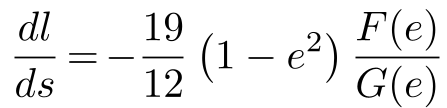
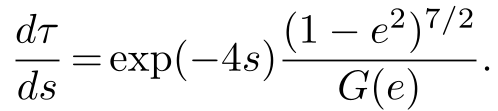
Notice that the terms are gone, replaced by an exponential decay , which is much better behaved for numerical solvers.
Experimental Results: Faster and Fail-Proof
The authors tested this new formulation against the classic equations using standard Python libraries (scipy.integrate.solve_ivp).
- Convergence: The original equations often failed to converge or threw warnings when nearing the merger. The new ln-space equations converged every time.
- Efficiency: Because the mathematical landscape is smoother, the integrator requires 60% to 70% fewer function evaluations. In a field where you might be simulating millions of systems, this is a massive win for green computing and researcher productivity.
- Scale Invariance: The method successfully evolved systems across eight orders of magnitude (from orbital distances of AU down to km) without losing precision.
Theoretical Insight: Why It Works
The "why" is rooted in Numerical Manifold Dynamics. By switching to a logarithmic scale, we are effectively performing a coordinate transformation that linearizes the growth of the error. In the original space, the error grows polynomially/exponentially as . In the transformed -space, the system's evolution becomes much more "uniform" from the perspective of the integrator's step-size logic.
Conclusion & Future Work
While this paper focuses on the lowest-order (Newtonian) gravitational wave emission, the authors note that the same "log-trick" could likely be applied to higher-order Post-Newtonian (PN) approximations.
This methodology has already been integrated into POSYDON, a popular open-source code for binary star evolution. For the broader community, it serves as a reminder that sometimes the best way to solve a "hard" physics problem isn't to change the physics, but to change the language (coordinates) in which the physics is written.
Key Takeaway: Don't integrate through a singularity if you can transform it away.