
OA-WAM: Solving the Identity Crisis in Robot World Models
OA-WAM: Object-Addressable World Action Model for Robust Robot Manipulation
OA-WAM (Object-Addressable World Action Model) is a Vision-Language-Action (VLA) policy that decomposes scenes into discrete object slots to achieve robust robot manipulation. It achieves SOTA results on LIBERO (97.8%) and SimplerEnv (79.3%) by representing the world as addressable object states rather than holistic image tokens.
TL;DR
Robot manipulation often fails when the background changes or the camera moves, even if the target object is still clearly visible. OA-WAM (Object-Addressable World Action Model) fixes this by forcing the robot’s "brain" to look at objects through stable, individual "addresses." By decoupling object identity from visual appearance at the tensor level, OA-WAM achieves SOTA robustness on geometric perturbations, effectively proving that robots need an object-centric table of contents to act reliably in the real world.
The "Holistic" Trap in Robotics
Modern Vision-Language-Action (VLA) models typically treat an image as a sequence of patches. While effective for simple tasks, this holistic representation is fragile. If you move the camera or add a distractor, the "patch" that previously represented a red mug might now represent a piece of the table. The policy "drifts" because it cannot separate the mug’s identity from its surrounding context.
The authors of OA-WAM identify this as a lack of Object Addressability. In current SOTA models like π0.5 or OpenVLA, finding the target object is an implicit learning problem rather than a structural guarantee.
Methodology: High-Level Architecture
OA-WAM uses a Chameleon-7B multimodal trunk but modifies it to be Slot-Aware. The pipeline works as follows:
- Decomposition: Using SAM 3 and DINOv3, the scene is broken into slots (1 robot, objects).
- Addressing vs. Content: Each slot vector is split into a frozen address ()—derived from the language label—and a dynamic content () representing pose and state.
- The Key Mask: In the transformer, the "Keys" used for attention are restricted to the address dimension only.
- The Reset Hook: At every one of the 32 layers, the model explicitly resets the identity subvector to prevent "identity leakage."
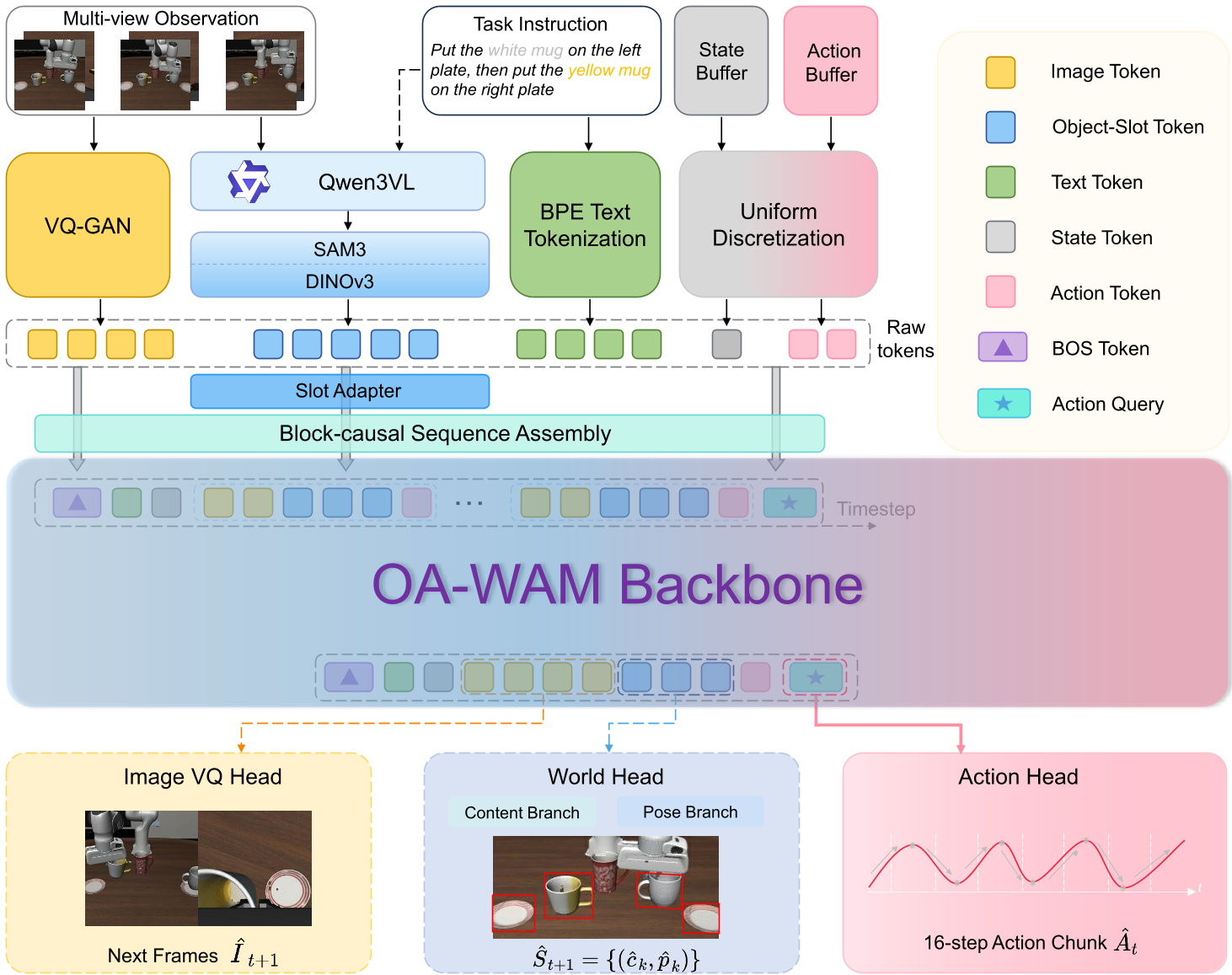
Figure: The OA-WAM architecture uses a block-causal sequence where a specialized world head predicts future object states while the action head decodes movement.
Why it Works: The Physics of Attention
By making the Key projection dependent only on the frozen , the model creates a permanent routing table. Even if the content of a slot changes (e.g., the mug is upside down or in a shadow), the "address" remains the same. This forces the action head to maintain a stable causal link to the correct object regardless of visual noise.
Results: Dominating the Robustness Leaderboard
OA-WAM was tested against the LIBERO-Plus benchmark, which specifically stresses models with camera shifts, lighting changes, and new layouts.
- Geometric Excellence: On the "Camera" axis, OA-WAM scored 80.5%, significantly higher than π0.5 (75.4%) and Cosmos-Policy (75.8%).
- Verifiable Binding: In a "Causal Slot Intervention" test—where the researchers manually swapped object addresses at inference—OA-WAM followed the swap with 0.87 cosine similarity, whereas holistic models ignored the swap (≤ 0.09). This confirms the robot is actually "looking" at the slot it was told to.
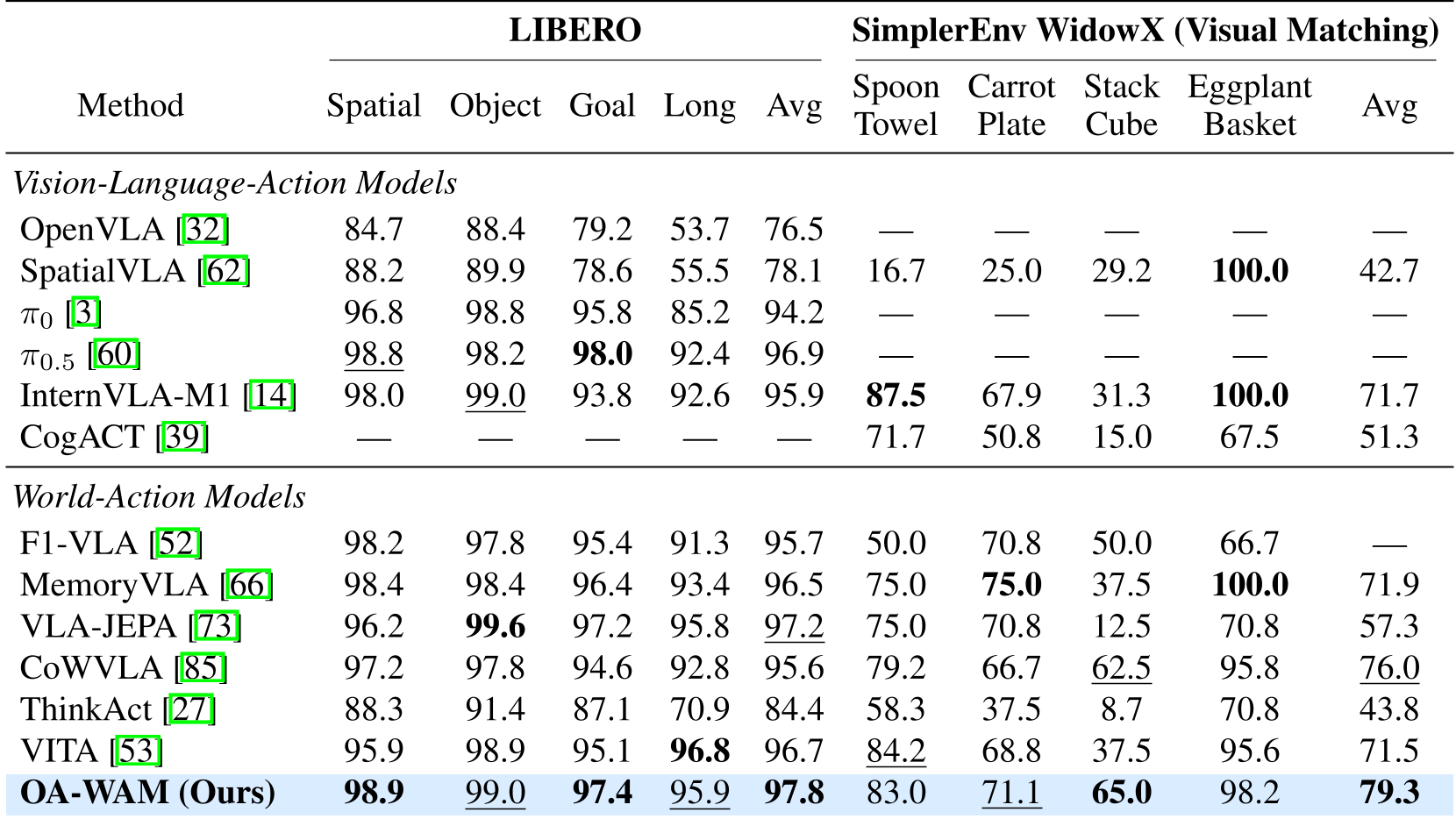
Table: Comparison across LIBERO and SimplerEnv benchmarks shows OA-WAM consistently matching or exceeding current SOTA performance.
Critical Insight: Inductive Bias vs. Brute Force
The beauty of OA-WAM is that its robustness is an architectural property, not just a result of more data. The "Ablation Study" (V0 vs V1 vs V2) showed that turning off the address-only key projection caused a massive drop in performance under camera shifts, despite keeping the same perception stack. This serves as a strong argument for returning to object-centric inductive biases in the era of foundation models.
Conclusion and Limitations
OA-WAM proves that organizing a world model as addressable object states is a viable path to robust manipulation.
Limitations to watch:
- The model relies on a frozen perception stack (SAM 3 / DINOv3). If the perception fails to "see" the object initially (due to reflections or occlusion), the policy cannot recover.
- The inference latency is currently ~233ms per chunk, which might be tight for high-speed dynamic tasks but is sufficient for general manipulation.
For researchers, this work opens a new door: How can we learn these addresses dynamically while maintaining the stability of frozen ones?