
OGPO: Unlocking Sample-Efficient Full Finetuning for Generative Robot Policies
OGPO: Sample Efficient Full-Finetuning of Generative Control Policies
This paper introduces Off-policy Generative Policy Optimization (OGPO), a sample-efficient algorithm for finetuning Generative Control Policies (GCPs) like diffusion and flow models. By decoupling expensive environment transitions from cheap computational denoising steps and utilizing off-policy critics, OGPO achieves SOTA performance on complex manipulation tasks with order-of-magnitude improvements in sample efficiency compared to on-policy methods.
TL;DR
Generative Control Policies (GCPs) like diffusion or flow-matching are the new standard for robot learning, but finetuning them autonomously is either too slow (on-policy) or too limited (residual/steering). OGPO (Off-policy Generative Policy Optimization) bridges this gap. It treats the internal denoising process of a GCP as a computational "imagination" that can be optimized using off-policy critics. The result: full-policy finetuning that is 10x more sample-efficient than prior benchmarks and works even with poor initial data.
The "Expressivity vs. Efficiency" Paradox
Modern robot learning relies on GCPs because they can represent complex, multimodal action distributions. However, when we try to improve these models through trial and error (Reinforcement Learning), we hit a wall:
- On-Policy Methods (e.g., DPPO): They are stable but "expensive" because they require fresh data from the physical robot for every update.
- Partial Updates (e.g., Steering/Residuals): They are fast because they reuse old data, but they can't discover entirely new behaviors because they only "tweak" the existing policy rather than changing its fundamental logic.
The authors of OGPO identify that the generative process is actually a "inner MDP" happening entirely inside the computer. Why not use a "terminal reward" from a learned critic to optimize this internal chain without needing the robot to move?
Methodology: Severing the Bi-level MDP
OGPO builds on the idea of a Bi-level MDP. In this view, there is an "Outer MDP" (the robot moving in the world) and an "Inner MDP" (the solver denoising noise into an action).
The core innovation of OGPO is Off-policy Policy Extraction. It uses Temporal Difference (TD) learning to train a Q-function ensemble on expensive environment samples. Then, it uses a zero-order PPO optimizer to update the policy by "imagining" trajectories in the Inner MDP.
 Figure 1: The OGPO framework severs the bi-level MDP. It uses Q-values as rewards at the end of the denoising chain, allowing the policy to learn from its "imagined" actions.
Why Zeroth-Order (PPO) instead of Backprop?
While one could theoretically backpropagate through the flow/diffusion chain (Backpropagation Through Time), the paper shows this often fails due to exploding gradients and the non-smoothness of contact-rich tasks. OGPO uses a GRPO-style Parallel Sampling approach:
- Pick a state from the buffer.
- Generate 32 parallel "imagined" action trajectories.
- Score them with the critic.
- Update the policy to favor the high-scoring "imaginations" using a clipped PPO loss.
Experimental Results: SOTA Efficiency
The researchers tested OGPO across high-precision tasks (Robomimic), multi-task settings (Franka Kitchen), and dexterous manipulation (Adroit Hand).
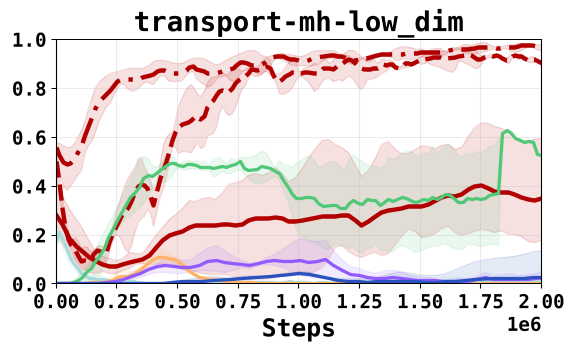 Figure 2: Performance on Square, Tool Hang, and Transport. OGPO (Blue/Orange) significantly outperforms Steering (DSRL) and Residual (EXPO) baselines in both final success and speed of learning.
Key Findings:
- Sample Efficiency: OGPO reaches near 100% success on Robomimic 10x faster than the previous on-policy SOTA (DPPO).
- Manifold Expansion: Unlike steering methods that stay within the "pre-trained" noise distribution, OGPO allows the policy to discover entirely new modes of action.
- Zero Expert Data: Surprisingly, OGPO+ can finetune poorly initialized policies to mastery without needing expert demonstrations in the online replay buffer.
Mitigating Critical Challenges
Finetuning expressive models risks "over-exploiting" a critic that isn't perfect yet. To handle this, the authors introduced:
- Conservative Advantages (OGPO+CA): Only updating the policy when the ensemble of critics agrees on an action's value.
- Success Buffer: Regularizing the policy to stay close to actions that have actually succeeded in the real world.
- Regularization: Used specifically for pixel-based (visual) RL to prevent the policy from drifting into "hallucinated" high-reward zones.
Conclusion & Insight
OGPO represents a paradigm shift in how we think about finetuning foundation models for robotics. By treating the generative solver as a differentiable (or in this case, optimizable) computation graph that can be trained against an off-policy value function, it provides a blueprint for robots that can start with high-level "hints" from imitation learning and autonomously practice until they achieve precision mastery.
The primary limitation remains the computational overhead of parallel sampling during training, but given that environment interaction is usually the bottleneck in robotics, this "compute-for-samples" trade-off is almost always worth it.