
Omni-Fake: Mastering Multimodal Deepfake Forensics via Curriculum RL
Omni-Fake: Benchmarking Unified Multimodal Social Media Deepfake Detection
This paper introduces Omni-Fake, the first unified multimodal deepfake benchmark for social media covering four modalities (Image, Audio, Video, and AV-Talking Head). The authors propose Omni-Fake-R1, an RL-driven detector based on Qwen2.5-Omni, achieving SOTA performance in joint detection, localization, and natural language explanation.
TL;DR
The proliferation of generative AI (Sora, Flux, Kling) has made social media a battlefield for authenticity. Omni-Fake emerges as a massive new benchmark with 1M+ samples across four modalities. Its counterpart, Omni-Fake-R1, leverages a sophisticated curriculum reinforcement learning strategy to not just flag fakes, but locate tampered pixels/frames and provide human-readable rationales, setting a new SOTA for real-world forensics.
The Gap: Why Current Detectors Fail in the Wild
Traditional deepfake detection is "fragmented." We have great image detectors and decent audio sniffers, but they operate in silos.
- The "Social Media" Problem: Real-world content isn't just a raw output from a GAN; it's compressed, resized, and often mixes real and synthetic elements (partial manipulation).
- The "Black Box" Problem: Knowing a video is 90% likely fake isn't enough for a moderator. They need to know where and why.
- The OOD Challenge: Models trained on StyleGAN2 fail miserably when faced with the latest Diffusion or Autoregressive models (OOD samples).
Methodology: Building the "Omni" Detector
The authors propose Omni-Fake-R1, built on the Qwen2.5-Omni-7B backbone. Its training isn't a simple fine-tuning spree; it's a strategic evolution.
1. Curriculum SFT with Modal Replay
To handle four modalities without "catastrophic forgetting," the authors use an incremental schedule: Audio → Image → Video → AV-Talking Head. By mixing new data with a 15% replay of previous modalities, the model preserves earlier skills while gaining new ones.
2. Unified GSPO Reinforcement Learning
Likelihood training (SFT) is insufficient for accuracy and format. The authors switch to Group Sequence Policy Optimization (GSPO). They designed a scalar reward function that combines:
- Format Reward: Did the model use the
<think>and<answer>tags correctly? - Detection Reward: Is the ternary classification (Real/Tampered/Synthetic) correct?
- Localization Reward: How close is the predicted bounding box (spatial) or time interval (temporal) to the ground truth (IoU)?
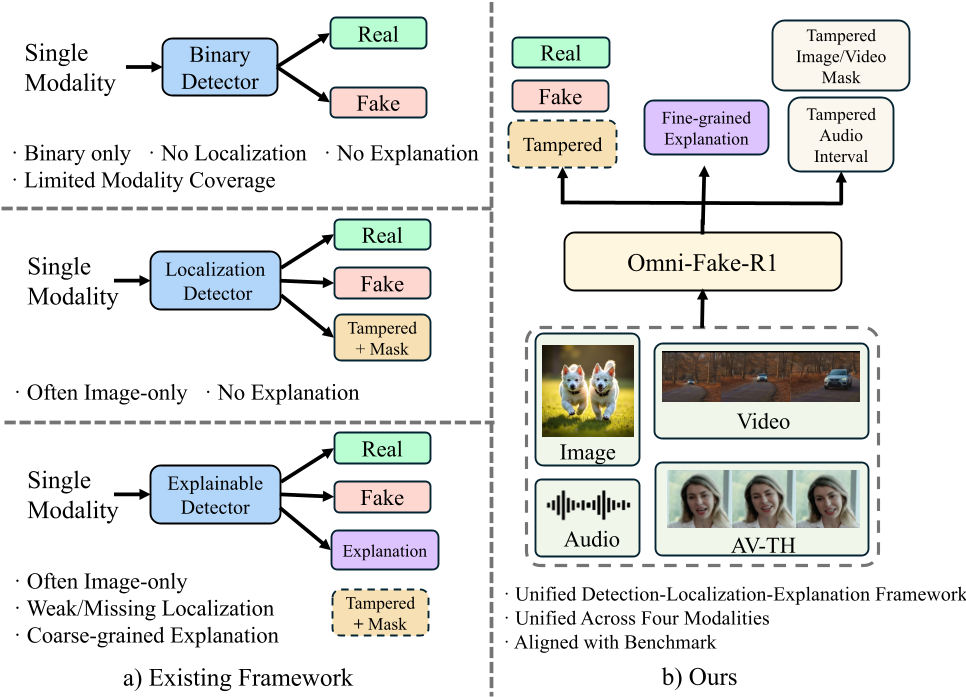 Figure 1: Comparison between fragmented non-Omni methods and the unified Omni-Fake-R1 architecture.
Experiments: Proving Robustness
The model was tested against top-tier baselines (CnnSpot, LipForensics, DeMamba).
- Superior Accuracy: Reached 96.18% Acc on AV-Talking Heads.
- OOD Generalization: On the Omni-Fake-OOD split (entirely disjoint generators), Omni-Fake-R1 outperformed specialized detectors by significant margins (e.g., +10-20% in multi-class F1).
- Explainability: Using ROUGE-L and Semantic Similarity (CSS), the model was found to generate rationales that experts judged as factually correct and useful for non-experts.
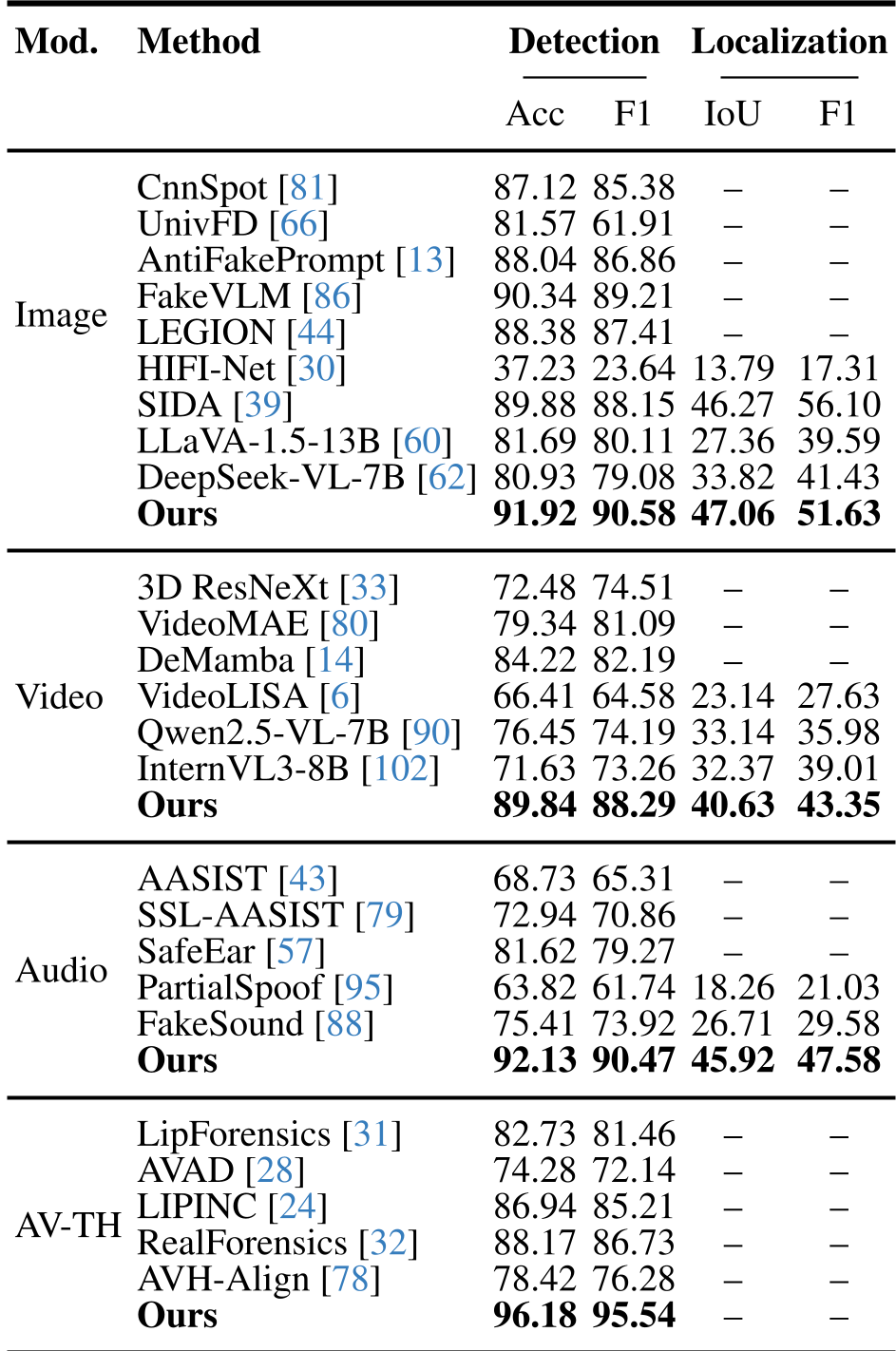 Table: Performance comparison across four modalities showing Omni-Fake-R1's dominance.
Critical Analysis & Conclusion
The core breakthrough of Omni-Fake is the shift from binary labels to structured reasoning. By forcing the model to "think" before answering, it relies on semantic inconsistencies (e.g., mouth shape not matching a phoneme) rather than just low-level signal artifacts that can be wiped away by JPEG compression.
Limitations
While comprehensive, the benchmark currently lacks:
- 3D Avatars: Emerging VR/AR manipulation.
- Extreme Multilingualism: Forensic patterns might shift across diverse dialects.
Future Outlook
Omni-Fake sets the stage for "Autonomous Forensic Agents." In the future, we expect these models to be integrated directly into social platforms, providing real-time, explainable authenticity scores for every piece of uploaded media.
Takeaway: If you are working on AI safety or digital forensics, Omni-Fake is the new gold standard for benchmarking and multi-modal alignment.