
OmniEncoder: Bridging the "Frame-Rate Gap" for Human-Like Continuous Perception
OmniEncoder: See, Hear, and Feel Continuous Motion Like Humans With One Encoder
Omni-Encoder is a unified Transformer-based backbone designed to co-embed visual and audio signals at a symmetrical 25 fps within a shared latent space. It achieves state-of-the-art results on continuous motion tasks like sign language recognition (90.32% on NationalCSL) and sports analysis, outperforming traditional modality-specific architectures.
TL;DR
Current AI "sees" the world like a stuttering slideshow (1-2 fps) while "hearing" it in high fidelity (25 fps). Alibaba's Omni-Encoder breaks this bottleneck by processing sight and sound symmetrically at 25 fps within a single Transformer backbone. By introducing Visual Continuous (VC) tokens, it captures micro-expressions and rapid gestures that traditional models miss, setting new SOTA records in sign language and sports analysis.
The Problem: The Mismatched Sensory Gap
In the rush to build Omni-modal LLMs, researchers have relied on "Technological Inertia." Most models (like Gemini or Qwen2-Audio) use a modular design: a slow visual encoder and a fast audio encoder.
- Visual: 1-2 frames per second (Coarse).
- Audio: 25-50 samples per second (Dense).
This creates a "blind spot" for continuous motion. If a gesture happens in 100 milliseconds, a 1 fps model misses it entirely. Furthermore, humans don't process sight and sound in isolation; our central nervous system integrates these signals at the earliest stages. Existing architectures fuse them only at the very end, leading to poor cross-modal reasoning.
Methodology: The Three Pillars of Omni-Encoding
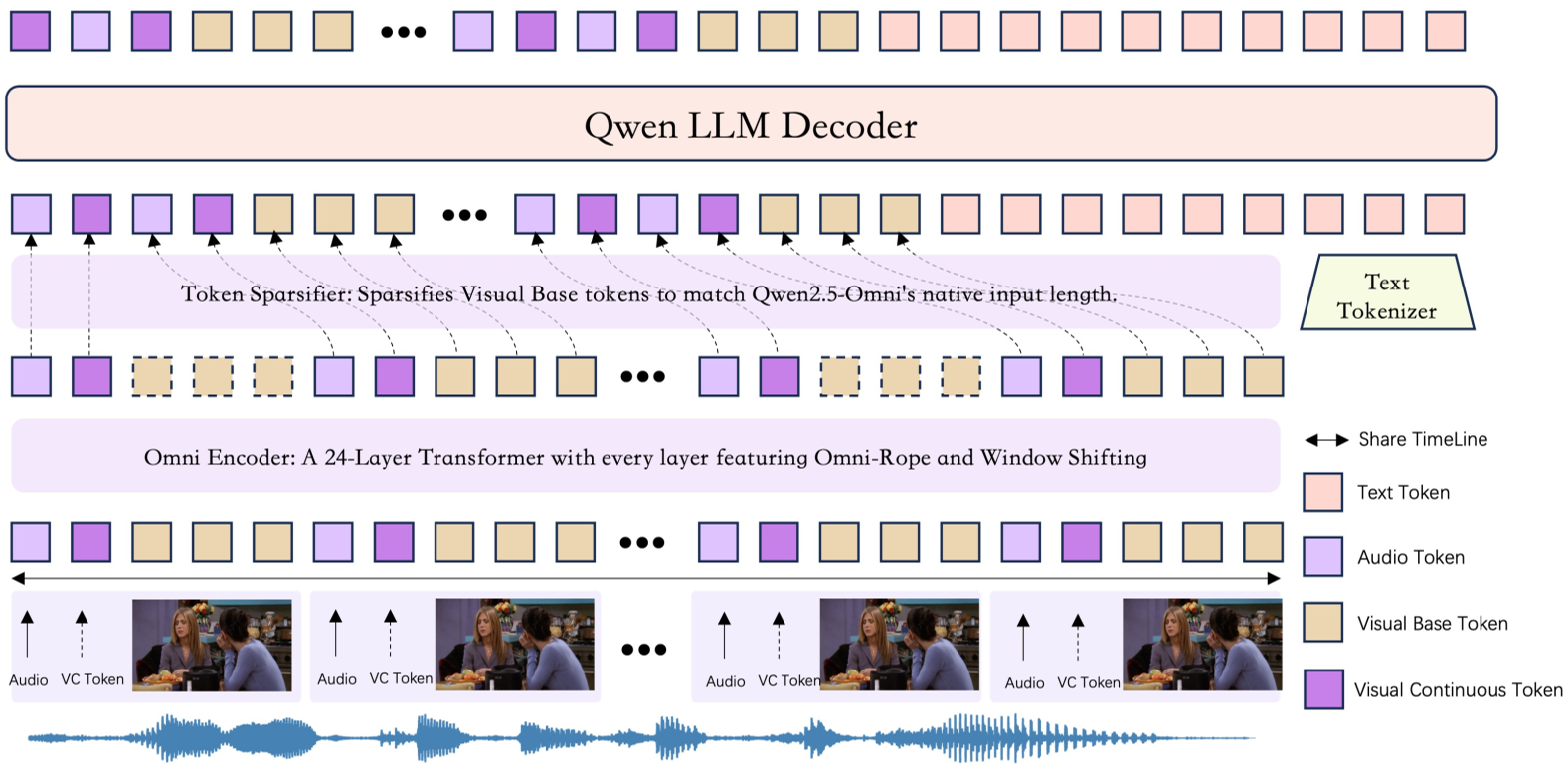
Omni-Encoder acts as a 24-layer Transformer "nervous system" that treats all inputs as equal citizens in a 25 fps stream.
1. The Token Template (VC vs. VB)
Instead of just flat image patches, the authors decompose video into:
- Visual Base (VB): Static features (textures, objects).
- Visual Continuous (VC): Frame-wise learnable queries that specifically track motion trajectories and micro-movements.
- Audio (A): Aligned waveforms.
2. Omni-RoPE: 3D Coordinate Awareness
How do you tell the difference between a sound and a pixel in a unified sequence? Omni-RoPE assigns a 3D coordinate to every token. By "shifting" the spatial coordinates of visual tokens, they leave a dedicated "origin" space for Audio and VC tokens, allowing the attention mechanism to distinguish modalities without separate heads.
3. Temporal Window Shifting
Processing 25 fps video with standard attention is computationally suicidal. The authors use a Temporal Window Shifting mechanism. By alternating between local windows and shifted windows (similar to Swin Transformers but in the temporal domain), complexity becomes linear (), making high-frequency video feasible.
Experiments: Why 25 FPS Matters
The results on "High-Density" tasks are transformative. In NationalCSL (Sign Language Recognition), Omni-Encoder achieved 90.32%, whereas previous specialists were stuck at 69.61%.
| Task | Gemini-2.5-Pro | Qwen2.5-Omni (Baseline) | Omni-Encoder |
|---|---|---|---|
| Diving48 (Action) | 4.94% | 25.7% | 90.8% |
| SLR500 (Sign Lang) | 1.2% | 37.3% | 97.8% |
Even more impressively, the Token Sparsifier ensures that while the encoder works at 25 fps, only the most important tokens are passed to the LLM decoder. This means Omni-Encoder gets the benefit of high-speed vision without overloading the language model's context window.

Critical Insight & Conclusion
The success of Omni-Encoder proves that high temporal resolution is more important than high spatial resolution for understanding human behavior. By treating motion as a first-class citizen (VC tokens) and unifying it with audio at the same frequency, we move closer to "Biological Plausibility" in AI.
Takeaway: The "Modular Era" of separate encoders is ending. The future belongs to unified, high-frequency backbones that "feel" the flow of time as a single, continuous stream.