
Oort Cloud Ecology: How Star Clusters Shuffle Our Cosmic Deck
Oort Cloud Ecology - IV. Exchanging Asteroids
This study investigates the exchange of asteroids and planets within star clusters using the Nemesis hybrid N-body integrator. By comparing sub-virial fractal clusters with virialised Plummer models, the authors demonstrate that initial cluster substructure significantly enhances the capture and excitation of minor bodies, producing Sednoid-like objects and "rogue" planets.
Executive Summary
TL;DR: New numerical simulations reveal that the Sun's "lost siblings" did more than just drift away—they likely swapped asteroids and planets with us. This research shows that if the Sun was born in a "clumpy," sub-virial fractal cluster (like NGC 1333), the resulting dynamical chaos would naturally produce the strange, highly-inclined orbits of objects like Sedna. However, the study throws cold water on the theory that the Oort Cloud is mostly "stolen" material, suggesting such a scenario would require an impossibly massive initial disk.
Background: This work sits at the intersection of Galactic Dynamics and Planetary Science, acting as a "forensic" reconstruction of the Solar System's birth environment. It moves beyond simple "density" arguments to show that the texture of the birth cluster matters most.
The Problem: The "Boring" Sun vs. The "Wild" Minor Bodies
While the major planets in our Solar System sit on nice, circular, co-planar orbits, our distant minor bodies—the Sednoids and Extreme Trans-Neptunian Objects (eTNOs)—are a mess. They have extreme eccentricities and high inclinations that "pristine" formation models can't explain.
Previous research often used Plummer models (smooth, sphere-like clusters) to simulate the Sun's birth. But real star-forming regions are messy, fractal, and "dynamically cold" (sub-virial), meaning they collapse and interact violently in their first few million years. This paper asks: Does this early chaos leave a readable "fingerprint" on the debris disks of stars?
Methodology: The Nemesis Hybrid Approach
Simulating a star cluster with planets is a computational nightmare. You need to track the tiny orbits of planets (days) and the massive orbits of stars (millions of years) simultaneously.
The authors use Nemesis, a hybrid tool that treats planetary systems as "children" and the cluster as a "parent."
- Local Scale: Uses the Huayno symplectic integrator to keep planetary orbits stable and energy-accurate.
- Global Scale: Uses the Ph4 Hermite integrator to handle the N-body interactions of the stars.
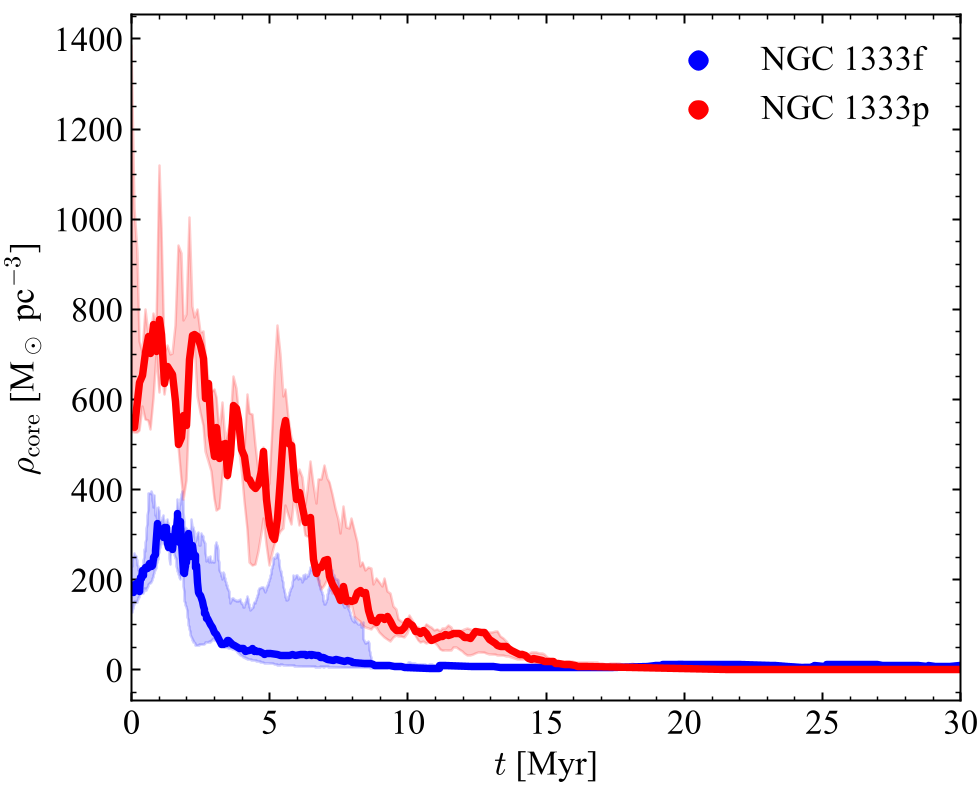 Fig 1: The core density evolution. Note how the Fractal model (blue) undergoes a "collapse and expansion" phase that the Plummer model (red) lacks.
Key Insights: Fractal Chaos Wins
The study compared two clusters: NGC 1333f (Fractal/Sub-virial) and NGC 1333p (Plummer/Virialised).
1. The Capture Economy
In the fractal cluster, stars "swap" material constantly. Massive stars (O/B types) are the biggest thieves, capturing the most asteroids and planets. Interestingly, captured planets are almost always "dynamically hot"—they end up with huge inclinations and eccentricities. If we ever find a planet like HD 106906b (very wide, tilted orbit), there is a ~36% chance it was stolen from another star.
2. Sednoids as Evidence
The research found that Sednoid-like objects are easily produced in fractal clusters. In the smooth Plummer models, these regions of space remained mostly empty. This suggests our own Solar System's weird outer edges are direct evidence that we weren't born in a smooth, boring cluster.
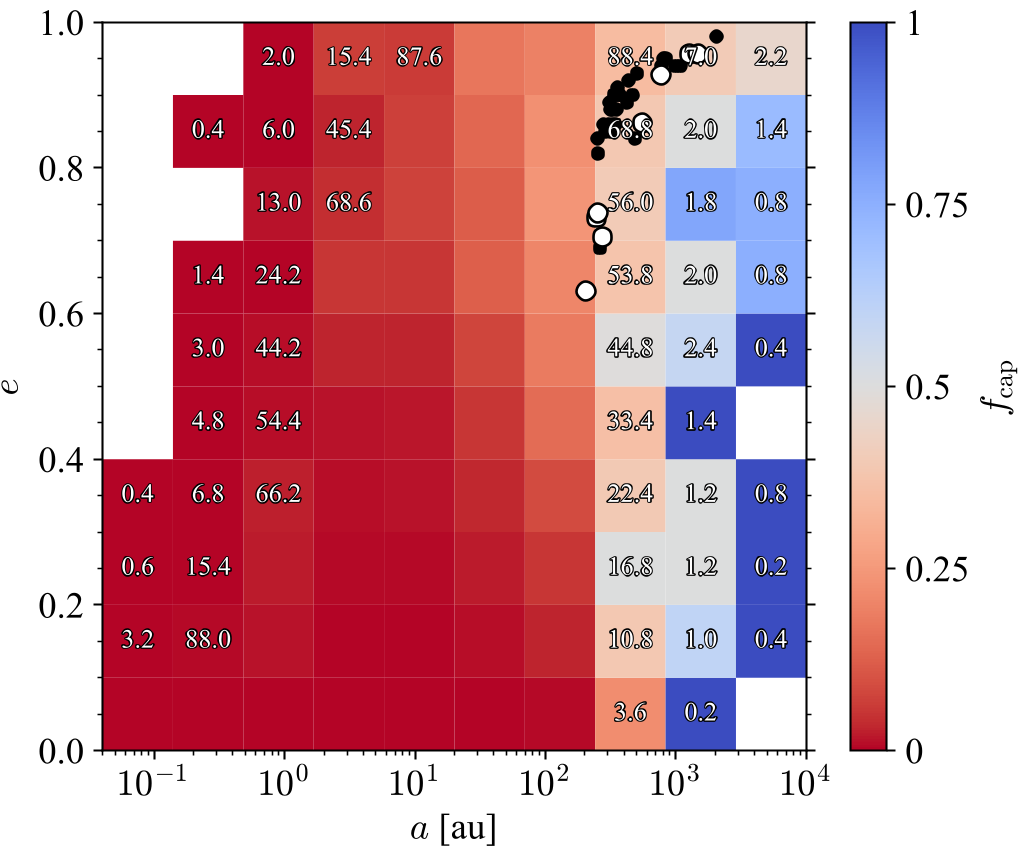 Fig 2: Heatmaps of orbital parameters. The right column (Fractal) shows a much richer population of "Captured" (colored) asteroids in high-inclination and high-eccentricity zones compared to the Plummer model (left).
3. The Oort Cloud Reality Check
A popular theory suggests >90% of our Oort Cloud was captured from other stars. This paper challenges that. The authors calculated that to build our current Oort Cloud via capture in these environments, the Sun's original debris disk would have to be 8 times more massive than any protoplanetary disk we've ever observed.
Critical Analysis & Conclusion
The Takeaway: High-density isn't the only way to stir up a planetary system; local substructure is a much more efficient "spoon." This means that measuring the orbital tilt of distant asteroids can actually tell us if the Sun's birth cluster was "clumpy" or "smooth."
Limitations: The study ignores gas dynamics and physical collisions. Gas would likely "dampen" some of this excitement, making the orbits slightly more circular than shown here. Furthermore, the simulation used 150 stars, while the Sun likely lived in a much larger "metropolis" of 2,000+ siblings.
Future Outlook: With the LSST (Legacy Survey of Space and Time) about to map 70% of our asteroid belt, we are on the verge of finding thousands of these "dynamical fossils." This paper provides the map to decode them.
Final Thought: We might not just be looking at our own history when we study the outer Solar System; we might be looking at specimens from a dozen different stars that have been long lost to the galaxy.