
OpenSearch-VL: Open-Sourcing the Recipe for Frontier Multimodal Search Agents
OpenSearch-VL: An Open Recipe for Frontier Multimodal Search Agents
OpenSearch-VL is a fully open-source recipe for training frontier multimodal deep search agents, utilizing a specialized data curation pipeline and agentic Reinforcement Learning (RL). By integrating a diverse toolset—including web search and visual enhancement tools like super-resolution—and a novel fatal-aware GRPO algorithm, it achieves SOTA performance, improving average scores by over 10 points across seven benchmarks.
TL;DR
OpenSearch-VL is a comprehensive, open-source framework designed to bridge the gap between proprietary frontier models and open research in multimodal search agents. By combining a Wikipedia-driven multi-hop data pipeline, a toolbox for active visual perception (like deblurring and cropping), and a "fatal-aware" RL algorithm, this work transforms MLLMs from passive observers into active, self-correcting investigators that can outperform commercial models on complex search benchmarks.
Positioning: This is a foundational "recipe" paper that provides the community with the data pipelines, training algorithms, and tool environments necessary to reproduce and advance the state-of-the-art in multimodal agentic reasoning.
The Bottleneck: Why "Search" is Not Enough
Current multimodal agents face two major hurdles. First, they are "allergic" to low-quality images. If a user provides a blurred photo or a skewed document, standard agents try to search for the content directly and fail. Second, training these agents using Reinforcement Learning (RL) is notoriously unstable. In a multi-turn interaction, if an agent makes a mistake at Step 5, the subsequent Steps 6-10 are usually garbage (a "fatal" state). Standard RL either keeps all tokens (injecting noise) or throws the whole attempt away (wasting the good reasoning in Steps 1-4).
Methodology: Active Perception and Fatal-Aware Learning
1. Hardening the Data: Wikipedia Path Sampling
To ensure the agent actually learns to reason rather than just lookup, the authors developed a pipeline that samples paths on the Wikipedia hyperlink graph. By rewriting intermediate entities into "fuzzy" descriptions and anchoring images far from the answer, they force the agent to traverse multiple steps of logic.
2. The Toolset: Fixing Perception Before Retrieval
Unlike traditional agents that only have a search bar, OpenSearch-VL has a "medical kit" for images:
- Sharpen & Super-Resolution: To fix bad inputs.
- Perspective Correction: To square up skewed documents.
- Crop & OCR: For foveated attention and structured data extraction.
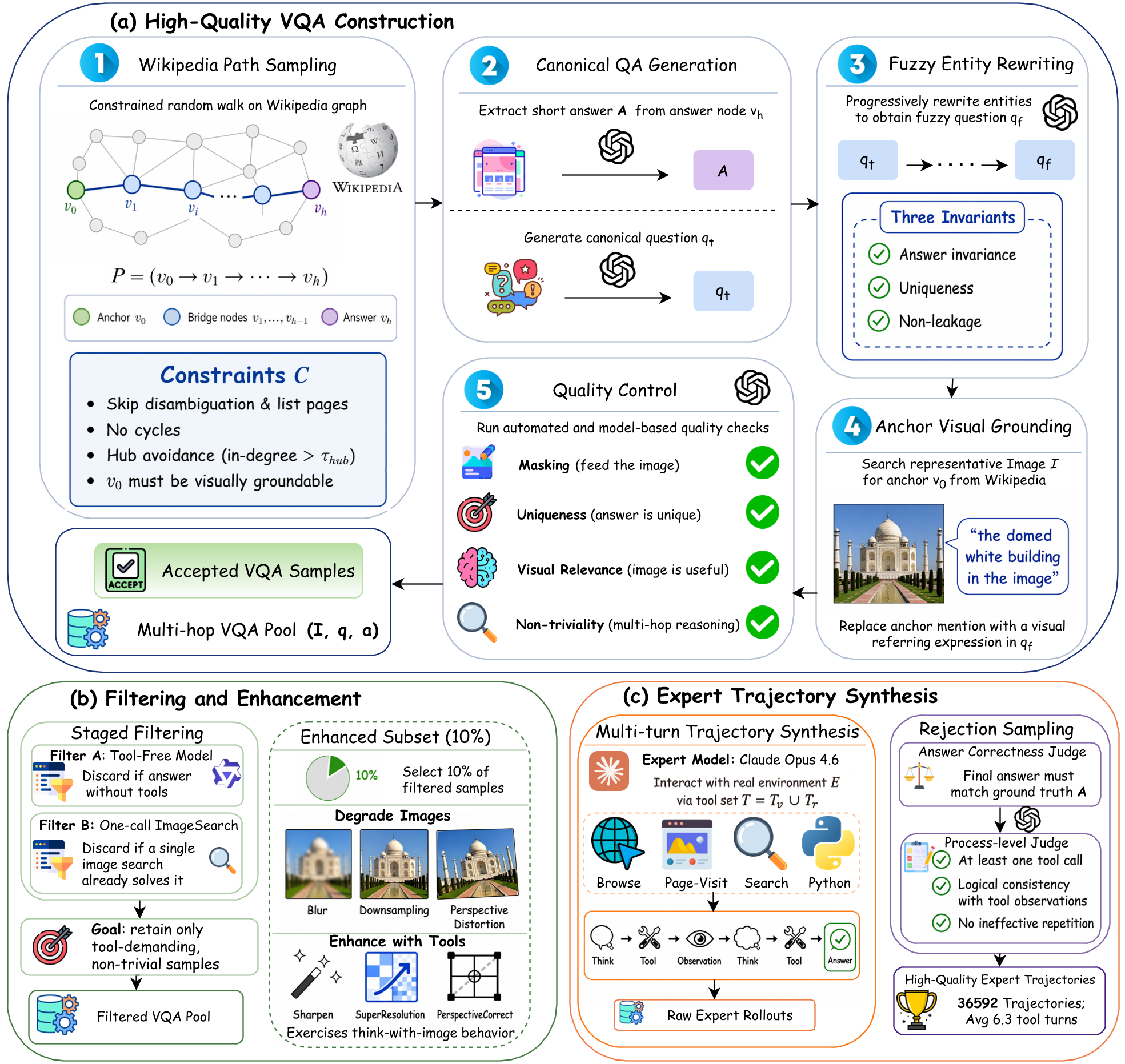 Figure 1: The data curation pipeline designed to prevent shortcuts and encourage multi-hop reasoning.
3. Training: Fatal-Aware GRPO
The core algorithmic contribution is a modified GRPO (Group Relative Policy Optimization).
- Fatal-Aware Masking: It detects when an agent has entered an unrecoverable failure loop and ignores those tokens during training.
- One-Sided Advantage Clamping: If a search fails halfway, but the first few steps were brilliant, the algorithm "clamps" the advantage to ensure those early valid steps are reinforced, rather than penalized for the eventual failure of the tool.
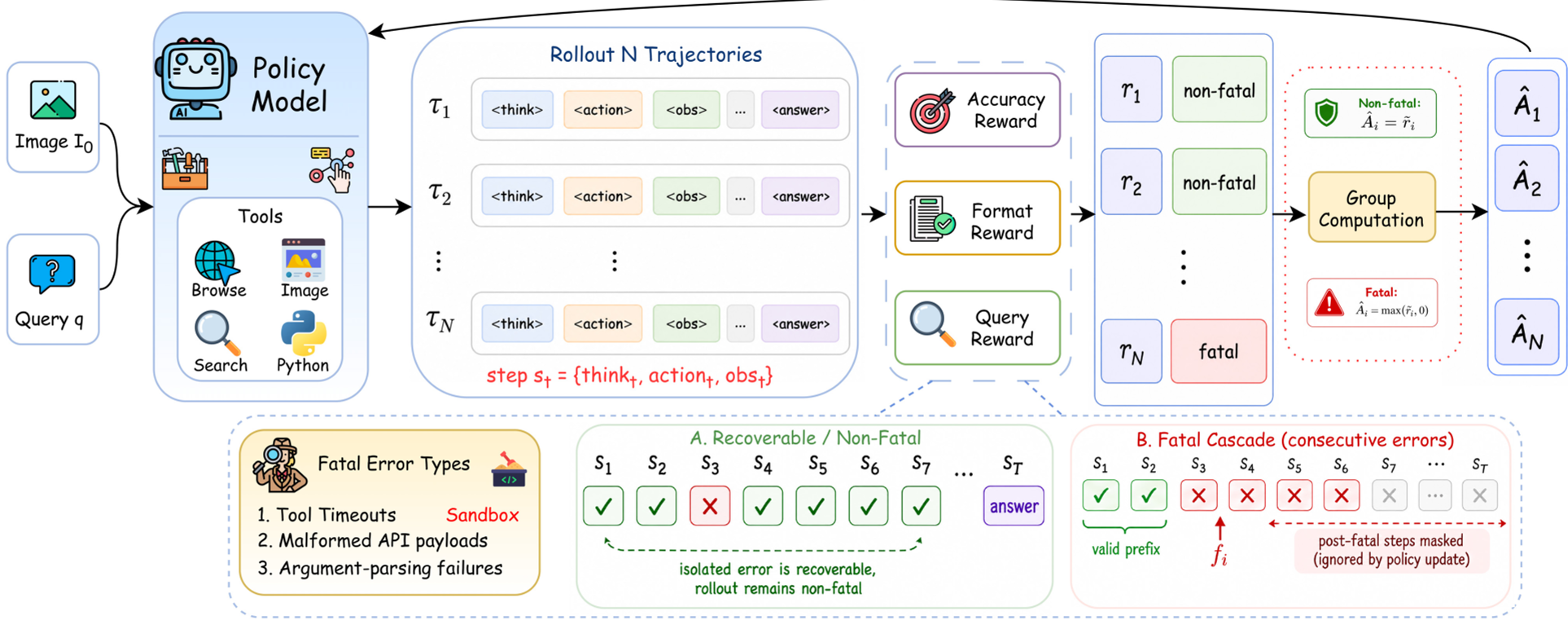 Figure 2: The RL pipeline featuring fatal-aware masking and composite rewards.
Performance: Smashing the SOTA
The results are striking. On benchmarks like MMSearch and VDR, OpenSearch-VL consistently beats strong 32B baselines and rivals proprietary models.
- Averaged Gains: +13.8 points across 7 benchmarks.
- Scalability: The "recipe" works across 8B, 30B (MoE), and 32B models.
- Ablation Success: The fatal-aware masking + clamping alone accounted for a 4.2-point jump in accuracy compared to vanilla RL methods.
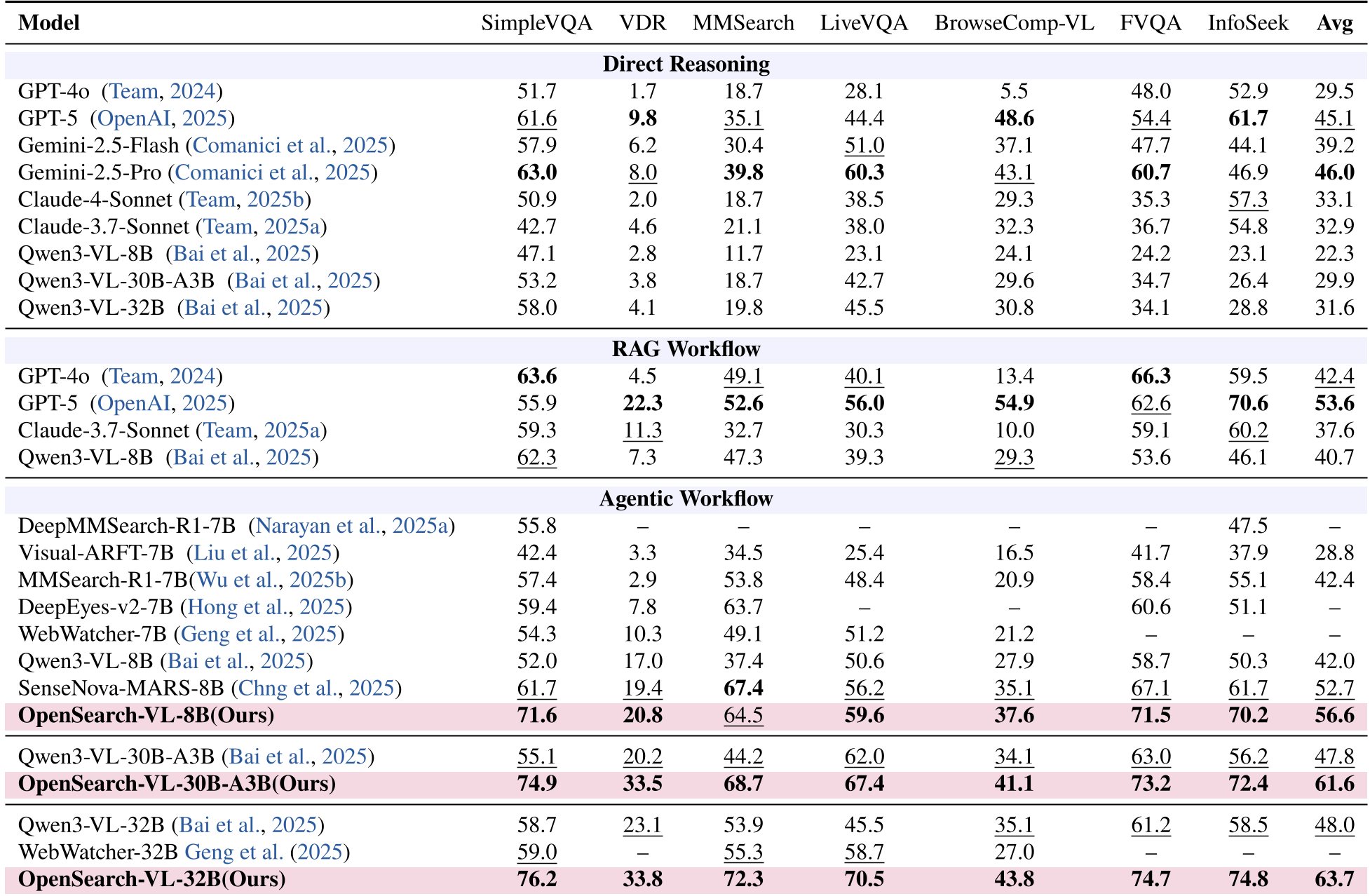 Table 2: Comparison against direct reasoning, RAG, and other agentic workflows.
Deep Insight: Why Advantage Clamping Matters
In standard RL, if your group mean is high, a "partially successful" attempt might still look "worse than average" and get penalized. OpenSearch-VL's one-sided advantage clamping ensures that as long as a fatal trajectory showed some promise in its early steps (beating the average for those specific turns), it acts as a positive signal. This allows the model to learn from "noble failures" rather than just "perfect successes."
Conclusion & Future Outlook
OpenSearch-VL proves that the secret to frontier-level agents isn't just bigger models, but better data quality and failure-tolerant training. By open-sourcing the SearchVL datasets and the fatal-aware GRPO code, the authors have provided the definitive blueprint for the next generation of multimodal agents.
Limitations: The framework currently relies on expensive proprietary models (like GPT-4o) for reward judging. The logical next step for the community is to develop Open Process Reward Models (PRMs) that can judge visual and search steps with the same fidelity as commercial LLM-as-a-judge systems.