
[LLVM 2026] Beyond the Legacy: Speeding Up 32-bit Division on 64-bit Targets
Optimization of 32-bit Unsigned Division by Constants on 64-bit Targets
This paper introduces a compiler optimization for 32-bit unsigned integer division by constants specifically for 64-bit architectures. By leveraging 64-bit registers to eliminate complex shift-and-add sequences in the classic Granlund-Montgomery (GM) method, the proposed approach achieves significant performance gains in LLVM and GCC.
TL;DR
Modern compilers like GCC and Clang have long relied on the Granlund-Montgomery (GM) method to replace slow division instructions with faster multiplications. However, for a significant portion of divisors, the generated code remains stuck in a "32-bit mindset," using complex instruction sequences to prevent overflows that modern 64-bit registers can handle with ease. This paper proposes a simplified 64-bit-native approach that reduces the operation to a single multiplication, delivering nearly 2x speedups on Apple M4 and Intel Sapphire Rapids.
The Problem: The 32-bit "Ghost" in 64-bit Machines
Integer division is notoriously expensive in terms of CPU cycles. To optimize this, compilers use "magic constants"—precomputed numbers that allow to be calculated via .
However, for about 23% of constant divisors (like 7, 19, or 107), the magic constant requires 33 bits. To avoid overflowing a 32-bit result during intermediate steps, current compilers generate a "shift-add-shift" dance:
- Multiply by the lower 32 bits of .
- Perform a subtraction and a right shift.
- Add the results back and shift again.
While this was necessary for 32-bit CPUs, it is a bottleneck on modern 64-bit hardware where we have plenty of register "headroom."
The Insight: Native 64-bit Scaling
The authors realized that if we are running on a 64-bit target, we can treat the 32-bit dividend as a 64-bit value and scale the magic constant such that the result resides purely in the upper bits of a 128-bit product.
Specifically, the operation is transformed to:
By pre-calculating , the division simply becomes the high 64 bits of the product of and .
Methodology & Architecture
The beauty of this method lies in its simplicity. Instead of the multi-line assembly sequence seen in Listing 2 of the paper, the proposed method utilizes the high-magnitude multiplication instructions available in modern ISAs.

- On x86-64 (BMI2): It uses the
mulxinstruction, which computes a 128-bit product and stores the high/low parts in separate registers. - On AArch64 (Apple M4): It uses
umulh(Unsigned Multiply High), which directly returns the top 64 bits of the product.
Experimental Results: Real-World Gains
The authors implemented this in LLVM and tested it against a sequence of divisions by 7, 19, and 107.
| CPU Architecture | Original Time (s) | Optimized Time (s) | Speedup |
|---|---|---|---|
| Intel Xeon (Sapphire Rapids) | 6.33 | 3.80 | 1.67x |
| Apple M4 | 6.70 | 3.38 | 1.98x |
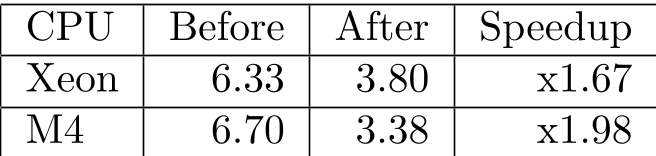
As shown in the assembly comparison (Listing 7 vs 8 in the paper), the loop body shrinks dramatically. The "sequence" of shifts and adds is replaced by a high-throughput multiplication, allowing the CPU's out-of-order execution engine to process iterations much faster.
Critical Analysis & Conclusion
The core contribution here is not a new mathematical theory, but a practical engineering refinement. It identifies a "performance debt" in compiler backends—where code generation strategies failed to evolve alongside register width.
Limitations:
- This optimization is only applicable when the target is 64-bit; 32-bit embedded systems must still use the legacy GM method.
- It specifically targets the "33-bit constant" case; the ~77% of cases where fits in 32 bits already use a single multiply-shift.
Takeaway: This work has already been merged into llvm:main. For developers using Clang or eventually GCC, 32-bit unsigned division—a fundamental building block of many algorithms—just got nearly twice as fast on modern hardware. It serves as a reminder that even "solved" problems in computer science often have room for optimization when hardware assumptions change.