
Streamlining Sovereign AI: How Token Pruning Solves the Curse of Multilinguality for Korean LLMs
Optimizing Korean-Centric LLMs via Token Pruning
The paper introduces a systematic benchmark of token pruning for Korean-centric LLMs, evaluating models like Qwen3, Gemma-3, and Llama-3. By surgically removing vocabulary tokens irrelevant to the target languages (English, Korean, Chinese), the authors achieve significant model compression and improved generation stability.
TL;DR
Researchers have demonstrated that "more" is not always "better" in the world of multilingual LLMs. By pruning redundant tokens from models like Qwen3 and Llama-3, they achieved near-perfect generation stability and reduced memory footprints without losing reasoning capabilities. For Korean-specific tasks, this technique actually boosts translation quality by removing the noise of irrelevant languages.
Current Standing: This work provides a rigorous benchmark for "sovereign AI" optimization, proving that we can decouple high-resource languages from massive multilingual vocabularies with zero performance penalty.
The Problem: The High Cost of Linguistic Redundancy
Global models like Llama-3 are "jacks of all trades but masters of none" regarding parameter efficiency. A significant fraction of their embedding layers—often hundreds of millions of parameters—is dedicated to scripts (like Cyrillic, Arabic, or Devanagari) that a Korean-centric service will never use.
This redundancy leads to two major issues:
- Memory Waste: Large embedding matrices bloat the model's footprint, making deployment on consumer GPUs or edge devices difficult.
- Language Confusion: Models often hallucinate, accidentally switching to a different language mid-sentence because the output probability space is cluttered with irrelevant tokens.
Methodology: Surgical Vocabulary Pruning
The researchers didn't just "cut" the model; they performed a surgical realignment. Using Unicode block filtering, they categorized every token into language groups.
The process follows three phases:
- Filtering: Identify tokens belonging to English, Korean (Hangul), and optionally Chinese (Hanzi).
- Remapping: Create a new, continuous index space for the retained tokens.
- Realignment: Physically rearrange the Weights of the Embedding matrix and the Output Projection layer to match the new indices.
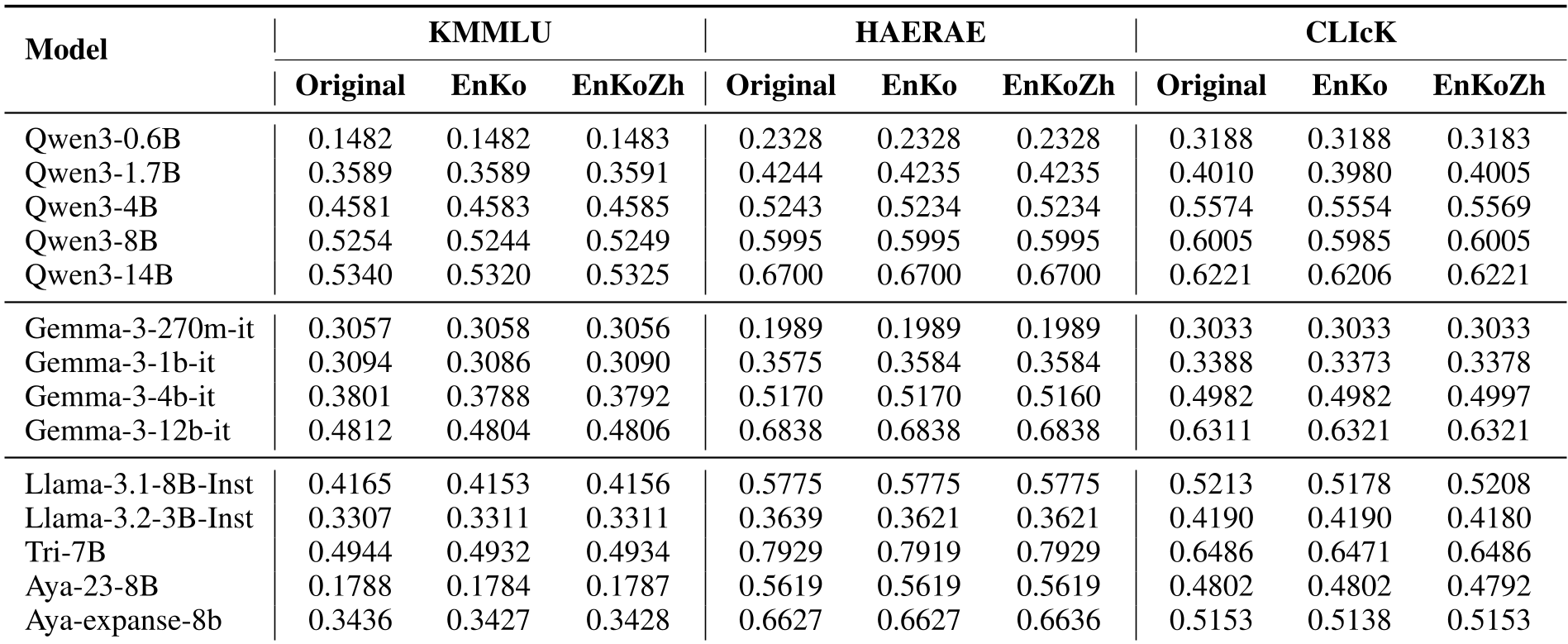 Table 1: Stability of general aptitude (KMMLU) and cultural literacy (HAERAE) across different pruning configurations.
Key Insights: Why Pruning Works
1. Eliminating the "Babble" Effect
The most striking result was the Word-level Pass Rate (WPR). In many multilingual models, "off-target" generation is a persistent bug. By removing the possibility of selecting a non-target token, the authors achieved WPR scores of >0.99. Effectively, pruning acts as a regularizer that forces the model to stay "on-topic" linguistically.
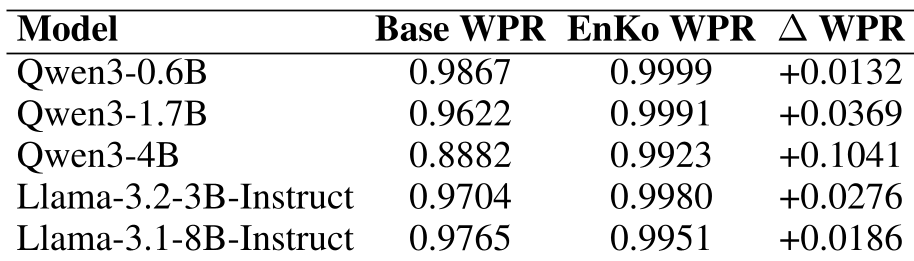 Table 4: Dramatic recovery in generation stability (WPR) post-pruning.
2. The Multi-Cultural Logic Bridge
Interestingly, for the Qwen series, keeping Chinese tokens (EnKoZh) yielded better results in instruction-following than just keeping English and Korean. This suggests that some models "think" across scripts—relying on latent cross-lingual alignments learned during pre-training on large Chinese corpora to solve logic puzzles in Korean.
3. Translation Synergy
Pruning outperformed the original models in Machine Translation (WMT24++). By sharpening the output distribution, the models became more proficient at the English-to-Korean pathway, proving that vocabulary reduction can be a form of performance enhancement, not just compression.
Critical Analysis & Future Outlook
While the memory savings are undeniable (reducing vocabulary size by ~36%), the inference latency gains were modest (<1%). This highlights a critical hardware reality: the computational bottleneck in modern LLMs lies in the Attention mechanism, not the Softmax/Embedding layers.
Takeaways for Developers:
- Don't fear the knife: Pruning irrelevant languages is safe for high-resource languages like Korean.
- Know your model's history: If your base model (like Qwen) was heavily trained on a specific 3rd language (like Chinese), pruning that 3rd language might ding the model's "IQ" even if you only want it to speak Korean.
Conclusion: Token pruning is the "low-hanging fruit" for localizing AI. It provides a cleaner, more stable, and memory-efficient foundation for building sovereign language models.
 Table 5: Significant vocabulary reduction vs. modest latency improvements.