
[FAIR @ Meta] AIRA2: Shattering the Performance Ceiling of AI Research Agents
AIRA_2: Overcoming Bottlenecks in AI Research Agents
AIRA2 is a next-generation AI research agent framework designed for high-throughput, autonomous machine learning experimentation. By addressing core structural bottlenecks in existing systems, it achieves a state-of-the-art mean Percentile Rank of 71.8% at 24 hours and 76.0% at 72 hours on the challenging MLE-bench-30 benchmark.
TL;DR
The dream of an autonomous "AI Scientist" often hits a wall where more compute leads to diminishing returns or even performance degradation. AIRA2, a new framework from FAIR at Meta, identifies that the problem isn't just model "intelligence," but the infrastructure of search. By introducing asynchronous parallel execution, a "Hidden Consistent Evaluation" protocol, and ReAct-based sub-agents, AIRA2 achieves a 76.0% Percentile Rank on MLE-bench, proving that agents can scale reliably with time and compute.
The Bottleneck: Why AI Scientists "Overfit"
Previous research (like AIRA-dojo) pointed out a paradoxical trend: as agents spend more time searching for solutions, their performance on held-out test sets often drops. Many attributed this to "overfitting" the training data.
The authors of AIRA2 argue otherwise. They posit that the "Generalization Gap" is actually caused by evaluation noise. If an agent is allowed to create its own validation splits or see labels, it eventually "games" the metric or gets lucky with a specific data split. Furthermore, synchronous execution means the agent sits idle while a GPU trains a model, starving the search process of the diverse samples it needs to find a global optimum.
Methodology: The Three Pillars of AIRA2
AIRA2 moves from a fragile, single-threaded script to a robust, distributed system.
1. Massively Parallel Asynchronous Evolution
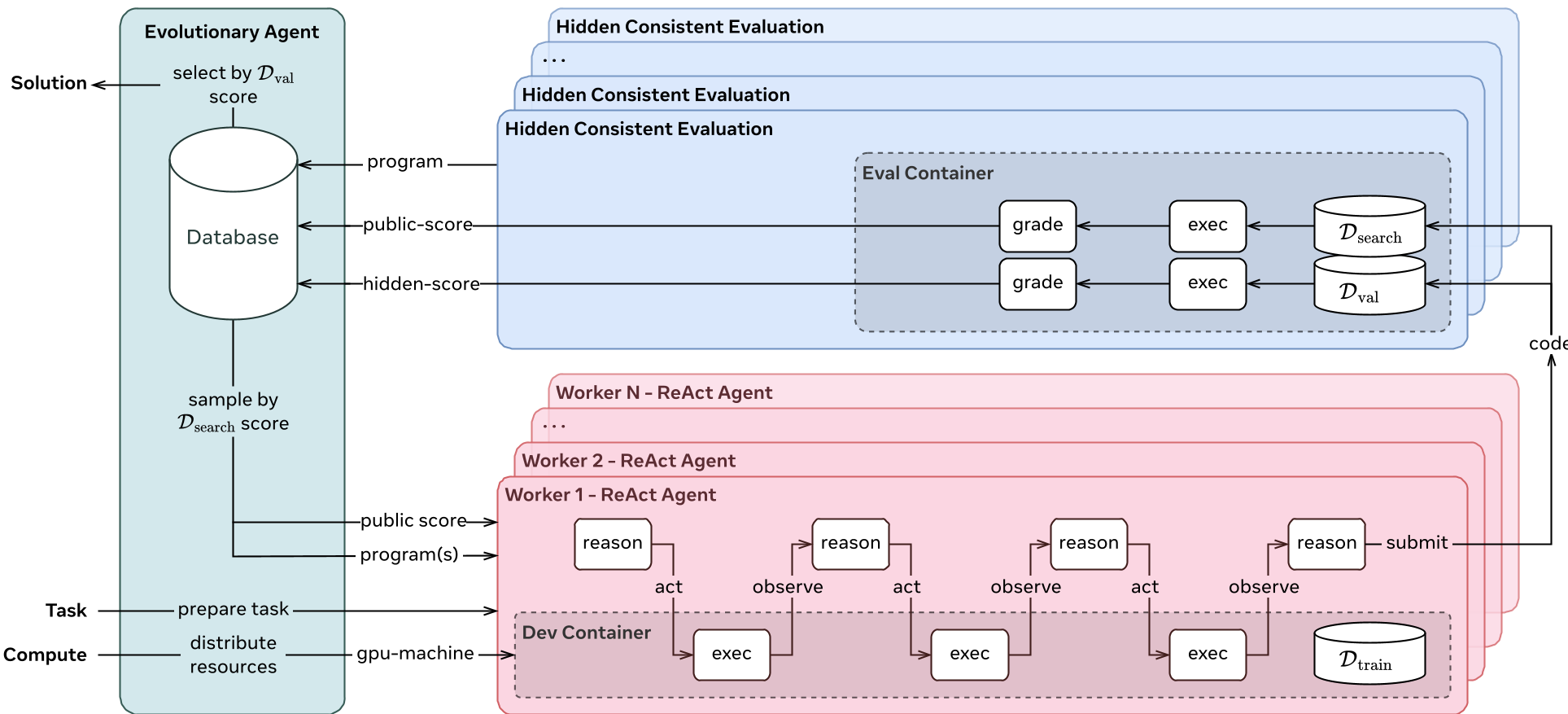
Instead of waiting for one experiment to finish, AIRA2 uses an Asynchronous Worker Pool. Whenever a GPU worker becomes free, the Orchestrator samples a parent solution from the population using rank-based selection and dispatches a new mutation task. This allows the system to utilize 8+ GPUs effectively, increasing throughput linearly.
2. Hidden Consistent Evaluation (HCE)
To stop metric gaming, AIRA2 implements HCE:
- Rigid Splits: Data is split once into Train, Search, and Val.
- Hidden Labels: The agent sees scores but never the ground truth labels for the search set.
- Externalized Logic: The evaluation happens in a separate, isolated container. This ensures the "hill-climbing" signal remains stationary and honest.
3. ReAct Agents as Operators
While previous agents used static "Draft" or "Improve" prompts, AIRA2 uses ReAct agents. These are sub-agents that can run Bash commands, check logs, and iteratively debug. If a script fails, the ReAct agent sees the traceback, formulates a hypothesis, and fixes it immediately—rather than wasting an entire exploration turn.
Experimental Results: Scaling to Gold
On the MLE-bench-30 (a subset of 30 complex Kaggle competitions), AIRA2 demonstrates a clear superior scaling curve.
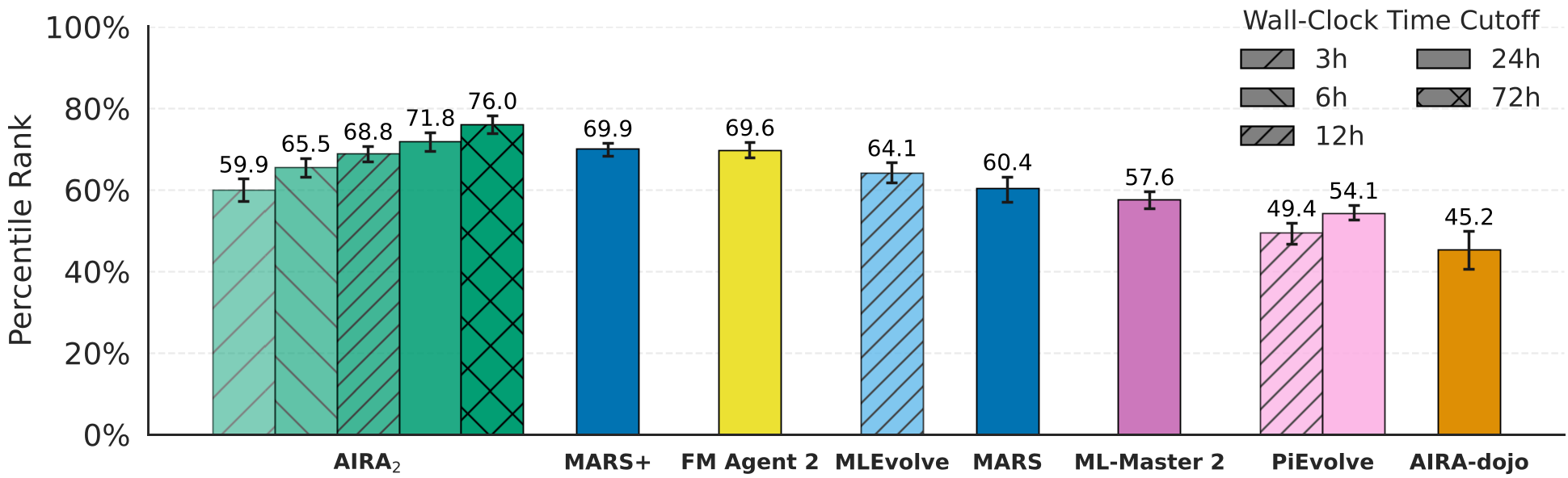
- 24h Wall-clock: 71.8% Percentile Rank (New SOTA).
- 72h Wall-clock: 76.0% Percentile Rank.
- The "Eureka" Moment: In the
champs-scalar-couplingtask, the agent correctly identified that a drop in validation score was due to underfitting rather than a bad methodology. It subsequently increased model size and training time, securing a Gold medal where all previous agents had failed.
Deep Insight: Noise vs. Memorization
The most profound takeaway from the AIRA2 ablation studies is the debunking of the "overfitting" myth in AI agents. When AIRA2 used the standard self-reported evaluation, performance degraded. When the exact same agent used the Hidden Consistent Evaluation protocol, the degradation vanished (see Figure 4a in the paper). This proves that current LLM agents aren't "memorizing" datasets as much as they are being misled by inconsistent, noisy feedback loops.
Conclusion
AIRA2 shifts the focus of AI research agents from better prompt engineering to better system architecture. By treating research as a high-throughput, parallel search problem with clinical evaluation standards, FAIR has provided a blueprint for agents that don't just solve simple tasks, but can navigate the messy, iterative process of real-world machine learning engineering.
Limitations & Future Work
- Data Contamination: The authors acknowledge that LLMs might have seen Kaggle solutions in their pre-training data.
- Compute Cost: AIRA2 is a "heavy" system, optimized for high-compute regimes rather than efficiency.
- Future Path: Transitioning these agents to "closed" private benchmarks to verify true zero-shot reasoning capabilities.