
[CVPR 2024] PanoVGGT: Redefining 3D Reconstruction for the 360° Era
PanoVGGT: Feed-Forward 3D Reconstruction from Panoramic Imagery
PanoVGGT is an end-to-end, feed-forward Transformer framework for joint 3D reconstruction from unordered panoramic images. It concurrently predicts camera poses, dense depth maps, and globally consistent 3D point clouds, achieving SOTA performance on benchmarks like Matterport3D and capturing high-fidelity outdoor geometry.
TL;DR
PanoVGGT is a breakthrough feed-forward Transformer that solves the 3D reconstruction puzzle for panoramic imagery. By moving beyond the "pinhole assumption" that limits traditional AI models, it jointly estimates camera poses, depth, and point clouds from unordered 360° shots in a single pass. Accompanied by PanoCity—the largest outdoor panoramic dataset to date—this work bridges the gap between perspective-based deep learning and spherical geometric reasoning.
The "Pinhole" Bottleneck
Modern feed-forward models like DUSt3R or VGGT have revolutionized 3D vision, but they harbor a hidden weakness: they are born in a pinhole world. When fed panoramic (equirectangular) images, these models struggle with the extreme distortions at the poles and the wrap-around seams at the edges.
Prior attempts to fix this usually involved "dodecahedral projection" (splitting a panorama into 12 pinhole crops), but this introduces artificial seams and breaks global geometric consistency. The authors of PanoVGGT asked a fundamental question: Can we reason about 360° geometry directly in the spherical domain?
The PanoVGGT Methodology: Spherical Intelligence
To bridge this gap, PanoVGGT introduces three key innovations that allow a standard Transformer backbone (DINOv2) to understand the sphere.
1. Spherical-aware Positional Embeddings
Unlike standard images where every pixel is equal, equirectangular panoramas have varying sampling densities. PanoVGGT uses a circular symmetric 4D vector passed through an MLP. This ensures that the model knows exactly where it is on the sphere and maintains continuity across the wrap-around seam.
2. Three-axis SO(3) Rotation Augmentation
Panoramas are unique: you can rotate the camera in any direction without losing data. The authors exploit this by rotating the RGB, depth, and pose triplets in 3D space during training. This forces the model to ignore local distortion patterns and focus on the underlying 3D structure.
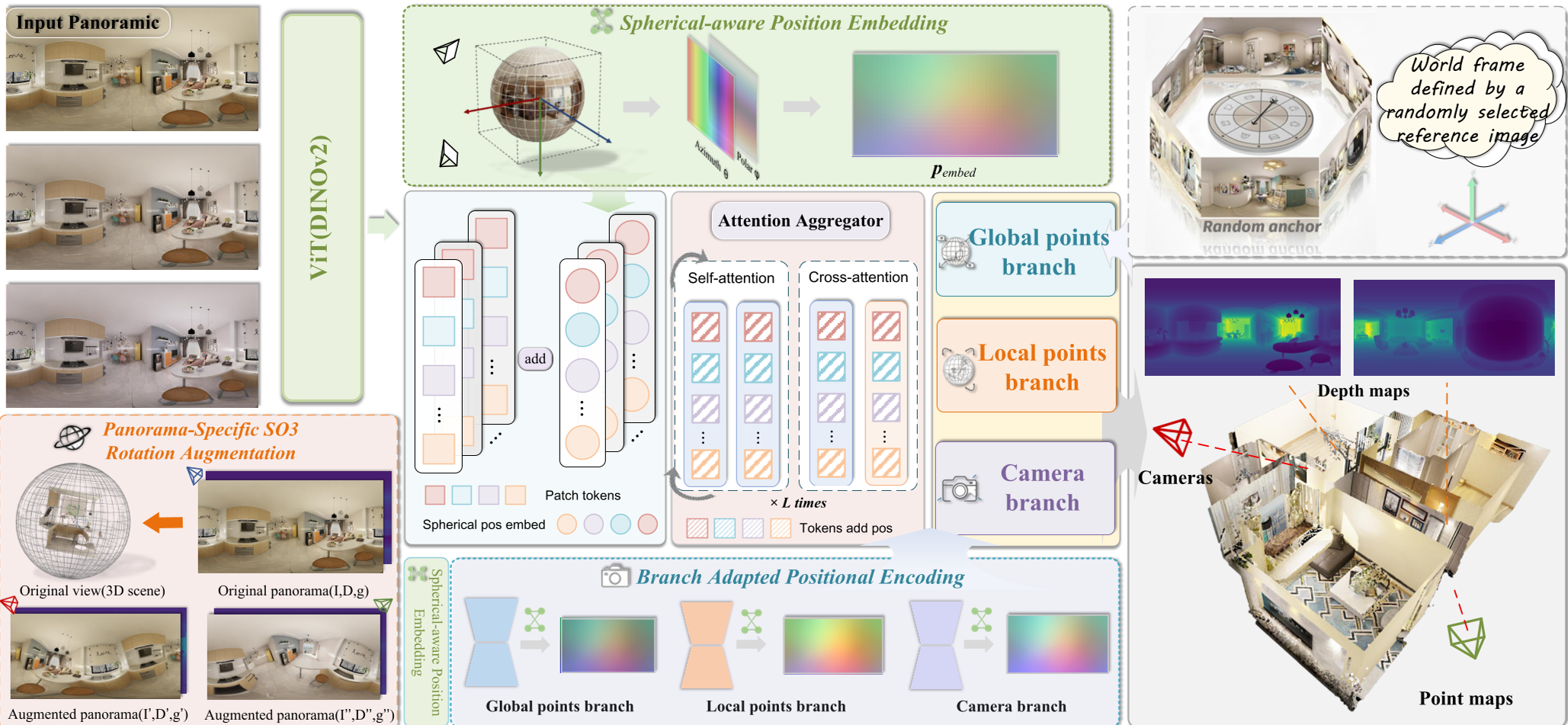
3. Stochastic Anchoring
In unordered sets, there is no "first" image. PanoVGGT uses a randomized re-centering strategy during training, defining an arbitrary image as the origin. This makes the model permutation-equivariant, meaning the results are identical regardless of the order in which you upload your panoramas.
PanoCity: The Fuel for the Engine
Data scarcity was the second major hurdle. Most panoramic datasets are indoor-only or have low overlap. The authors released PanoCity, featuring over 120,000 frames of photorealistic outdoor urban scenes rendered in Unreal Engine 5. This provides the "continuous trajectory" data needed for the model to learn 6-DoF motion and dense depth in complex environments.
Experimental Results
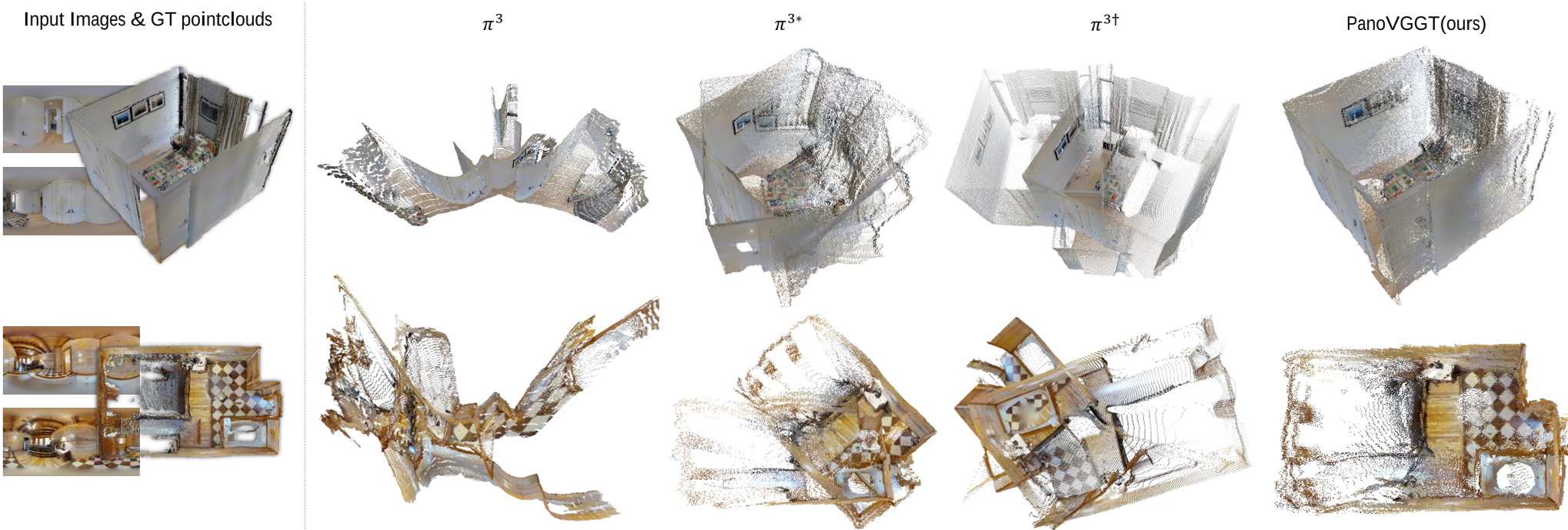
The impact of these design choices is stark. When compared to the state-of-the-art perspective model , PanoVGGT achieves a massive leap in accuracy:
- Pose Estimation: On Matterport3D, PanoVGGT achieves an AUC@30 of 0.459, while the perspective baseline languishes at 0.047.
- Depth Prediction: It delivers metrically consistent depth maps that outperform specialized panoramic models like PanoFormer.
- Point Cloud Fusion: The resulting reconstructions are sharper, more consistent, and lack the "seams" seen in patch-based methods.
Critical Insight: Why Does It Work?
The genius of PanoVGGT lies in decoupling. By keeping the positional embeddings fixed to the grid but rotating the visual content, the network learns a "modulation signal." It understands that a feature near the North Pole of the image should be interpreted differently (higher distortion) than one at the equator. This allows it to achieve SO(3)-equivariant reasoning without the computational overhead of spherical convolutions.
Looking Ahead
While PanoVGGT is a milestone, it remains tailored to equirectangular projections. Future work could extend this "spherical-first" logic to other non-pinhole cameras, such as fisheye lenses or catadioptric systems. For the robotics and AR industries, this provides a scalable, feed-forward path to mapping entire urban environments from a single 360° camera sweep.
Senior Editor's Note: PanoVGGT is more than just a model; it's a statement that our AI "eyes" shouldn't be limited to the narrow fields of view of the past. By embracing the sphere, we move one step closer to situational awareness at the level of biological vision.