
Momentum DeltaNet: Escaping the SGD Trap in Linear Attention
MDN: Parallelizing Stepwise Momentum for Delta Linear Attention
Momentum DeltaNet (MDN) is a linear attention architecture that integrates a stepwise momentum update rule into the Delta Rule framework. By utilizing a novel chunkwise parallel algorithm and Triton-based kernels, it achieves O(L) complexity, outperforming SOTA models like Mamba2 and Gated DeltaNet in language modeling and retrieval tasks.
TL;DR
Linear Attention (LA) has long promised Transformer-level performance with RNN-level efficiency, but it often fails at "remembering" fine-grained details. Momentum DeltaNet (MDN) solves this by replacing the standard SGD-like update with a Stepwise Momentum rule. By framing the update as a second-order dynamical system and inventing a clever way to parallelize it without breaking causality, MDN beats Mamba2 and Gated DeltaNet (GDN) on both retrieval and reasoning tasks.
The Problem: Why Linear Attention "Forgets"
Most modern linear models (Mamba2, DeltaNet, GLA) can be viewed as Online Learners. As they process a sequence, they perform a closed-form version of Stochastic Gradient Descent (SGD) to update their internal "Fast Weights."
However, SGD is notoriously sensitive to noise and suffers from rapid information decay. In the world of optimization, we use Momentum to smooth out noise and speed up convergence. But in sequence modeling, momentum is a nightmare to parallelize:
- Blockwise Momentum: Fast, but ruins causality (future info leaks into the past).
- Stepwise Momentum: Causally correct, but painfully slow (sequential).
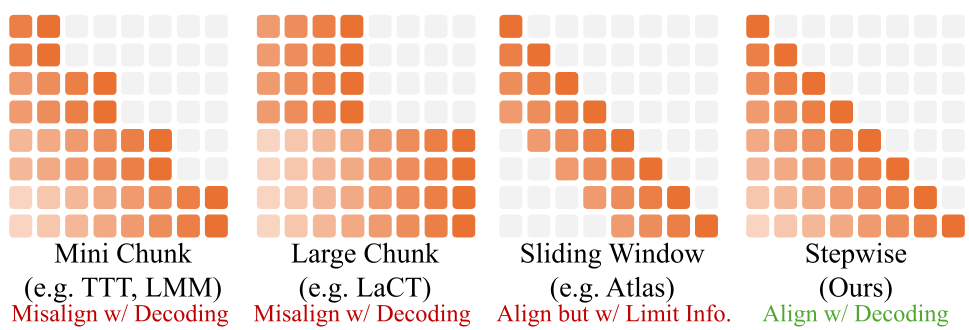 Figure 1: Comparison of causal structures. MDN maintains strict causality during training, unlike blockwise schemes.
Methodology: High-Order Dynamics & Parallelization
The core contribution of MDN is twofold: a mathematical trick for parallelization and a stability theory based on dynamical systems.
1. The Geometric Decoupling Trick
To make stepwise momentum fast, the authors had to solve a nested summation problem. By viewing the update as a traversal over a lower-triangular index domain, they reordered row-wise scans into column-wise scans. This allowed them to decouple coefficients and compute the "Fast Weights" () and "Momentum" () using a chunkwise parallel algorithm.
2. Spectral Stability (Second-Order Dynamics)
Unlike 1st-order systems (decay/delta rules) which have real eigenvalues, MDN's momentum induces complex conjugate eigenvalues. This allows the model to capture oscillatory patterns—essentially giving it a "phase-aware" memory. To prevent this power from causing "NaN" explosions, the authors enforced a Quadrant Constraint, ensuring eigenvalues stay in the stable right-half plane.
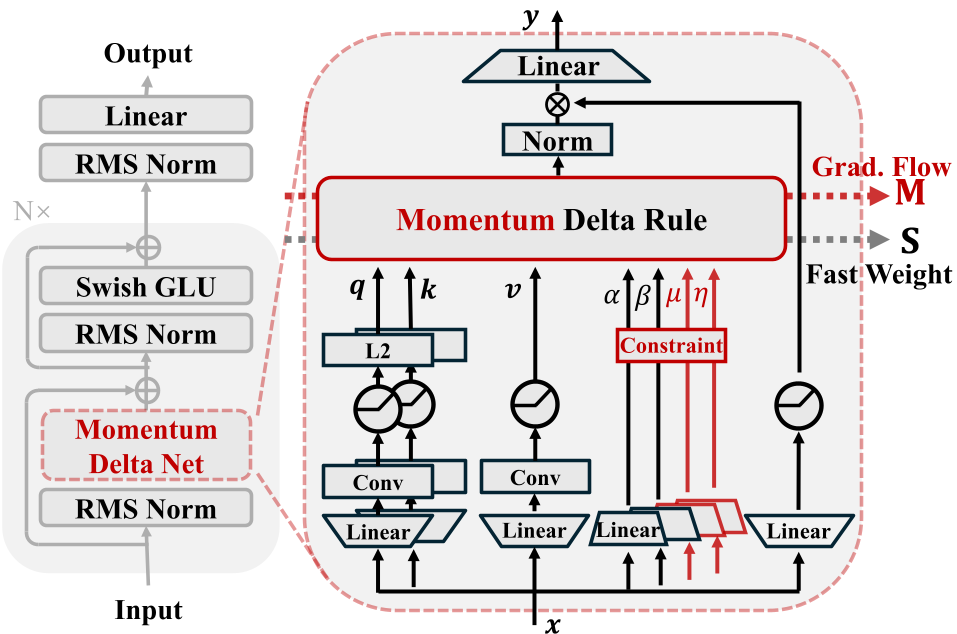 Figure 2: Spectral analysis showing how momentum expands the eigenvalue space into complex domains while constraints keep the system stable.
Experiments: Narrowing the Retrieval Gap
MDN was tested at 400M and 1.3B parameters. The results are clear: while most RNNs struggle with retrieval tasks (like the "Needle-In-A-Haystack"), MDN narrows the gap to Transformers significantly.
- In-Context Retrieval: MDN outperformed GDN and Comba, reaching 36.14% average accuracy at 1.3B.
- Efficiency: Despite the extra state (Momentum + Fast Weights), MDN's Triton implementation keeps throughput competitive with Mamba2.
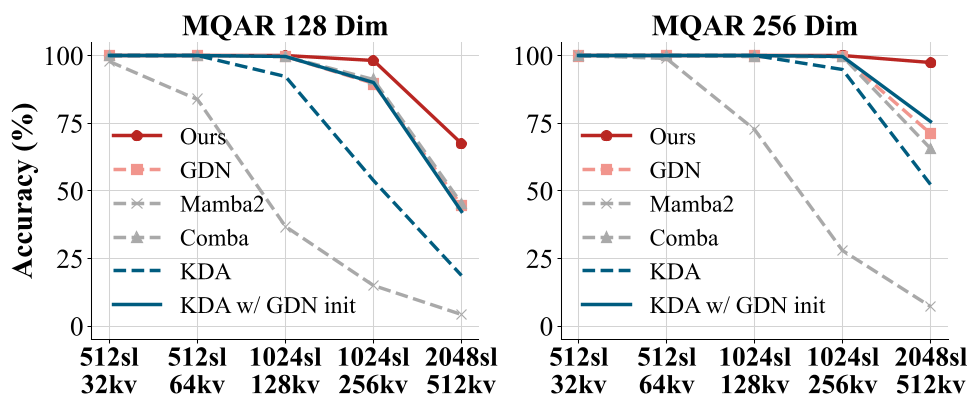 Figure 3: Multi-Query Associative Recall (MQAR) performance. MDN scales much better with sequence length than previous linear models.
Critical Analysis & Takeaways
The jump from SGD to Momentum is a logical step for the evolution of Fast Weight Programmers. MDN proves that the bottleneck in Linear Attention wasn't just "capacity," but the optimization trajectory of the state itself.
Limitations:
- State Size: MDN requires storing both and , which increases memory overhead during training compared to simple decay models.
- Complexity: The parallel derivation is mathematically intense, requiring specialized Triton kernels for practical use.
Future Outlook: As we push towards 7B/70B linear or hybrid models, MDN's stability-aware gating and momentum updates provide a robust blueprint for replacing vanilla Attention in long-context applications.
Conclusion
Momentum DeltaNet successfully brings 2nd-order optimization to the world of Linear Attention. It provides a mathematically sound and hardware-efficient way to ensure that "fast weights" don't just learn fast, but learn well.