
Pumping Anyons: Exploring Parameter-Space Topology in the Toric Code
Parameterized Families of Toric Code Phase: $em$-duality family and higher-order anyon pumping
The paper investigates non-trivial parameterized families of topological orders within the 2D Toric Code phase. By interpolating em-duality and fractionalized Z2xZ2 symmetries, the authors construct explicit 1-parameter (S1) and 2-parameter (T2) lattice Hamiltonians that exhibit topological pumping of anyonic defects and higher-order anyon modes.
TL;DR
Researchers have moved beyond simple charge pumping to explore how "twisting" the parameters of a topological order (specifically the Toric Code) can move exotic defects. This paper constructs 1D and 2D loops in the space of Hamiltonians that swap and anyons and pump topological indices to the boundary, providing a lattice-level realization of the long-theorized moduli space of topological phases.
Background: From Thouless to Anyons
In classical topological physics, the Thouless Pump tells us that cycling a 1D system's parameters can transport an integer amount of charge. But what happens when the system is topologically ordered? Instead of just moving charges, we can move the very rules of the universe: we can swap anyon identities or pump many-body Berry phases. This paper bridges the gap between high-level category theory and concrete lattice models.
The Core Problem: The Interpolation Gap
To create a "cycle" of Hamiltonians, you need a symmetry that you can gradually turn on and off. The Toric Code famously has an em-duality (swapping electric and magnetic charges). However, the standard way to do this involves shifting the lattice by half a unit cell—a "jump" that cannot be done smoothly.
The authors solve this by using Finite-Depth Quantum Circuits (FDQC). By decomposing the swap into a sequence of local CNOT and Hadamard gates, they create a unitary operator that can be continuously tuned from the identity to the full symmetry.
Methodology: The Boundary Algebra Diagnostic
How do you prove a Hamiltonian loop is "nontrivial"? The authors use the Boundary Algebra method.
- Truncation: They cut the system in half to create a boundary.
- Automorphism: As the bulk parameter goes from to , it induces a transformation on the boundary operators.
- The Index: They prove this transformation is a Kramers-Wannier duality (for the S1 family), which has a quantized "index" that prevents the loop from being shrunk to a point.
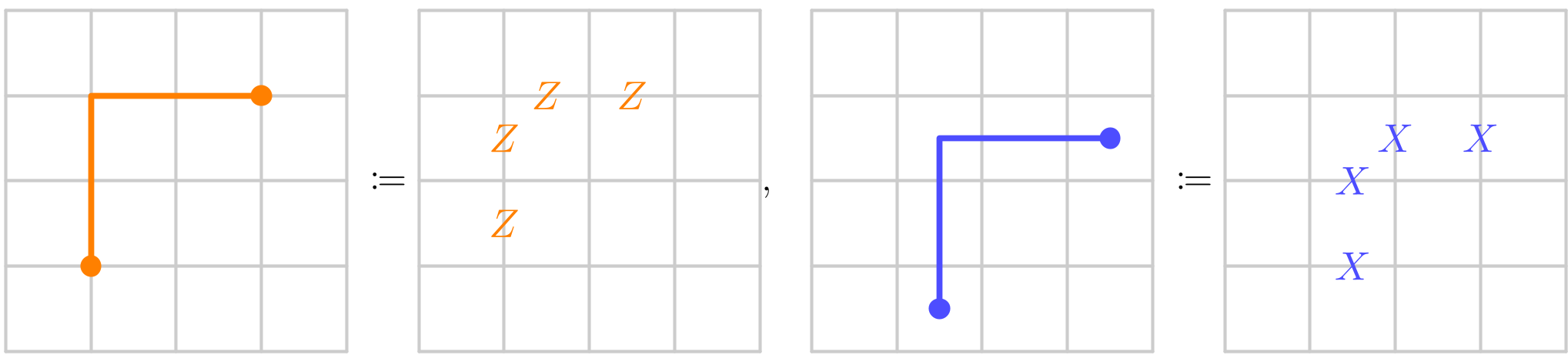 Figure 1: Standard e and m anyons in the Toric Code, which serve as the foundation for the pumped defects.
Higher-Order Pumping (The T2 Family)
The paper goes further to construct a T2-family (a torus in parameter space). This is essentially a "pump of a pump."
- By using fractionalized symmetries, the authors show that traversing one cycle () creates a 1D SPT (Symmetry Protected Topological) phase on the boundary.
- Traversing the second cycle () then pumps this entire 1D top-phase along the edge.
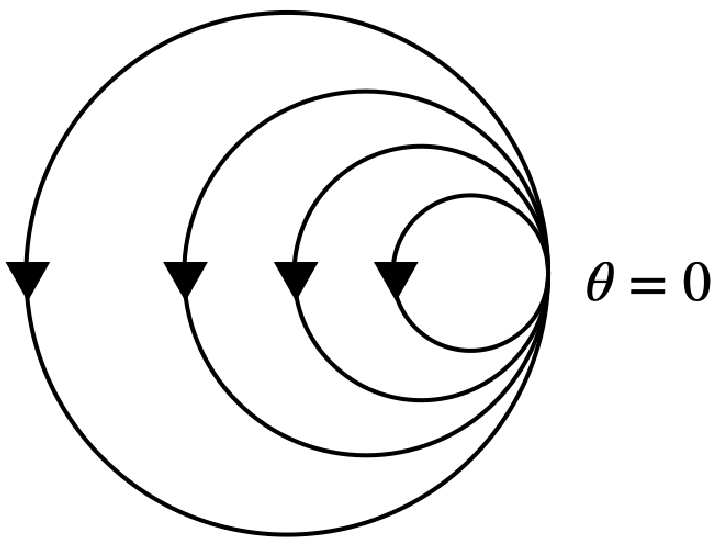 Figure 2: The logic of non-contractibility. If the boundary automorphism possesses a non-zero index, the family cannot be continuously deformed to the identity.
Higher-Order Anyon Pumping
In Section 4, the authors introduce a crystalline version of the model protected by rotation symmetry.
- The Result: As the parameter evolves, anyons are specifically transported to the corners of the square lattice.
- The Proof: They use a "Gauging" procedure, mapping the topological order to a 2D Cluster State (an SPT phase) and showing that the resulting boundary modes are non-trivial.
Critical Analysis & Conclusion
This work is a tour de force in "Family Topology." While previous work was largely restricted to field theories, this paper provides the exact stabilizers and unitary circuits needed to simulate these effects on a quantum computer.
Key Takeaways:
- em-exchange is more than a symmetry; it’s a topological invariant of the parameter space.
- Boundary Algebra is a powerful tool to detect bulk topology without needing to solve the full many-body wave function.
Limitations: The research focuses on Commuting Projector Hamiltonians. Real-world materials have non-commuting terms (perturbations). Whether these quantized pumps survive strong perturbations is the next big question for the condensed matter community.