
[CVPR 2026] PathMoE: Solving the Combinatorial Explosion of MoE Routing via Path Constraints
Path-Constrained Mixture-of-Experts
The paper introduces PathMoE, a novel Sparse Mixture-of-Experts (MoE) architecture that constrains the combinatorial expert path space by sharing router parameters across blocks of consecutive layers. PathMoE achieves consistent SOTA performance on 0.9B and 16B models, significantly improving downstream task accuracy and perplexity without requiring auxiliary load balancing losses.
TL;DR
Sparse Mixture-of-Experts (MoE) models are powerful but statistically messy. Standard MoE treats every layer as a vacuum, making independent routing decisions that result in possible paths—a space too vast for models to navigate efficiently. PathMoE reframes this by sharing router parameters across blocks of layers. This simple architectural shift reduces the "Path Entropy," eliminates the need for auxiliary load balancing losses, and yields a model that is both more specialized and 22.5x more robust to noise.
The Problem: The Curse of
In a standard MoE setup, if you have 16 experts and 24 layers, a single token can follow any of possible paths. This is a combinatorial explosion.
The authors argue that this leads to statistical inefficiency. When the path space is a million times larger than your training set, the model cannot possibly learn a coherent "specialization" for every path. Prior works tried to fix this with complex auxiliary losses to force experts to balance out, but these often act as a "band-aid" rather than addressing the underlying entropy of the path space.
Methodology: Block-wise Parameter Sharing
The core intuition of PathMoE is that token representations in deep residual networks change slowly. If layer and layer see almost the same representation, why should they use entirely different routing logic?
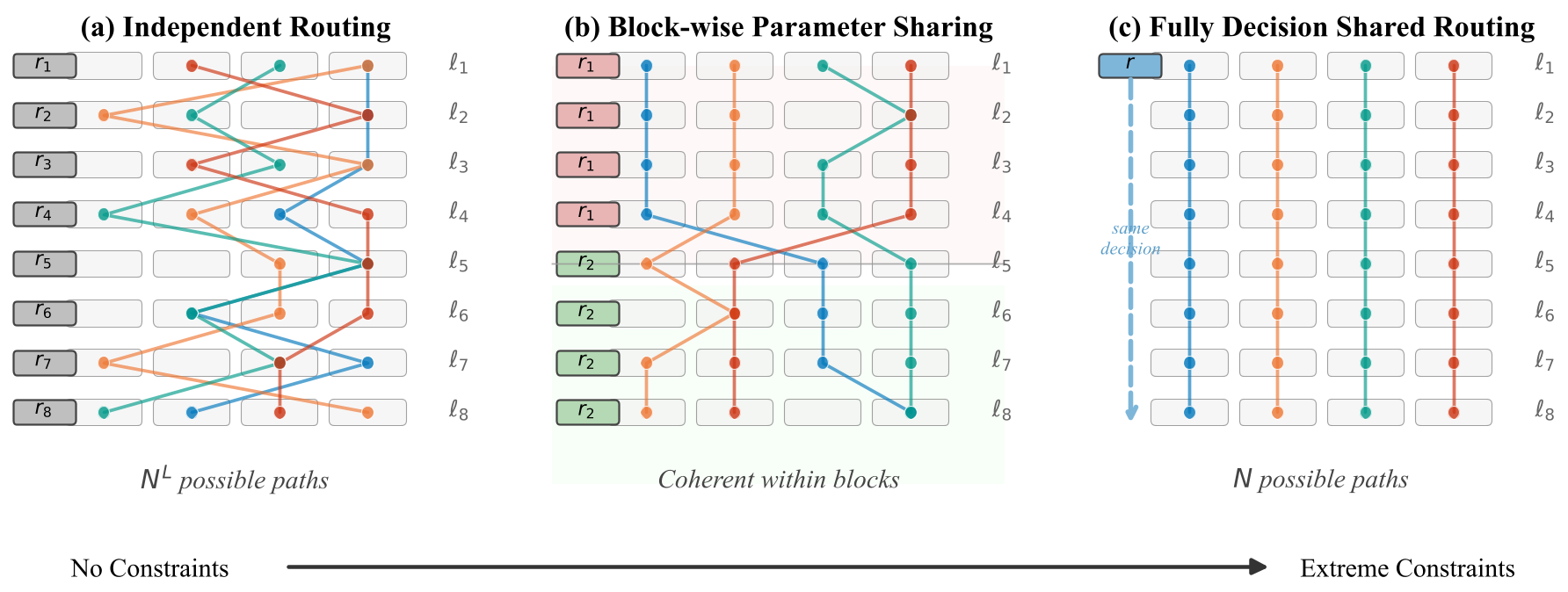 Figure 1: Comparison of independent routing (a) vs. PathMoE block-wise sharing (b).
PathMoE introduces Block-wise Parameter Shared Routing:
- Divide layers into blocks of size (e.g., ).
- All layers within a block use the same router weights ().
- Because the inputs and are similar, they naturally "gravitate" toward the same experts, creating a coherent Expert Path.
This reduces the effective path space. Empirical measurements showed that PathMoE reduces routing entropy by 1 bit, effectively halving the active path space, allowing more training signals to reach specific expert sequences.
Experimental Battlefront: SOTA Performance
The researchers tested PathMoE across 0.9B and 16B parameter scales.
1. Superior Accuracy & Efficiency
PathMoE (specifically the B4 variant) consistently outperformed independent routing and even more complex "Recurrent Routers."
 Table 1: PathMoE achieves highest average scores and lowest perplexity compared to standard MoE (Indep-MoE).
2. Death of the Auxiliary Loss
One of the most annoying parts of training MoEs is tuning the load balancing loss weight (). PathMoE effectively "self-balances." By coordinating paths across layers, the model maintains uniform expert utilization naturally. In fact, removing the auxiliary loss actually improved PathMoE's performance, whereas it made standard MoE training erratic.
Deep Insight: Emergent Linguistic Specialization
Why does this work? The authors analyzed the "Expert Paths" and found something fascinating: tokens don't just pick experts; they pick computational journeys.
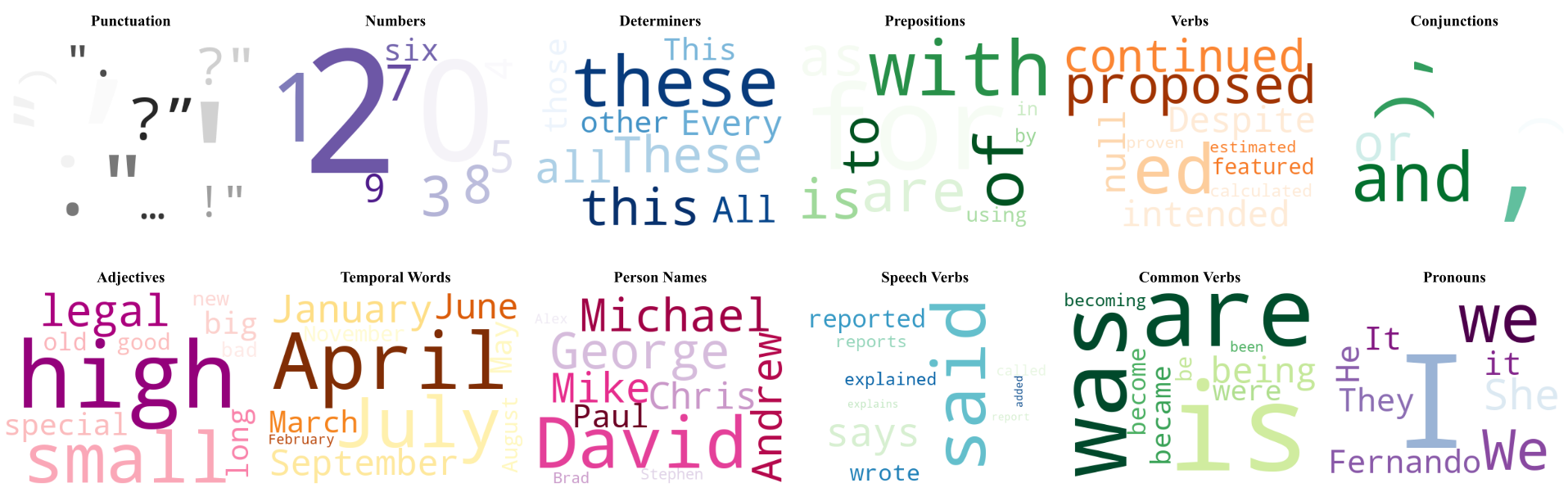 Figure 2: Interpretable routing paths for punctuation, names, and temporal words.
Tokens following a specific path cluster into crisp linguistic categories (e.g., punctuation, named entities, proper nouns). While standard MoE shows some of this, PathMoE's clusters are significantly more concentrated.
Robustness: The Ultimate Stress Test
The most shocking result is Robustness. If you randomly permute (shuffle) expert assignments at test time:
- Standard MoE: Perplexity explodes by 5,328%.
- PathMoE: Perplexity only increases by 237%.
PathMoE creates a "coordinated" intelligence across layers. Even if a router is slightly off, the shared logic across the block provides a stabilizing force that independent routers lack.
Critical Analysis & Conclusion
Takeaways: PathMoE is a rare "free lunch" in AI research. It reduces parameter count (fewer routers), increases accuracy, and improves robustness. It suggests that the future of MoE isn't just "more experts," but "smarter paths."
Limitations: The authors note that this currently benefits token-choice routing. For expert-choice routing (where experts pick tokens), the benefits were negligible, likely because expert-choice already possesses an inherent stability.
Future Outlook: Expect this to become a standard internal component for LLMs, potentially combined with model compression—since we now know which paths are specialized, we can prune the underutilized ones far more effectively.