
PVM: Solving the "Visual Dilution" Crisis in Deep Multimodal Reasoning
Persistent Visual Memory: Sustaining Perception for Deep Generation in LVLMs
The paper introduces Persistent Visual Memory (PVM), a lightweight parallel module designed for Large Vision-Language Models (LVLMs) to solve "Visual Signal Dilution." Integrated into the Qwen3-VL (4B/8B) series, it achieves a 4.8% average accuracy gain across eight benchmarks, setting a new SOTA for open-source reasoning models.
TL;DR
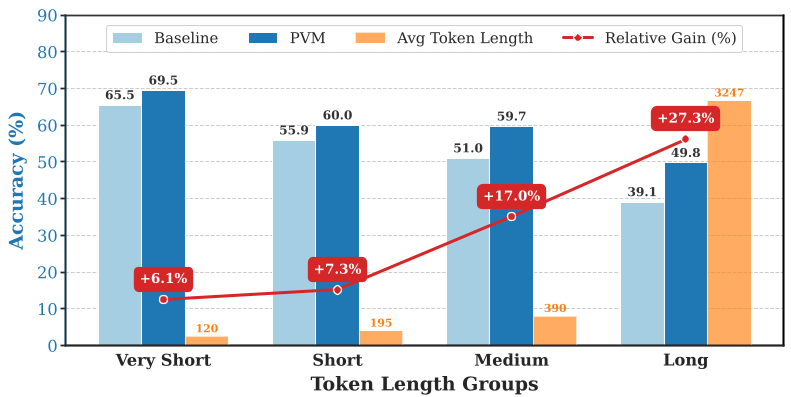
As Large Vision-Language Models (LVLMs) generate longer responses, they "forget" the image. This paper identifies this as Visual Signal Dilution—a structural decay of attention. To fix this, the authors propose Persistent Visual Memory (PVM), a parallel neural branch that allows the model to "re-look" at the image without interrupting its logical "thinking" process. PVM delivers up to a 27.3% boost in long-form reasoning with almost zero extra compute cost.
The "Blind Painter" Problem: Why Models Forget
Standard LVLMs (like Llama-3-VL or Qwen-VL) treat images as a prefix. As the model writes a long chain of thought, the "attention" given to the image tokens is naturally diluted by the massive accumulation of its own text.
The authors prove this mathematically: visual attention mass decays at a rate of . By the time the model is mid-reasoning, the image signal is a whisper compared to the roar of the textual history. This is the Low-Attention Equilibrium, where the model starts hallucinating because it literally stopped "looking" at the prompt.
Methodology: The Parallel "Looking Path"
Previous attempts to fix this involved "re-injecting" visual tokens into the sequence. However, this is like interrupting someone's train of thought—it breaks the logical flow.
Persistent Visual Memory (PVM) solves this by bifurcating the Transformer block into two paths:
- The Reasoning Path (FFN): The original, frozen Feed-Forward Network that handles logic and linguistic patterns.
- The Looking Path (PVM): A lightweight, learnable cross-attention module that retrieves raw visual evidence on demand.
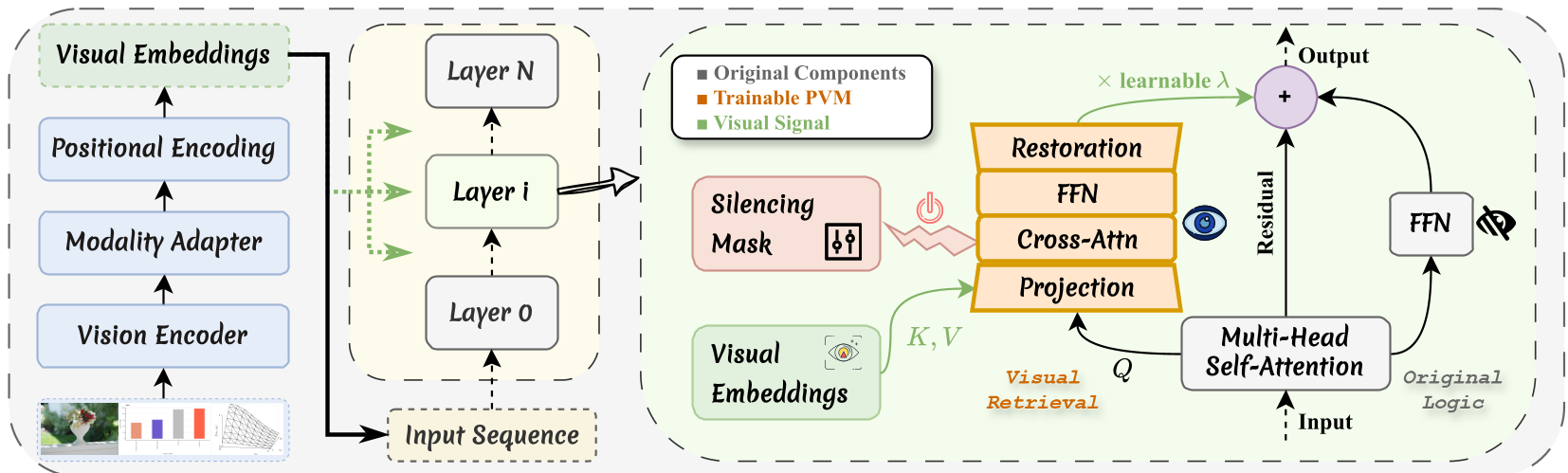
By utilizing Independent Attention Normalization, PVM ensures that the visual signal remains constant regardless of how many thousands of words the model has already generated.
Experimental Results: Performance under Pressure
The authors tested PVM on the Qwen3-VL series across 8 benchmarks (MMMU, MathVerse, etc.).
- Scale Consistency: Improvements were seen at both 4B (+4.4%) and 8B (+4.8%) scales.
- The "Long" Advantage: In the MathVerse benchmark, PVM showed a massive +27.3% relative improvement in the "Long" sample group, where baseline models usually fail due to signal decay.
Mechanistic Insight: LogitLens Analysis
Using a technique called LogitLens, the researchers tracked how quickly the model's internal layers "decide" on an answer. PVM-enhanced models reached a stable prediction distribution much earlier than the baseline. This suggests PVM doesn't just add "knowledge"—it accelerates the transition from perception to reasoning.
Critical Analysis & Takeaways
Why is this a big deal? Most current research focuses on bigger Vision Encoders or more SFT data. PVM points out that the architecture of the Transformer itself is biased against visual persistence.
Limitations: The current work is optimized for static images. In a world moving toward video agents, a key challenge will be applying PVM to streaming visual contexts where the "memory" itself changes over time.
Conclusion: PVM demonstrates that "seeing" shouldn't be a one-time event at the start of a prompt. For AI to handle complex tasks, it needs a dedicated, persistent visual buffer—a "Third Eye" that remains open even when the "Brain" is busy talking.