
[PRX 2026] The Geometry of Doping: Uncovering Half-Integer Chiral Superconductivity in Fractional Chern Insulators
Phases of itinerant anyons in Laughlin's quantum Hall states on a lattice
The paper investigates the phases of itinerant anyons in hole-doped Laughlin-like fractional Chern insulators (FCIs) on a lattice. By employing parton mean-field theory and Variational Monte Carlo (VMC), the authors discover how the interplay between band geometry and anyon dispersion leads to various phases, most notably a charge-2e anyon superconductor with a half-integer chiral central charge () in doped fermionic states.
Executive Summary
TL;DR: Researchers have bridged the gap between the abstract theory of "anyon superconductivity" and the reality of lattice-based Fractional Chern Insulators (FCIs). By analyzing how anyons move and interact within the unique "ideal" bands of moiré materials, the study reveals a new pathway to superconductivity in the state. They predict a specific superconducting state with a half-integer chiral central charge (), derived from the collective behavior of fundamental anyons.
Background Positioning: This work sits at the intersection of topological order and strongly correlated electrons. It advances the "Anyon Superconductivity" hypothesis—originally proposed in the late 80s—by providing a modern, microscopic foundation that justifies recent experimental sightings of superconductivity in materials like MoTe2 and rhombohedral graphene.
Problem & Motivation: Why Doping Changes Everything
In a standard Fractional Quantum Hall (FQH) effect, anyons are "quenched" by a uniform magnetic field; they are essentially stationary. However, in an FCI, the underlying lattice breaks continuous translation symmetry. This allows anyons to become itinerant—they develop kinetic energy and move according to a Bloch momentum.
The fundamental tension is this:
- Kinetic Energy: Anyons want to delocalize to minimize energy.
- Statistical Interaction: At finite densities, anyons feel each other's "exchange phases." For fractional particles, this acts as a source of frustration.
Previous theories (e.g., Shi & Senthil) suggested that anyons might pair into composites to cancel this statistical phase, leading to superconductivity. However, those models often treated partons as distinct entities. This paper argues that parton symmetry (specifically invariance) is a critical, often overlooked feature of Laughlin states that dictates which anyonic phase ultimately wins.
Methodology: Partons, Flux, and Geometry
The authors use a Parton Construction, where a physical electron is decomposed into virtual fermions (partons). To ensure physical reality, these partons are "glued" by an internal gauge field.
The Core Insight: Flux Re-distribution
When you hole-dope a state, you introduce quasiholes. The authors demonstrate that the system can minimize energy by re-arranging the effective magnetic flux seen by each parton species.
- The "Trace Condition" & Ideal Bands: The researchers move beyond standard Landau Levels to "Ideal Chern Bands." They prove that the average energy of a parton band depends on the interplay between Berry curvature fluctuations and effective dispersion.
- Energetic Tuning: By adjusting a geometric parameter ( in their model), they can simulate how different moiré materials might favor one anyonic phase over another.
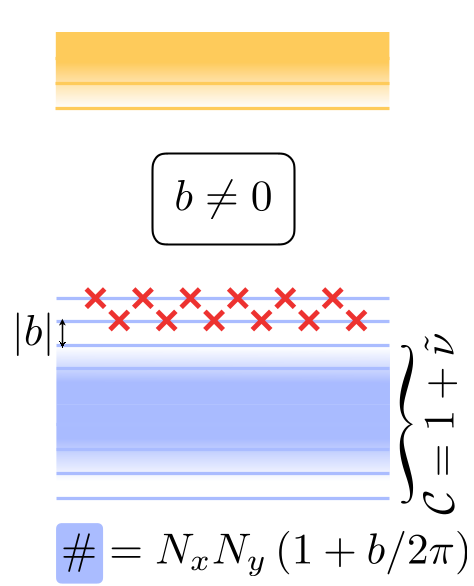 Figure 1: The competition of mini Landau Levels (mLLs) as flux is redistributed among the three parton species.
The Results: A New Superconducting Candidate
Using Variational Monte Carlo (VMC) on a generalized Kapit-Mueller lattice, the authors tested three scenarios for the state:
- Large Negative (Strong Dispersion): Favors the "Secondary Composite Fermi Liquid" (CFL). All holes go to one parton species.
- Near-Zero or Slightly Negative : The system enters a Anyon Superconducting state. This is the star of the paper. It describes a state where two partons share the same mean-field flux, leading to a charge-2e superconductor with a central charge .
- Positive : Preserves full symmetry but remains gapless at the mean-field level.
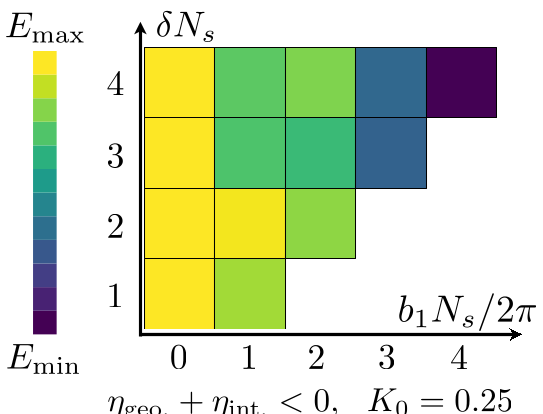 Figure 2: VMC energy comparisons showing the transition between the gapped superconductor and the gapless phase as the geometric parameter is tuned.
Why Matters
In the weak-pairing limit, a half-integer central charge is consistent with triplet pairing, which is a natural fit for the spin-polarized electrons typically found in these moiré systems. This gives a concrete, falsifiable prediction for thermal Hall conductance measurements.
Deep Insight & Conclusion
Takeaway: Superconductivity in doped FCIs isn't just about pairing—it’s about how anyons manage their "statistical frustration" through flux redistribution and band geometry.
Limitations: The mean-field parton approach, while powerful, is inherently "uncontrolled." While VMC provides numerical support, the exact nature of the transition between the gapped and gapless phases requires further investigation into gauge field fluctuations.
Future Outlook: This framework provides a roadmap for experimentalists to "tune" moiré materials (via twist angle or strain) into specific superconducting regimes. It elevates band geometry—specifically the Quantum Geometric Tensor—from a mathematical curiosity to a primary tool for designing topological superconductors.