
[2026] Photon-Echo Synchronization: Cracking the "Short Link" Code in Quantum Networks
Photon-echo synchronization and quantum state transfer in short quantum links
The paper introduces a Delay Differential Equation (DDE) framework to model "short quantum links" where the photon travel time is comparable to the emitter lifetime . It identifies a phenomenon of photon-echo synchronization and demonstrates that STIRAP protocols outperform traditional SWAP and CZKM methods in this regime, achieving a quadratic infidelity floor of .
TL;DR
Researchers have solved the "short link" problem in quantum interconnects—a regime where the time it takes for a photon to travel between qubits () is nearly equal to the qubit's own decay time (). By moving beyond simple cavity models to a Delay Differential Equation (DDE) framework, the study reveals that qubits "self-synchronize" via photon echoes. This discovery allows STIRAP protocols to reach unprecedented fidelities ( error) in hardware like 5-meter circuit-QED cables, outperforming traditional SWAP and wavepacket methods.
The "Missing Middle" of Quantum Interconnects
In the world of quantum communication, we usually think in two extremes:
- The Cavity Limit (): Photons move so fast the interaction is "instantaneous." We treat the link as a single mode of light.
- The Waveguide Limit (): The link is so long it's a continuum. We use "photon shaping" to send wavepackets.
However, modern experiments (using 0.73m to 5m cables) live in the Short Link Regime (). Here, the cavity model is too simple, and the waveguide model ignores the "echoes" of photons bouncing back and forth. Previous attempts to model this usually truncated the number of modes, missing the "kinks" and retardation effects that define real-world hardware.
The Secret Sauce: Photon-Echo Synchronization
The paper's breakthrough is the observation of Self-Synchronization. When an excited emitter relaxes into a short link, the photon travels to the end, reflects, and returns at . This "echo" re-excites the qubit, creating a "kink"—a non-differentiable point in the decay curve.
Instead of chaotic decay, the system locks into a stable, quasi-periodic oscillation. The authors equate this to a Discrete Time Crystal—a spontaneous symmetry breaking where the system oscillates at a frequency without any external driving.
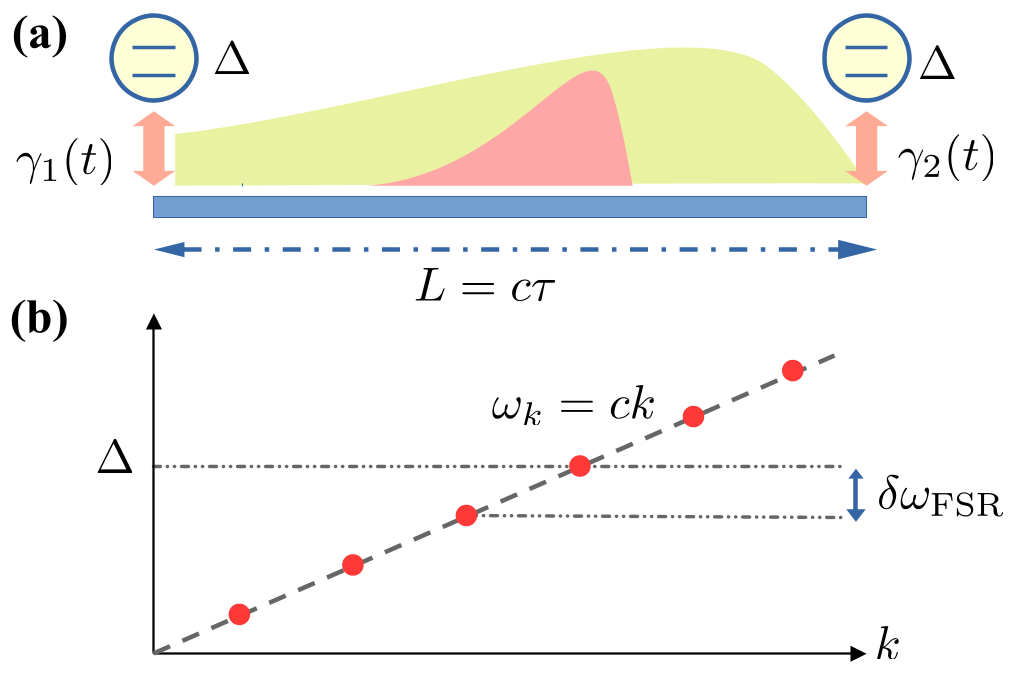 Above: Typical setup of two emitters in a short link. The DDE framework captures the sharp discontinuities (kinks) caused by returning photon echoes.
Methodology: Why DDEs?
The authors replace standard Master Equations with Delay Differential Equations (DDEs). Unlike Markovian models that only care about the "now," DDEs explicitly include terms like , representing the state of the system one travel-time ago.
This mathematical shift reveals a Spectroscopic Goldmine:
- Vacuum Rabi Splitting: Even in very long cables, the "echoes" create a ladder of hybridized states.
- Quasi-Dark States: Specific frequencies where the qubit is "protected" from decaying into the link.
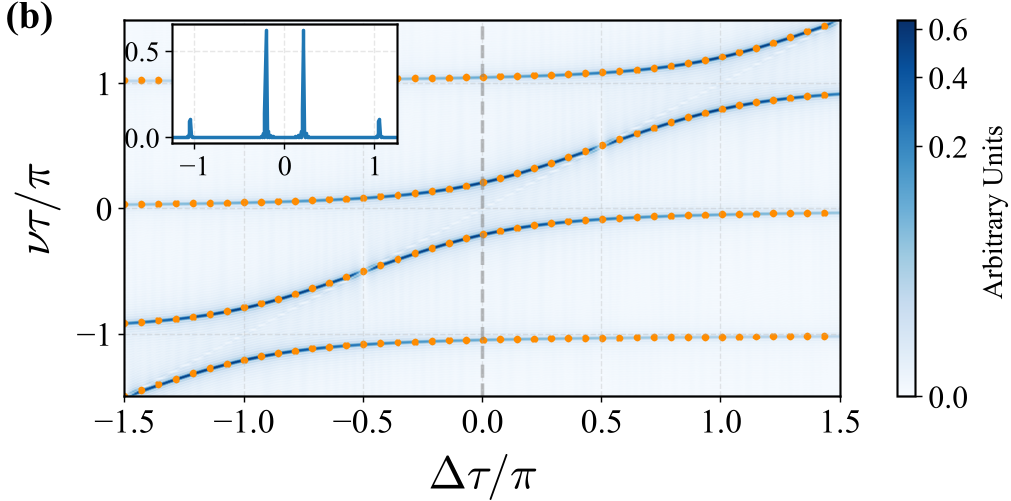 Experimentally observable: As coupling strength increases (superstrong coupling), the Rabi splitting saturates, but the quasi-dark states persist.
Benchmarking Quantum State Transfer (QST)
The paper benchmarks three heavy-hitters across the full spectrum:
- SWAP: Uses constant coupling. It suffers from a "linear error floor" because it's too sensitive to the multimode "jitters" in the link.
- STIRAP: The winner. By adiabatically following a "dark state" path, it suppresses errors quadratically . It stays effective up to .
- CZKM (Wavepacket Engineering): The gold standard for very long links. It only becomes faster and better than STIRAP once the link is so long that retardation dominates everything.
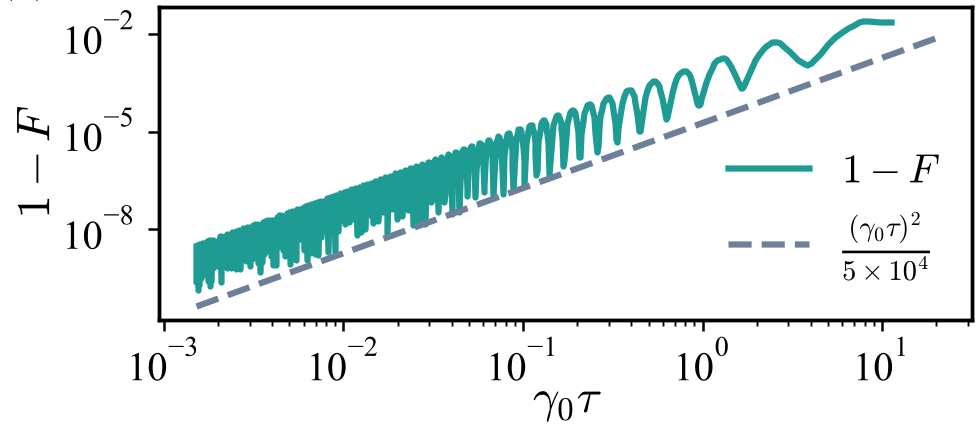 The "Survival of the Adiabatic": STIRAP (green/purple) maintains much higher fidelity than SWAP (blue) as retardation () increases.
Engineering Insight: Beyond the Theory
This isn't just math. The 5m link at ETH Zurich () and the 64m link at Tsinghua () can directly use these DDE analytical bounds to optimize their pulse sequences.
Main Takeaway: If you are building quantum links between superconducting racks, don't just "shape" your photons. Leverage the inherent synchronization of the link. By using STIRAP to navigate the quasi-dark states, you can achieve fidelities that were previously thought impossible in the presence of retardation.
Limitations & Future Work
While DDEs provide exact solutions for 1-2 emitters, scaling this to 100-node networks remains numerically challenging. However, this work provides the "unit cell" logic needed to understand how photon timing affects large-scale quantum internet topology.