
PhysForge: Transforming "Hollow Shells" into Interactive, Physics-Grounded 3D Assets
PhysForge: Generating Physics-Grounded 3D Assets for Interactive Virtual World
PhysForge is a decoupled two-stage framework for generating physics-grounded, interactive 3D assets from a single image. It utilizes a VLM-based planner to create hierarchical blueprints and a diffusion model with a novel KineVoxel Injection (KVI) mechanism to synthesize high-fidelity geometry alongside precise kinematic parameters.
TL;DR
Static 3D models are a solved problem, but interactive 3D models are not. PhysForge introduces a two-stage paradigm—VLM-based Planning and Diffusion-based Realization—to generate 3D assets that aren't just pretty to look at, but are fully functional. These assets come equipped with hierarchical kinematics, material properties, and functional logic, making them ready for immediate deployment in Embodied AI simulators.
The Problem: The "Hollow Shell" Bottleneck
In the current 3D generation landscape (think LRM, TripoSR, or TRELLIS), we have become very good at generating "hollow shells." These models have high-fidelity textures and geometry, but if you try to open a drawer or pull a lever, the model breaks down.
Current methods suffer from:
- Lack of Functional Logic: Models don't understand that a handle should be "metal" and a cabinet door should be "movable."
- Ambiguous Granularity: Without physical constraints, models struggle to decide where one part ends and another begins.
- Precise Kinematic Ambiguity: High-level models like VLMs are great at naming parts but terrible at predicting the exact numerical 3D coordinates of a joint axis.
The PhysForge Strategy: Architecture of a Physical Asset
PhysForge solves this by shifting the focus from "form" to "function." The framework is built on two primary stages:
1. The VLM as a Physical Architect
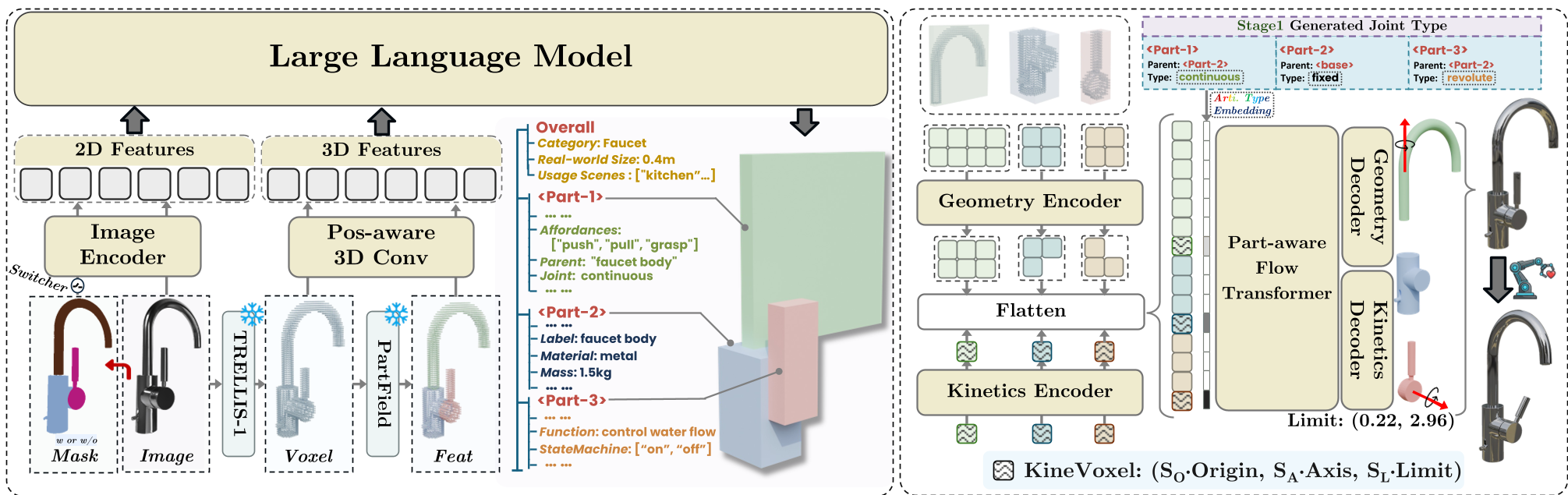
Instead of generating everything at once, PhysForge first uses a Vision-Language Model (VLM) to draft a "Hierarchical Physical Blueprint." By fine-tuning Qwen2.5-VL with 3D spatial awareness, the model acts as an architect that identifies:
- Part Layout: 3D bounding boxes for every component.
- Static Properties: Material (e.g., wood), mass, and semantics.
- Functional Logic: Is it a container? Is it a toggle?
- Interactive Constraints: Is it a revolute joint? What are its parent-child relationships?
2. Physical Realization via KineVoxel Injection (KVI)
While the VLM plans the "what," the Diffusion-based Generation stage handles the "how." The core innovation here is KineVoxel Injection (KVI).
Traditional diffusion models process geometry as voxels. PhysForge introduces a KineVoxel—a special latent representing an 8D vector of kinematic parameters (Origin, Axis, Limits). These are injected directly into the denoising transformer, allowing the model to learn the synergistic relationship between a part's geometry and its physical movement.
PhysDB: Fueling Physical Intelligence
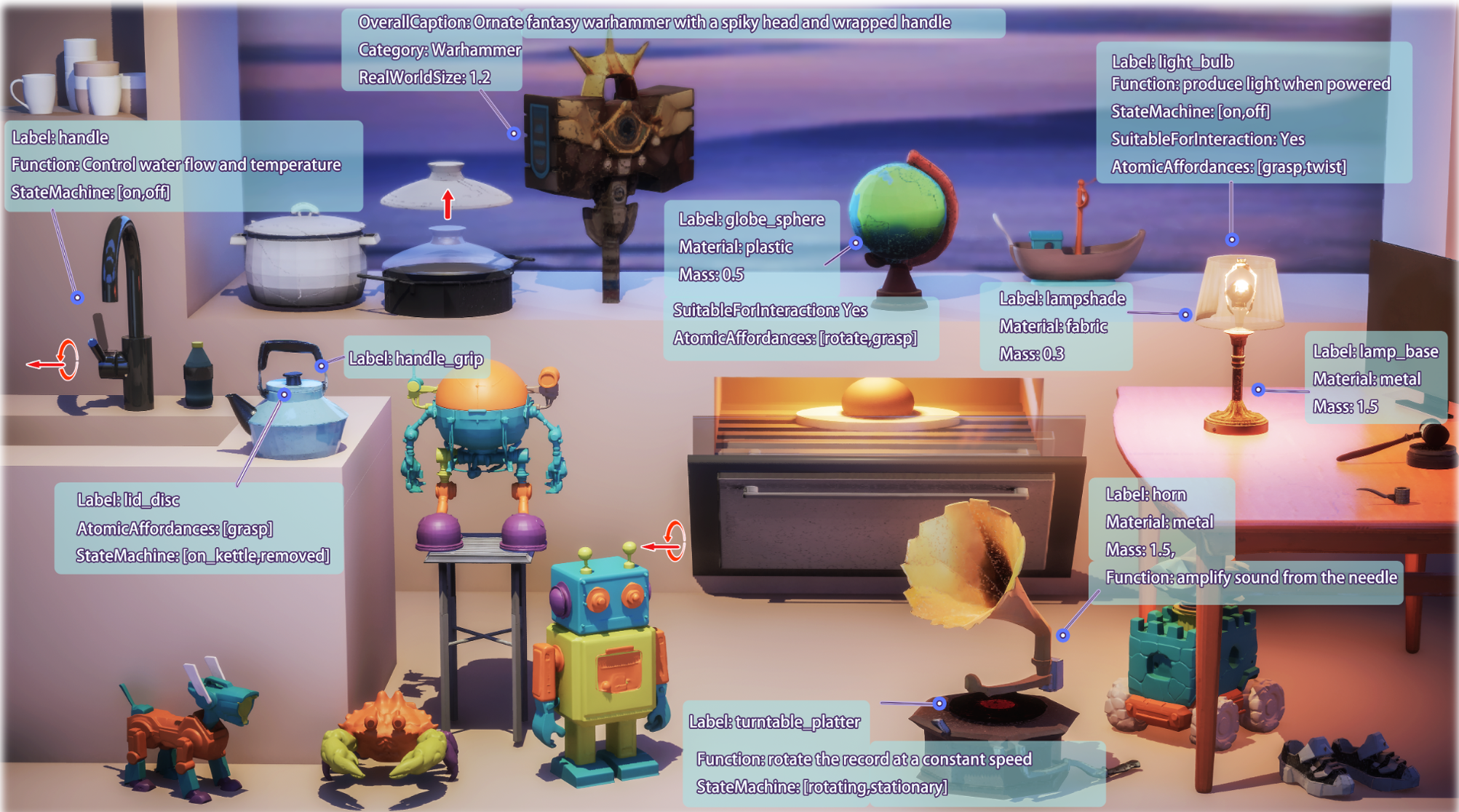
To train such a model, the authors created PhysDB, a massive dataset of 150,000 assets with a unique four-tier physical annotation system:
- Holistic: World scale and context.
- Static: Materials and mass.
- Functional: Intrinsic functions and state machines.
- Interactive: Joint types and atomic affordances.
Experiments & Results
PhysForge doesn't just match SOTA performance in geometry; it crushes it in physical accuracy.
| Metric | TRELLIS | PhysXGen | PhysForge |
|---|---|---|---|
| F1-0.05 (Geometry) | 53.28 | 50.57 | 55.38 |
| Absolute Scale Err (m) | - | 1.08 | 0.37 |
| Function CLIP-Sim | - | 0.36 | 0.83 |
The reduction in joint axis error is particularly impressive, proving that the Joint Type Embedding from the VLM provides a critical inductive bias that helps the diffusion model converge on the correct physical parameters.
Deep Insight: Why This Works
The "synergistic effect" mentioned in the paper is the most profound takeaway. The authors found that predicting physics actually makes the geometry better. By forcing the model to understand the function of a part (e.g., this is a hinge), the model naturally resolves ambiguities in part decomposition that purely visual models struggle with.
Downstream Impact: Simulation-Ready Assets
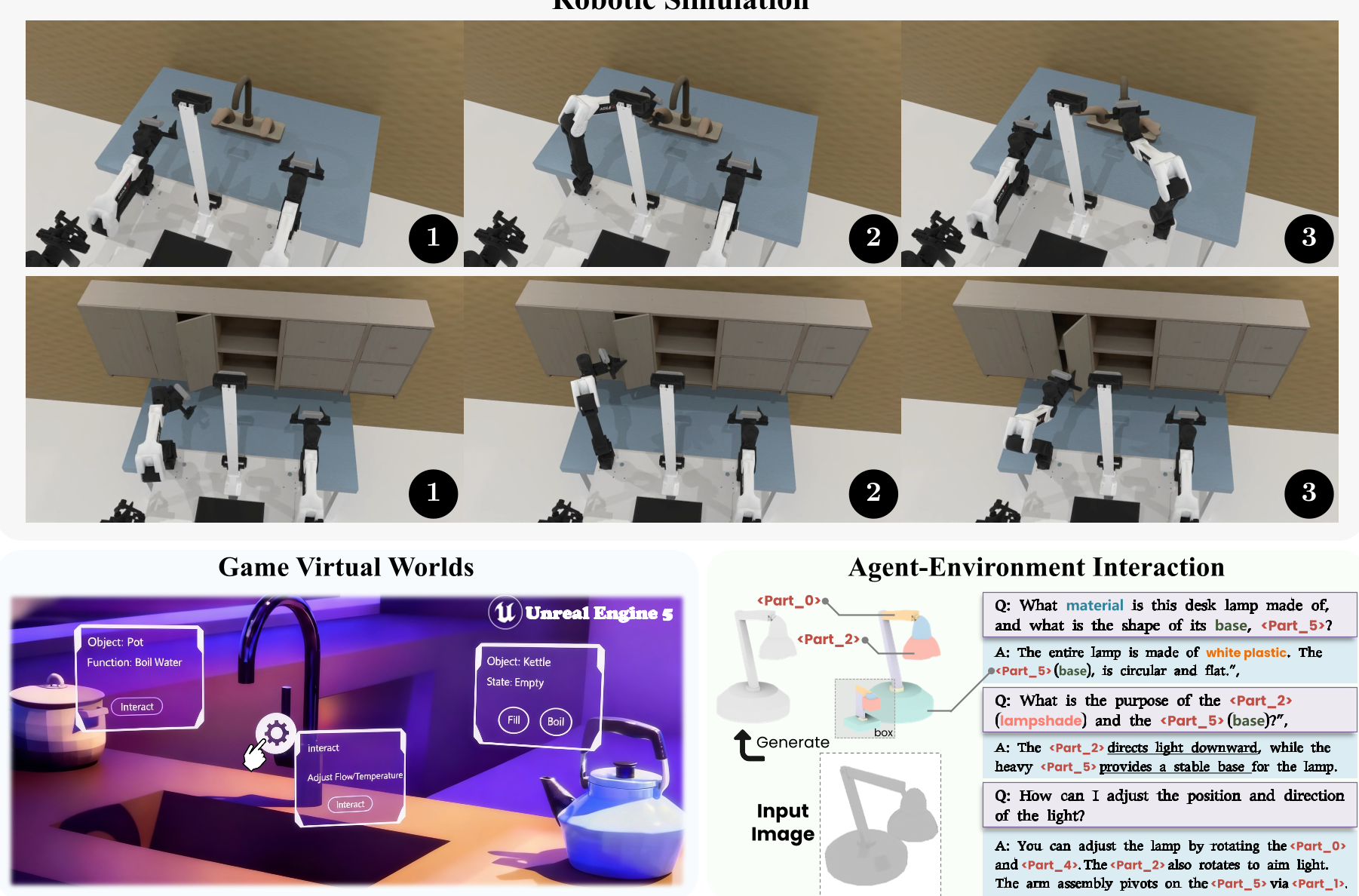
The assets generated by PhysForge are not just for show; they have been successfully tested in:
- RoboTwin Simulators: Enabling robots to learn manipulation skills on AI-generated furniture.
- Virtual Worlds (UE/Unity): Allowing game developers to import assets that already "know" how they should move and what they are made of.
- VLA Interactions: Giving embodied agents a language-based blueprint to plan complex tasks like "open the second drawer and retrieve the metal object."
Conclusion
PhysForge represents a pivot point in 3D AI. We are moving from the era of "3D Modeling" to "3D Engineering." By coupling the semantic world knowledge of VLMs with the precise generative power of Diffusion, PhysForge provides the essential data engine for the next generation of interactive virtual worlds and physical AI.