
From Pixels to Tokens: Decoding the Power of Latent Action Supervision in VLA Models
From Pixels to Tokens: A Systematic Study of Latent Action Supervision for Vision-Language-Action Models
This paper presents a systematic study of latent action supervision for Vision-Language-Action (VLA) models, comparing image-based and action-based formulations across four integration strategies. The study reveals a task-formulation correspondence: image-based latent actions excel at long-horizon reasoning, while action-based tokens favor complex motor coordination, ultimately showing that direct discrete token supervision achieves SOTA performance.
TL;DR
Building a "Generalist Robot" requires training on massive, often messy, heterogeneous datasets. This paper systematically proves that Latent Actions—intermediate representations of motion—are the key to solving data inconsistency. By testing four integration strategies, the authors found that direct discrete token supervision is the most effective way to upgrade VLA models, with image-based latents boosting reasoning and action-based tokens mastering motor control.
Background: The Heterogeneity Headache
Modern Vision-Language-Action (VLA) models, like OpenVLA or RT-2, are the brains behind general-purpose robots. However, they face a massive data problem: human videos have no action labels, and different robot arms (e.g., JAKA vs. Franka) speak different "action languages." This semantic mismatch across datasets often leads to "negative transfer," where learning a new task actually makes the model worse at old ones.
The proposed solution? Latent Actions. Instead of predicting raw motor signals (like joint torques) directly, the model learns to predict "tokens" representing high-level concepts of movement.
Methodology: Two Perspectives, Four Strategies
The researchers didn't just propose a new model; they built a "unified laboratory" based on Qwen3-VL-2B to rigorously test how latent actions should be used. They categorized the approach into two mapping directions:
1. Regularizing the Trajectory (Image-Based)
This uses visual transitions (what the scene should look like next) to guide the model.
- LA-Align: Implicitly matching VLM internal features to latent embeddings.
- LA-Direct: Explicitly forcing the VLM to "write out" the latent tokens.
- LA-Cond: Making the final action prediction dependent on the written-out plan.
2. Unifying the Target Space (Action-Based)
This compresses complex motion chunks into a single "language" of tokens.
- LA-Tok: Mapping continuous actions into discrete tokens that the VLM predicts just like words.
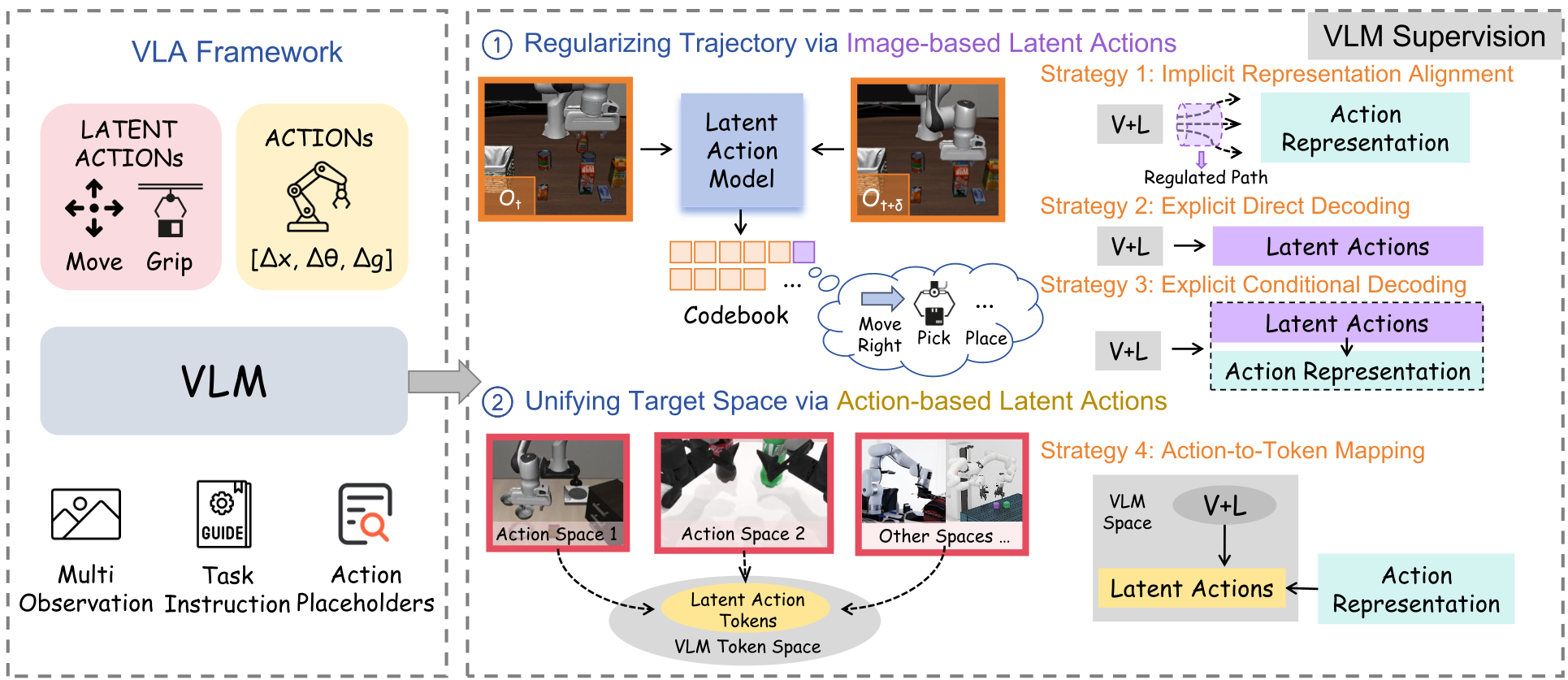 Figure 1: The Unified VLA Baseline and the four integration strategies for latent action supervision.
Key Insights: Formulation-Task Correspondence
The most striking discovery was that there is no "one size fits all" latent action.
- Long-Horizon Tasks (e.g., LIBERO-Long): Image-based latent actions are king. By focusing on visual transitions, the model "imagines" the sequence of sub-goals better, leading to a +10.8% improvement.
- Motorically Complex Tasks (e.g., RoboTwin 2.0): Action-based tokens excel. When dual-arm coordination or high-frequency control is needed, discretizing the action space into a unified vocabulary helps the VLM master fine motor skills, yielding a massive +17.5% gain.
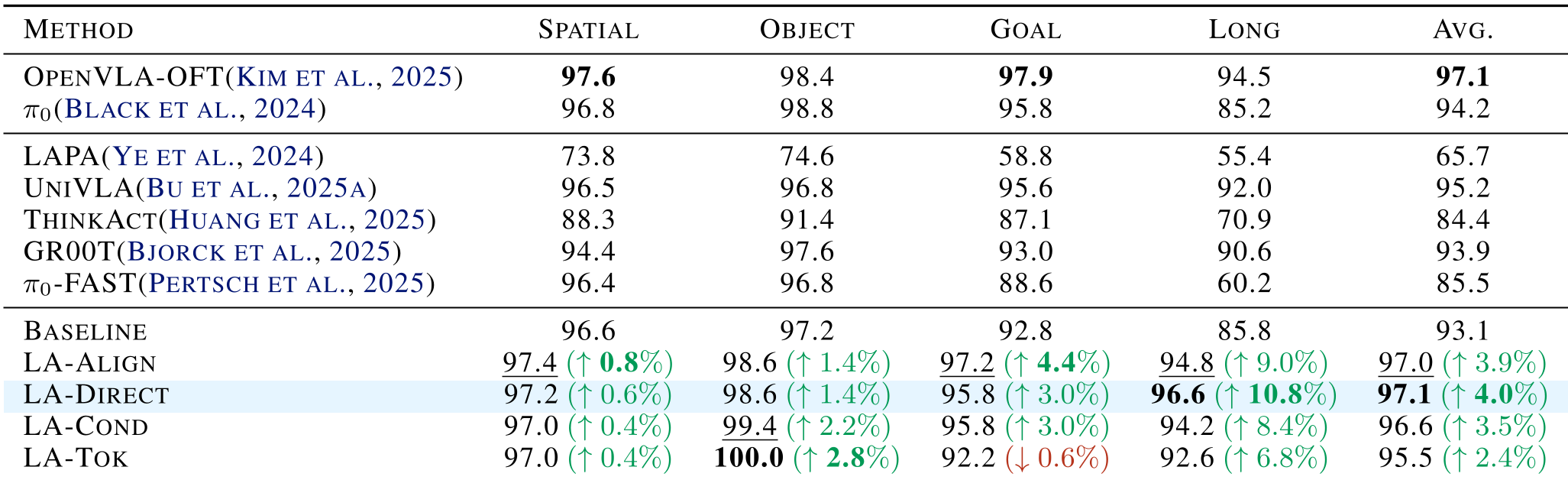 Table 1: Performance on LIBERO. Notice how LA-Direct (Image-based) dominates the "Long" category.
Why Discrete Tokens Beat Continuous Regressions
One of the paper's critical "Aha!" moments is the comparison between predicting a continuous number (regression) and a discrete category (tokenization). The experiments showed that Discrete Tokens are superior.
Why? Tokens provide a more structured supervision signal that aligns with the VLM's pre-trained "brain" (which is inherently built to predict discrete text tokens). This also helps the model handle Multi-task Joint Training without the performance of one task crashing into another.
Real-World Validation: The JAKA Arm
The authors didn't stop at simulations. They took the models to a real JAKA robotic arm for tasks like stacking 4 bowls and wiping stains.
- Scene Generalization: Under Out-of-Domain (OOD) settings (new distractor objects), image-based strategies were significantly more robust.
- Sample Efficiency: Using latent actions allowed the model to reach 94% success with only 50% of the training data.
Conclusion and Future Outlook
This systematic study serves as a "blue-print" for the next generation of generalist robots.
Takeaway for Researchers: If your robot needs to plan long-term, use Image-based Direct Decoding. If it needs to perform delicate surgery or complex bimanual tasks, use Action-based Token Mapping. Most importantly: always use discrete tokens.
While limited to single-arm platforms in the real world for now, the path is clear—latent actions are the bridge from raw pixels to meaningful robotic intelligence.