
[NeurIPS 2025] The PokéAgent Challenge: Why Pokémon is the Ultimate Stress Test for Frontier AI
The PokeAgent Challenge: Competitive and Long-Context Learning at Scale
The PokéAgent Challenge is a large-scale decision-making benchmark featuring two tracks: competitive Pokémon battling and RPG speedrunning. It introduces the largest Pokémon battle dataset (22M+ trajectories) and demonstrates that specialized RL and search methods (like MCTS) still significantly outperform generalist LLMs in complex, partially observable environments.
TL;DR
The PokéAgent Challenge is a massive new benchmark designed to push AI agents to their limits in two arenas: Competitive Battling (strategic reasoning under partial observability) and RPG Speedrunning (long-horizon planning across thousands of steps). The results from over 100 competing teams are clear: while LLMs are improving, they still suffer from "panic behavior" and "computational paralysis" when faced with the stochastic, adversarial depth of Pokémon, lagging behind specialized Reinforcement Learning (RL) and Search systems.
Background Positioning
In the landscape of AI testbeds, we've moved from Chess (Board Games) to StarCraft (RTS) to Diplomacy (Negotiation). Pokémon represents a unique "living benchmark" because it combines a state space of —dwarfing Go—with a metagame that evolves constantly via a massive human player base. It is a SOTA-shaking benchmark that proves our current evaluation suites (MT-Bench, MMLU, etc.) are failing to capture strategic resilience.
The "Orthogonality" Problem: Why Pokémon is Different
The authors performed a fascinating SVD (Singular Value Decomposition) analysis using the BenchPress matrix. They found that Pokémon performance is almost entirely uncorrelated with standard LLM benchmarks.
- The Insight: A model can be a "Grandmaster" at coding or math but "collapse" in a Pokémon battle. This is because Pokémon requires recovery from errors under pressure, a capability not tested by static Q&A datasets.
Methodology: Bridging the Gap between RL and LLMs
1. Competitive Battling (Track 1)
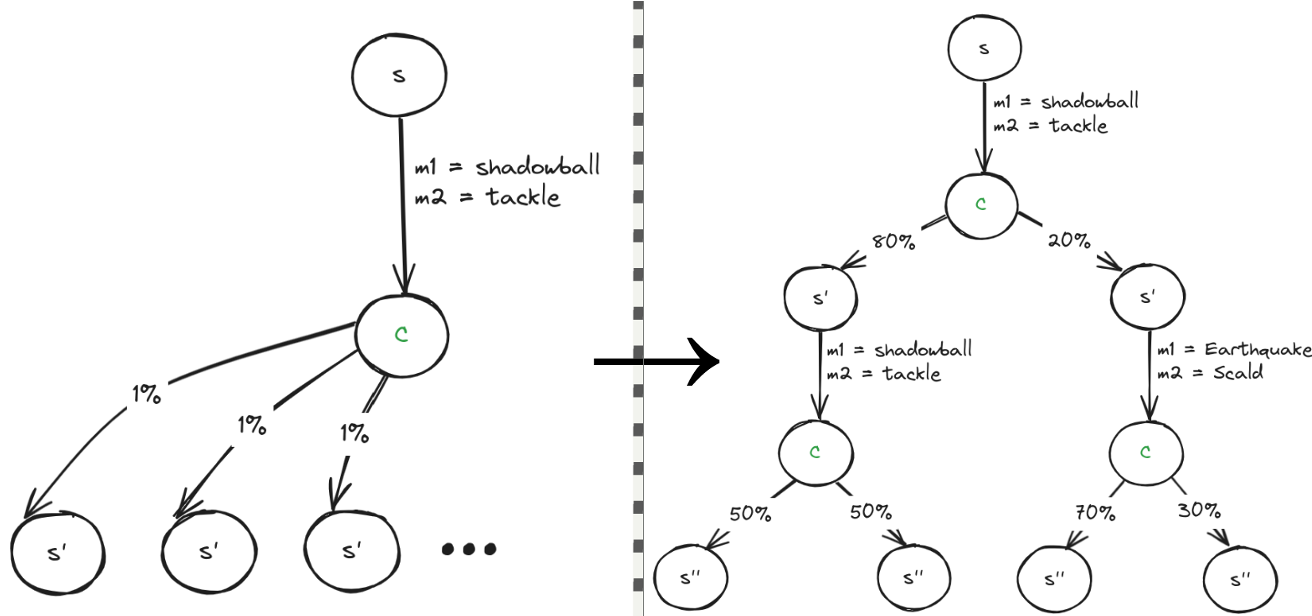
The winning approach, FoulPlay, utilized Root-Parallelized MCTS with a custom Rust-based engine. To combat the state space, it used Damage Roll Grouping. Instead of simulating every possible damage number, it clustered outcomes by their functional impact (e.g., "Does this move KO or not?").
2. RPG Speedrunning (Track 2)
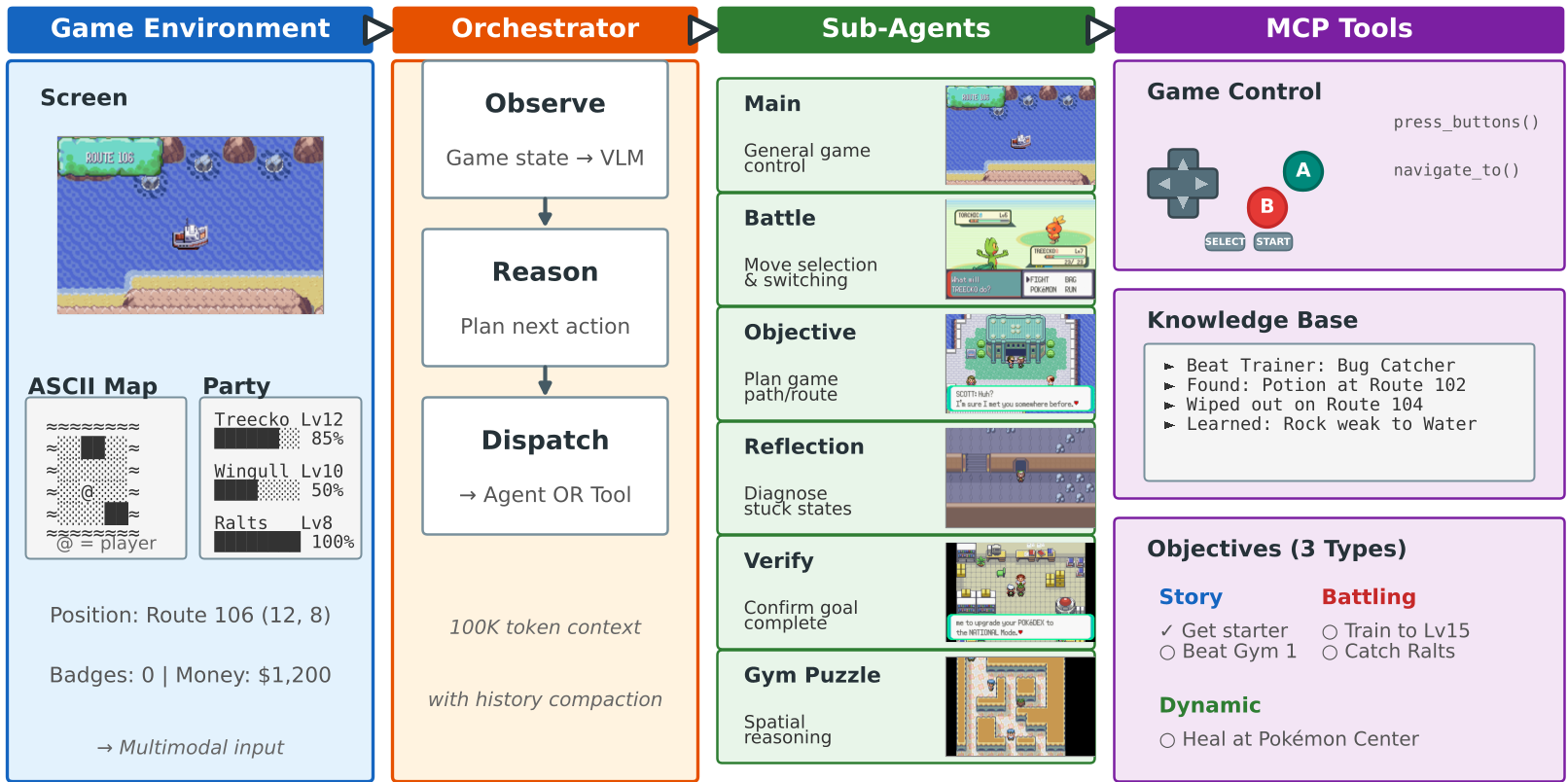
Speedrunning requires maintaining a coherent plan over 35,000+ actions. The standout method was Scripted Policy Distillation (SPD).
- The Intuition: Use an LLM to write high-level "scripts" (subgoals), then use RL to "distill" those scripts into a neural network. This allows the agent to have the strategic "prior" of a human but the execution speed and optimization of a machine.
Core Results & Performance Hierarchy
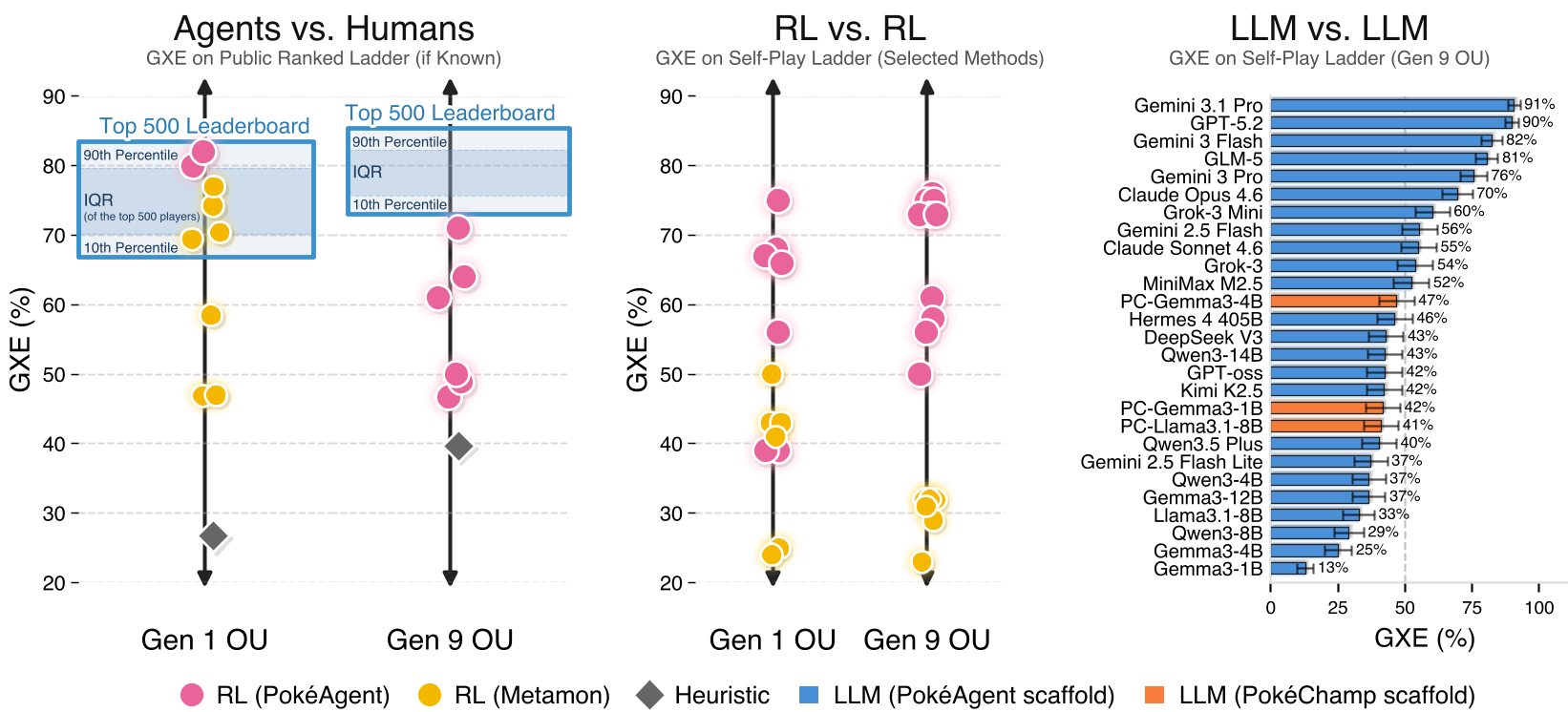
The competition validated a clear hierarchy of agents:
- Specialist RL/Search: Dominates the leaderboard (e.g., FoulPlay's 50-14 victory in the finals).
- Harness-supported LLMs: Capable of "High-Level" play but struggle with fine-grained probability estimation.
- Raw Frontier Models: Generally fail ("wandering aimlessly") without a sophisticated scaffold for perception and memory.
Critical Pathologies: Why LLMs Fail
The authors identified four distinct "failure modes" using Chain-of-Thought (CoT) Visualization:
- Panic Behavior: Compounding a minor tactical error into a game-losing streak.
- Computational Paralysis: Getting stuck in recursive loops ("Is Water weak to Fire?") while the game timer runs out.
- Memory Corruption: Following an incorrect path for hours once a single false fact enters the context window.
Deep Insight & Future Outlook
The PokéAgent Challenge proves that General Intelligence Strategic Competence.
The Takeaway for Developers: If you are building autonomous agents (for coding, robotics, or gaming), the "Scaffold/Harness" is not just a UI layer—it is a fundamental part of the reasoning engine. The future of AI doesn't lie in just "bigger LLMs," but in Hybrid Architectures where LLMs handle the "Why" (Goal setting) and RL handles the "How" (Optimal execution).
Limitations
- Vision Bottleneck: VLM-based agents still struggle with basic spatial localization (VLM-SLAM).
- Inference Gap: The best agents are still ~2.2x slower than human world records, primarily due to LLM deliberation time.