
The Positivity Bootstrap: How Axion Wormholes Force the Weak Gravity Conjecture
Positivity of the gravitational path integral implies the axionic weak gravity conjecture
This paper derives the axionic Weak Gravity Conjecture (WGC) by enforcing the positivity of the gravitational path integral. It demonstrates that theories with an exact axion shift symmetry lead to divergent wormhole amplitudes and negative norms in the Hilbert space, necessitating non-perturbative "instanton" corrections that break the symmetry.
TL;DR
Unitarity is not just a luxury in quantum mechanics; it is a rigid constraint in Quantum Gravity. By analyzing the gravitational path integral (GPI), this paper proves that an axion with an exact shift symmetry is mathematically inconsistent because it produces "negative norm" states. To fix this, the universe must contain instantons that break the symmetry, leading to a rigorous derivation of the Axionic Weak Gravity Conjecture (WGC) with precise numerical constants.
Problem & Motivation: The Symmetries That Shouldn't Be
In the landscape of Effective Field Theories (EFTs), axions are everywhere—from the Strong CP problem in QCD to string theory moduli. Standard EFTs treat the axion shift symmetry () as potentially exact. However, a long-standing "folk theorem" in quantum gravity suggests that no global symmetries can exist.
While the axionic WGC suggests that there must be an instanton with action , the "Why" has always been a bit fuzzy, often relying on the absence of black hole remnants. The authors of this paper take a more fundamental route: they ask if the gravitational path integral used to compute state overlaps is positive semi-definite. If it isn't, the theory doesn't have a valid Hilbert space.
Methodology: Divergent Wormholes and the Imaginary Distance
The core of the argument lies in axion wormholes. These are gravitational saddles that connect different parts of spacetime.
- The Divergence: When we complexify the axion field (moving in the imaginary direction of the moduli space), the amplitude of these wormholes becomes unbounded.
- The Critical Bound: The authors identify a universal critical value for imaginary field excursions:
- Positivity Violation: Using the Stieltjes moment problem, the authors show that as the wormhole amplitude (the variance) blows up while the mean stays finite, the probability of having states with negative norms approaches 50%. This is a "catastrophe" for a quantum theory.
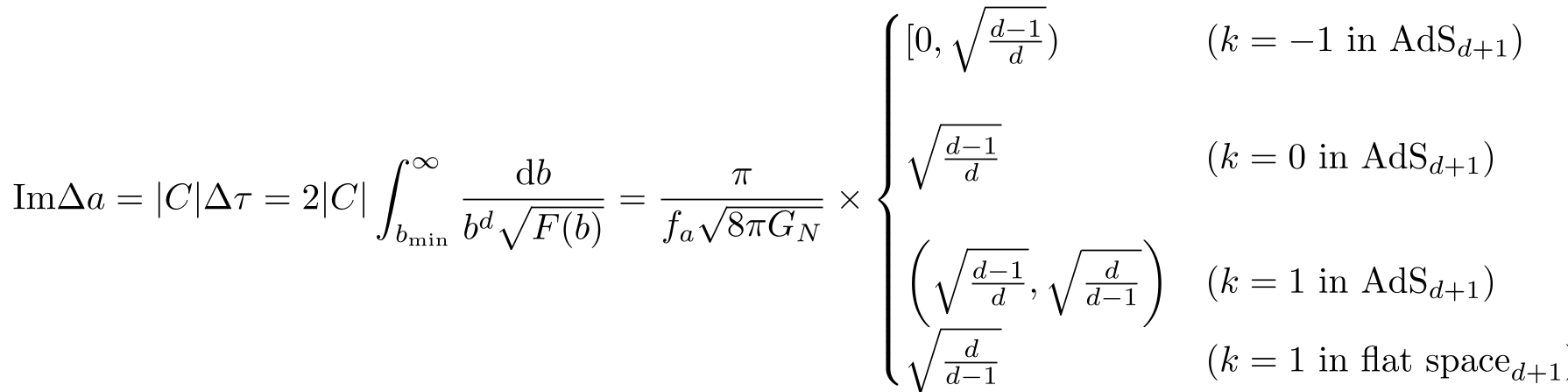 Eq (B3): Calculation of the critical axion difference across various slicing geometries.
The Weak Gravity Argument: Instantons to the Rescue
How does Nature prevent this divergence? The authors argue the wormhole must be non-perturbatively unstable.
Specifically, instantons must proliferate before the wormhole amplitude can diverge. This requires the instanton action to be small enough to "kick in" early. By setting the instanton suppression factor equal to the wormhole divergence threshold, the authors derive the WGC: This is not just a qualitative check; it provides the precise O(1) factors that have been debated in the Swampland community for years.
Experiments & Results: From Theory to Our Universe
The paper doesn't stay in the realm of abstract math. It applies the bound to our universe:
- QCD Axion: By estimating the instanton action for Yang-Mills (~12), they find that for the QCD axion should be GeV.
- String Theory: They check the bound against Type IIB Supergravity on . They find that the actual coupling in string theory () safely satisfies their derived stability bound ().
Note: The paper relies on verifying that well-known UV-complete theories like Type IIB string theory satisfy these new consistency conditions.
Critical Insight & Conclusion: The "Imaginary Distance Conjecture"
The paper introduces a fascinating concept: the Imaginary Distance Conjecture. While the standard Distance Conjecture talks about towers of states appearing as you move an infinite distance in real moduli space, this work suggests a "hard wall" in the imaginary direction.
Limitations
- The authors assume that multi-boundary wormholes (which connect 3, 4, or more points) are subleading. While standard in the expansion, this is notoriously difficult to prove in higher dimensions.
- The "instanton" is a catch-all term for any non-perturbative effect; the exact nature of the UV completion remains to be specified for specific models.
Final Takeaway
This work represents a massive leap for the Swampland Program. By moving away from "patterns in string theory" and toward "positivity of the path integral," the authors have grounded one of the most famous conjectures in particle physics in the bedrock of quantum mechanical consistency.