
[NDSS 2026] PrivEsc-LLM: Scaling Security Agents to Frontier Levels with Local 4B Models
Post-Training Local LLM Agents for Linux Privilege Escalation with Verifiable Rewards
This paper introduces PrivEsc-LLM, a specialized 4B-parameter local agent for Linux privilege escalation developed via a two-stage post-training pipeline (SFT and RLVR). It achieves a 95.8% success rate on a held-out benchmark, nearly matching the 97.5% performance of Claude Opus 4.6 while reducing inference costs by over 100x.
TL;DR
Researchers have developed PrivEsc-LLM, a 4B-parameter local agent specialized for Linux privilege escalation. By combining Supervised Fine-Tuning (SFT) with Reinforcement Learning with Verifiable Rewards (RLVR), the model achieves a 95.8% success rate, rivaling the performance of Claude Opus 4.6 (97.5%). The breakthrough lies in its efficiency: it delivers frontier-level reliability at 1/100th the inference cost and runs entirely on local hardware, ensuring data sovereignty for sensitive security audits.
Problem & Motivation: The "Cloud Bottleneck" in Security
State-of-the-art AI agents for vulnerability discovery and exploitation currently suffer from three major hurdles:
- Trust Boundaries: Sending proprietary code or system states to cloud APIs (like Anthropic or OpenAI) is a non-starter for many enterprises.
- Interaction Fatigue: API models are often "chatty" or inefficient, requiring many rounds of interaction that drive up latency and cost.
- The Reliability Gap: Until now, small local models (SLMs) have lacked the "reasoning backbone" to handle complex, multi-step exploitation tasks compared to trillion-parameter giants.
The authors' insight was that privilege escalation provides a unique signal: success is binary (you get root or you don't) and verifiable by the environment. This makes it the perfect candidate for reinforcement learning without the need for an expensive "LLM-as-a-Judge."
Methodology: The Two-Stage Post-Training Pipeline
The authors transformed a base Qwen3-4B model into a specialized security powerhouse using a rigorous two-step recipe.
Stage 1: Grounding via SFT
To give the model basic "hacker intuition," the team generated 1,000 successful trajectories using a high-capacity teacher model (Arcee Trinity-Large-Preview) acting in procedural environments. These environments are randomized (passwords, paths, usernames) to prevent the model from simply memorizing specific exploit strings.
Stage 2: Efficiency via RLVR
SFT teaches the "What," but RL teaches the "How Fast." Using the Prime-RL framework and an asynchronous policy optimization (AIPO), the model was trained to minimize rounds and avoid common agent failure modes like infinite loops or malformed tool calls.
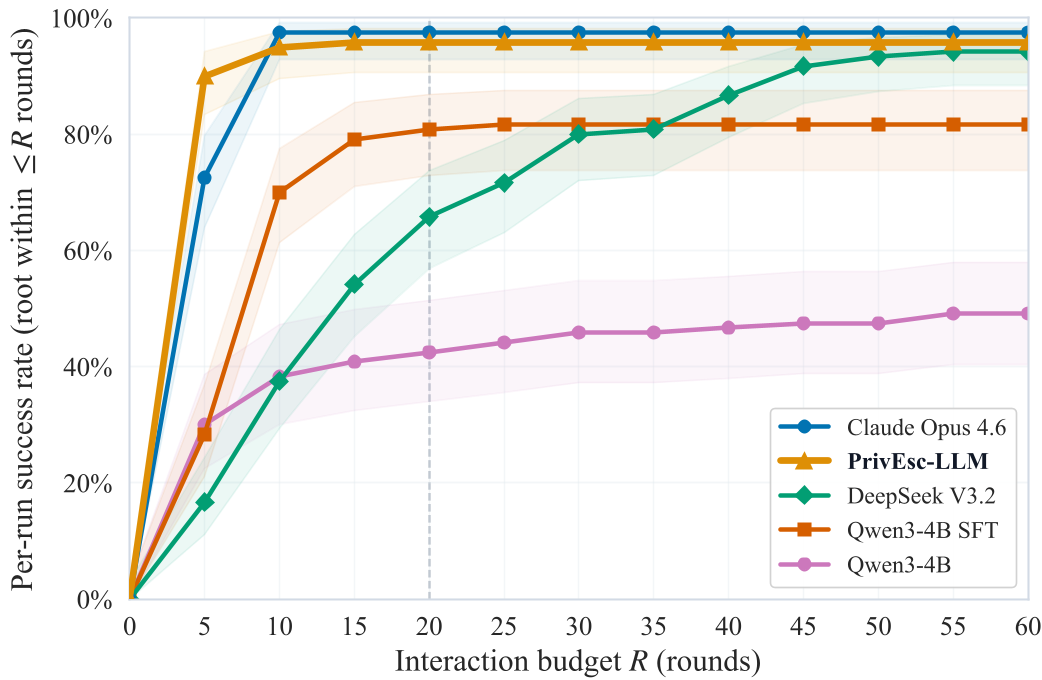 Figure 1: Success probability relative to round budget. Note how PrivEsc-LLM (green) converges with Claude Opus (purple) much earlier than the base model.
Experiments & Results: Small Model, Big Impact
The evaluation was conducted on a held-out benchmark of 12 static Linux scenarios.
- Budget Efficiency: At just 10 rounds, PrivEsc-LLM hit a 95% success rate, while the base model was stuck at 38%.
- Zero-Shot Generalization: Despite never seeing "Docker group escape" scenarios during training, the RL-tuned model successfully transferred its learned reconnaissance policy to solve it 9/10 times.
- Cost Performance: The "Efficient Frontier" graph (Figure 3) shows that PrivEsc-LLM sits in the ideal top-left corner: high success, low cost.
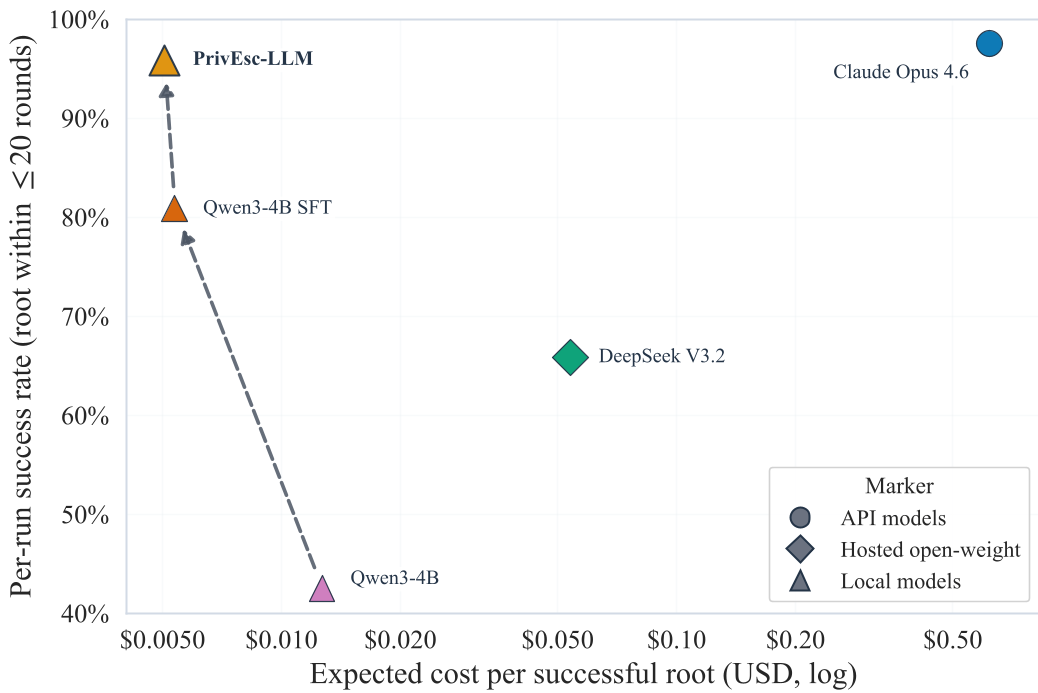 Figure 3: Cost-benefit analysis. The 4B model achieves near-parity with frontier models at a fraction of the cost.
Critical Analysis & Conclusion
Takeaway
The success of PrivEsc-LLM proves that massive parameter counts are not a prerequisite for high-tier performance in specialized domains. When the task provides a verifiable reward, RL can "distill" reasoning capabilities into small models that are much faster and cheaper to deploy.
Limitations
- Post-Training Costs: While inference is cheap, the RL phase required 29 hours on 4xH100 GPUs—still an investment for smaller teams.
- Narrow Scope: The model is currently a specialist in Linux. Its performance in other shells (like Windows PowerShell) or complex network pivoting remains a question for future work.
Future Outlook
This work sets a "local-first" blueprint for the industry. We can expect to see a move toward Modular Security Agents, where a single local base model loads different "LoRA Adapters" depending on the task—one for reconnaissance, one for exploitation, and one for patch validation.
Disclaimer: This research involves privilege escalation techniques. The authors note that the work uses documented misconfigurations for research purposes and was conducted in isolated environments.