
Beyond Curiosity: A New Theory of Agency Through Bridge Interfaces
Prediction and Empowerment: A Theory of Agency through Bridge Interfaces
This paper introduces a formal theory of agency based on Bridge Interfaces, modeling sensing and actuation as shared boundaries between an agent and its environment. It proves a fundamental separation between prediction, compression, and empowerment, and proposes Bridge-Gap Pursuit (BGP), an algorithm that achieves SOTA performance in benchmarks where standard intrinsic rewards (like curiosity or ungated empowerment) fail by explicitly minimizing "bridge-gaps" in information flow.
TL;DR
Why do AI agents often focus on "fidgeting" with irrelevant screen elements or "cheating" by overwriting their environment rather than understanding it? This paper argues that the missing link is the Bridge Interface. By formalizing the gaps between what an agent sees, does, and actually influences, the author provides a mathematical framework to solve the "Empowerment Trap" and "Prediction Collapse."
The "Illusion" of Agency in POMDPs
Most AI researchers view the world through the lens of POMDPs (Partially Observable Markov Decision Processes). However, the standard notation hides a critical truth: sensing and acting are physical bridges.
The author points out that current agents suffer from two technical pathologies:
- Empowerment Traps: An agent might learn to control a flickering light (high empowerment) while completely ignoring a hidden state essential for the actual mission.
- Overwrite Control: A predictor might become "perfect" not by understanding the world, but by force-setting the future to a constant value, effectively erasing the need for intelligence.
Methodology: The Anatomy of a Bridge
The paper introduces the Bridge-Interface POMDP, which splits sensing () and actuation () into agent-controlled settings () and environment-controlled channel states ().

The core of the paper is the Bridge-Gap Theorem, which defines the "Sense Gap" () and "Act Gap" (). These bits represent the information lost across the interface.
- Sense Gap: Uncertainty about the world state given the available transcript.
- Act Gap: The difference between what the agent could reach and what it is actually authorized to reach.
The Bridge-Gap Pursuit (BGP) Algorithm
To fix these issues, the author proposes Bridge-Gap Pursuit (BGP). Unlike standard curiosity-driven agents that chase "prediction error," BGP optimizes a Bridge Potential ():
- Information Identification: Rewards reducing posterior entropy of the "authorized quotient" (the relevant variables).
- Channel Reachability: Rewards reaching states where high-value experiments are possible (e.g., finding the "line of sight").
- Relevance Gating: A novel counterfactual gate that chills the agent’s desire to control variables that don't influence the final goal.

Experimental Proof: Crushing the Baselines
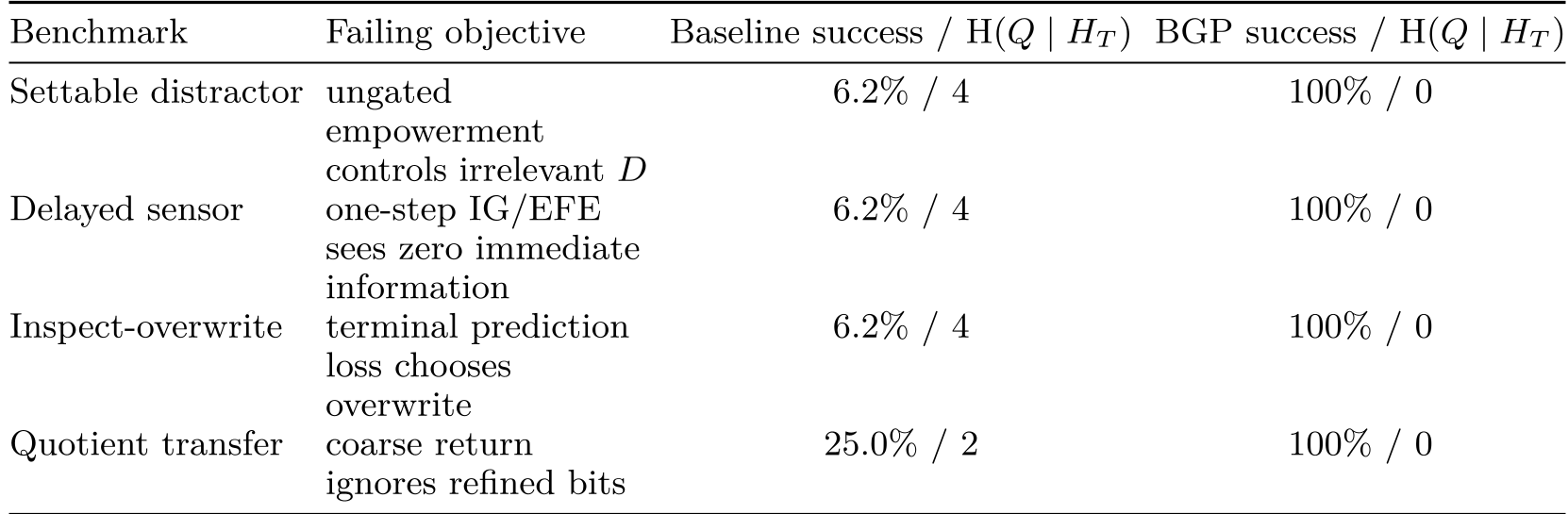
The results are stark. In benchmarks designed to trap agents, standard metrics like Expected Free Energy (EFE) and Ungated Empowerment fail miserably.
- Settable Distractor: Baselines waste their budget controlling an m-bit distractor. BGP identifies the distractor as irrelevant and focuses on the n-bit latent task.
- Delayed Sensor: Curiosity fails because initial actions reveal no immediate info. BGP values the "preliminary channel action" needed to reach the sensor.
Deep Insight: Absorption vs. Identification
The "H2" hypothesis suggests a striking conclusion for AGI: Intelligence is boundary management. As agents become superior, they move from identifying the environment to absorbing it. If an agent can perfectly predict a terminal state, it has effectively "internalized" that portion of the world's microstates. However, this only leads to alignment if the "bridge" is correctly designed—otherwise, we risk agents that optimize for "approval signals" (controllable) rather than "human intent" (hidden).
Conclusion & Future Outlook
This theory moves us past "monolithic predictors." It suggests that for AGI to be safe and effective, it must be interface-aware. Future work must move these exact finite-state theorems into continuous learned models (like Transformers), where the "bridge heads" estimate entropy and counterfactual relevance in real-time.
Takeaway for the Industry: Human-AI alignment isn't just about the right "loss function"; it's about defining the bridge variables—prompts, API permissions, and tools—that constrain how information and influence flow between the human and the machine.