
PrefixGuard: Real-Time Failure Prediction for LLM Agents
PrefixGuard: From LLM-Agent Traces to Online Failure-Warning Monitors
The paper introduces PrefixGuard, a trace-to-monitor framework designed for online failure warning in LLM agent trajectories. It utilizes an offline StepView induction method and a trainable monitor (GRU, Transformer, or FSM) to achieve SOTA prefix-risk scoring, reaching up to 0.900 AUPRC on WebArena.
TL;DR
LLM agents are increasingly used for "long-term" tasks like software engineering or web navigation. However, if an agent makes a mistake at step 2 of a 50-step task, we usually don't find out until step 50. PrefixGuard fixes this by synthesizing lightweight "Prefix Monitors" that watch agent execution traces in real-time, flagging "imminent failure" long before the task ends, all without the cost of a deployment-time LLM judge.
Background: The "Too Late to Intervene" Problem
Traditional LLM evaluation relies on a "Success/Fail" check at the very end of a trace. For high-stakes applications (e.g., financial management), this is a disaster. We need a "smoke detector" that triggers when a trajectory starts to drift. Current solutions are either too brittle (manual rules) or too expensive (calling GPT-4 for every single action the agent takes).
The Intuition: Why Deterministic Adapters Matter?
The authors recognized that LLM agent traces are "messy"—a mix of JSON, HTML selectors, and raw dialogue. Their core insight is StepView: instead of making a neural network read raw logs, they use an LLM once (offline) to write a parser. This parser turns messy logs into "Typed Records" (Action, Result, Status). This "Normalization" step provides a massive +0.137 AUPRC boost because it allows the model to focus on logic rather than string formatting.
Methodology: The PrefixGuard Pipeline
PrefixGuard follows a structured "Neural-Symbolic" path:
- StepView Induction: LLM creates a deterministic extractor.
- Differentiable Abstraction: A Gumbel-Softmax layer learns to map these steps into a "Discrete Alphabet" (K symbols).
- Monitor Backend: A GRU or Transformer scores the risk of the current prefix.
- DFA Extraction: For transparency, the system can compile its logic into a Deterministic Finite Automaton (DFA), allowing developers to see exactly which state leads to a crash.
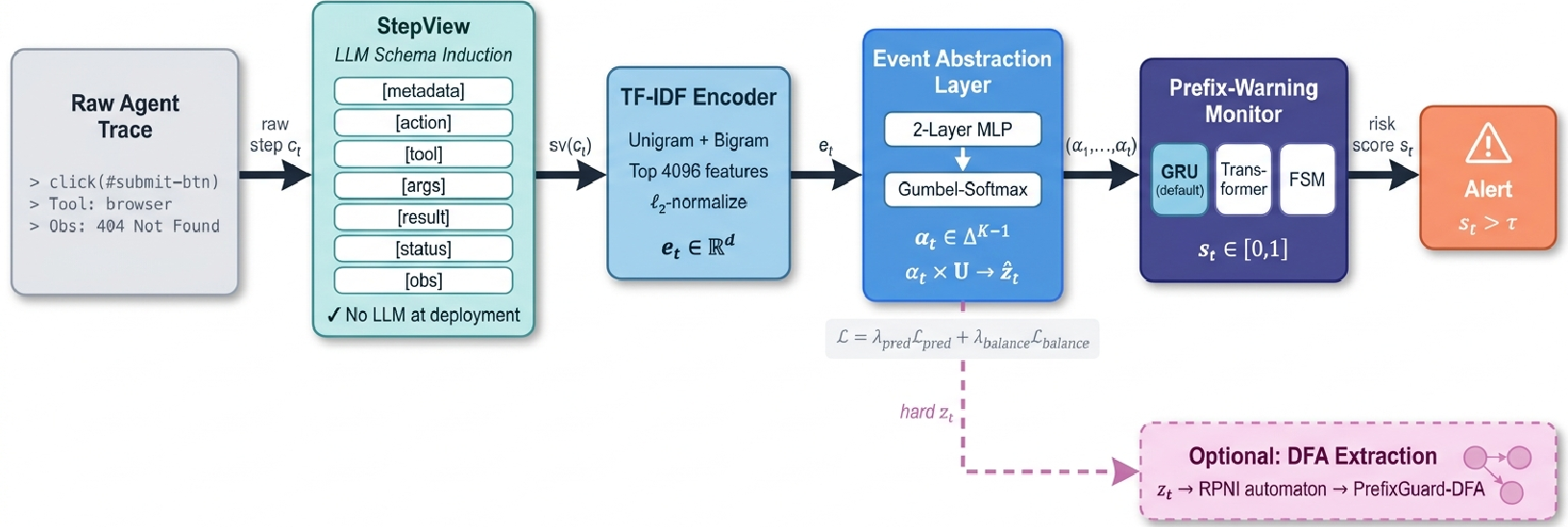 Figure 1: The PrefixGuard pipeline, showing the transition from raw traces to learned symbol risk scoring.
Experiments & Deep Insights
The researchers tested PrefixGuard across four distinct regimes: WebArena (Web), τ2-Bench (Dialogue), SkillsBench (Coding), and TerminalBench (CLI).
1. The Power of Representation
The "StepView" input consistently outperformed "Raw Text" inputs. In coding tasks (SkillsBench), the typed exposure of "Status" and "Result" codes was the difference between a useless monitor and a functional one (+0.218 AUPRC gain).
2. The AUPRC Trap
A fascinating finding in this paper is that high AUPRC does not equal high utility. On WebArena, the model had a massive 0.900 AUPRC, but failed to provide meaningful early warnings. Why? Because in browser tasks, failures happen so suddenly (step-local) that by the time there is evidence, you are already in the "failure window." Conversely, in Terminal/CLI tasks, the model fired early alerts with much better "Lead Time."
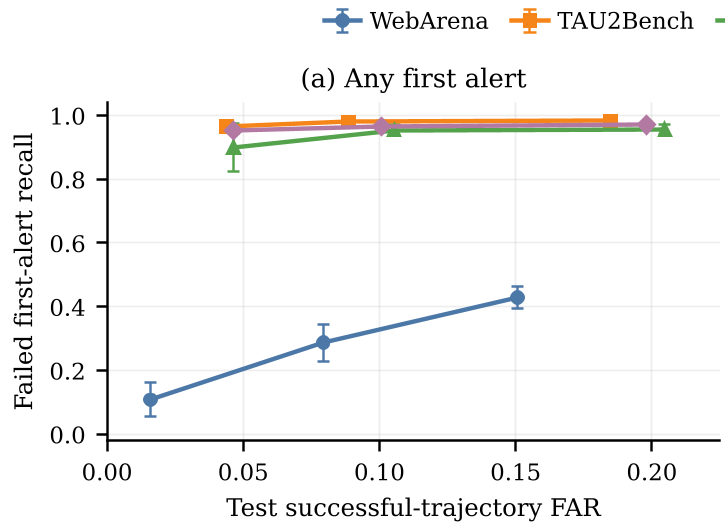 Figure 3: First-alert diagnostics showing the trade-off between False Alarm Rate (FAR) and Early Recall.
Critical Analysis & Future Outlook
While PrefixGuard is a breakthrough in lightweight monitoring (no LLM at runtime), it has a clear boundary: Observability. The authors derived a mathematical "AUPRC Ceiling"—if a mistake leaves no evidence in the trace, no model (no matter how large) can catch it. This pushes the field to reconsider how agents should "report" their internal state to make themselves more "monitorable."
Summary:
- Pro: Efficient, auditable (via DFA), and significantly more accurate than zero-shot LLM judges.
- Con: Relies on trace evidence; if the agent fails "silently" in its thoughts but the external output looks normal, the monitor is blind.
- Future Work: Linking these monitors back to "Automatic Recovery" policies, where the monitor not only flags a failure but rolls the agent back to a previous "Safe State."