
[NIPS 2025/NeMo] ProRL Agent: Scaling Multi-Turn LLM Training via Rollout-as-a-Service
ProRL Agent: Rollout-as-a-Service for RL Training of Multi-Turn LLM Agents
ProRL Agent is a scalable infrastructure for multi-turn LLM agent reinforcement learning, introducing a "Rollout-as-a-Service" (RaaS) architecture. It decouples I/O-intensive environment interactions from GPU-intensive policy training, achieving SOTA results on SWE-Bench Verified and integrating into NVIDIA NeMo Gym.
TL;DR
Training LLMs to become autonomous agents (capable of using tools like Bash or Python over many turns) is notoriously difficult to scale. ProRL Agent breaks the bottleneck by treating the entire agent interaction lifecycle as an independent, asynchronous service. By decoupling "thinking/learning" (GPUs) from "doing" (I/O & Sandboxes), it achieves nearly double the performance on software engineering benchmarks and enables seamless deployment on restricted HPC clusters.
The Architectural Bottleneck: Why "Doing" Hinders "Learning"
In standard RLHF, "rollouts" are simple: the model generates a response, and a reward model scores it. In Agentic RL, a single rollout is a marathon. The agent must:
- Initialize a secure sandbox (Docker/Singularity).
- Execute iterative commands (Shell, Python, Web browsing).
- Wait for environment feedback (which can be slow or non-deterministic).
- Evaluate the final outcome (often requiring full test suite execution).
Existing frameworks like SkyRL or Agent Lightning often embed this logic directly into the training loop. This "tight coupling" leads to Resource Interference: GPU workers sit idle while the CPU waits for a Bash command to finish, and I/O-heavy sandbox setups throttle the gradient descent process.
Methodology: Rollout-as-a-Service (RaaS)
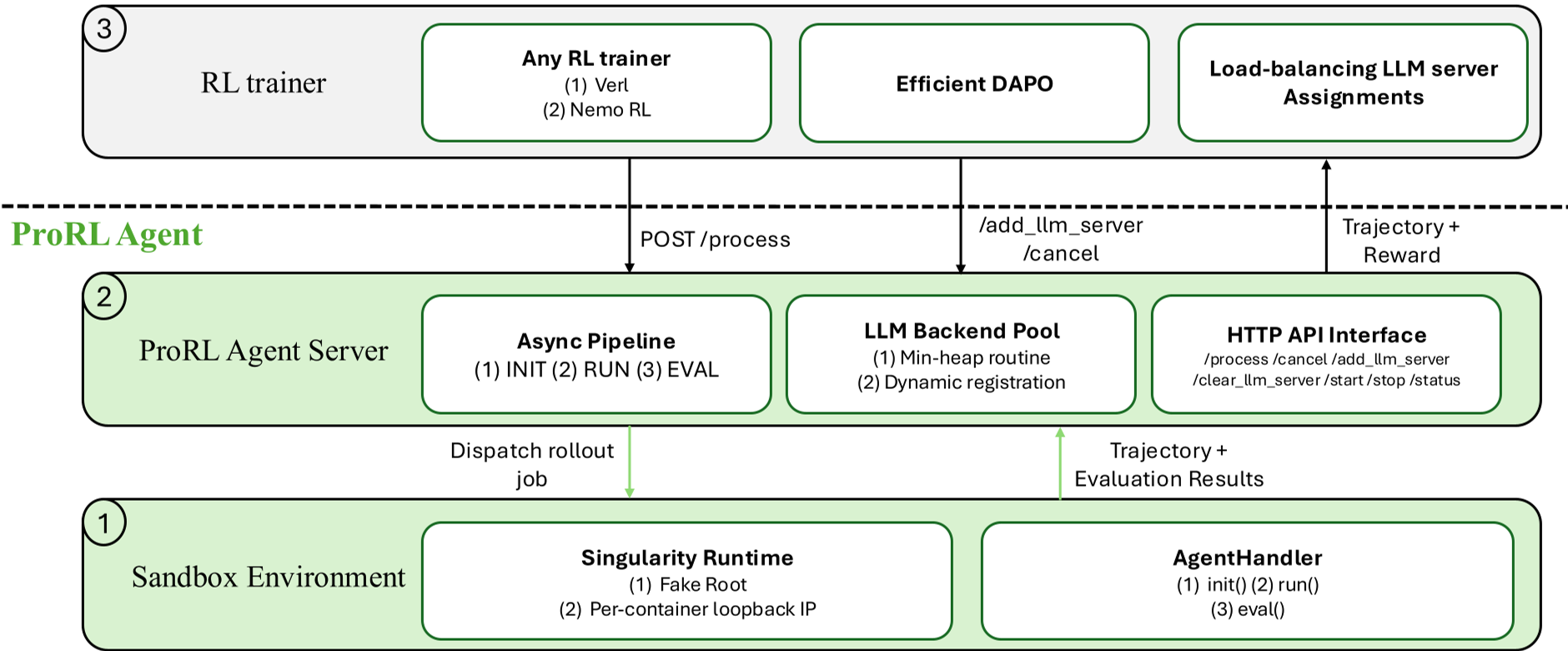
ProRL Agent introduces a clean separation. The RL Trainer (e.g., NeMo RL or veRL) only cares about sending a prompt and receiving a trajectory with a reward.
1. The Three-Stage Asynchronous Pipeline
To maximize throughput, ProRL Agent treats rollouts like an assembly line:
- INIT Pool: Handles the I/O-bound task of spinning up rootless Singularity containers.
- RUN Pool: Manages the multi-turn agent loop. It optimizes tool execution via direct pseudo-terminals (bypassing
tmuxoverhead) and Unix Domain Sockets (UDS) for lower latency. - EVAL Pool: Scores the results, which can range from simple math checks to complex repository-level testing.
2. Solving the "Root" Problem in HPC
Most agent environments rely on Docker, which requires root privileges—a luxury often unavailable in shared university or corporate clusters (Slurm). ProRL Agent uses Singularity, allowing for "rootless" deployments where each container gets its own loopback IP to avoid port conflicts during massive parallel training.
3. Eliminating Drift: Token-in/Token-out
A subtle but lethal bug in RL is "re-tokenization drift." If a trajectory is converted from tokens to text and back to tokens, the IDs might shift, causing the trainer to calculate gradients for a sequence the model didn't actually produce. ProRL Agent preserves Token IDs from the moment of generation through the entire service pipeline to the trainer.
Experiments: Superior Efficiency and Generality
The authors validated the system across Software Engineering (SWE-Bench), Math, STEM, and Coding tasks.
SOTA Results on SWE-Bench
On the challenging SWE-Bench Verified benchmark, ProRL Agent-8B achieved an 18.0 score, nearly doubling the 9.4 achieved by SkyRL-Agent-8B-v0. This suggests that the stability and scale provided by the RaaS architecture allow models to benefit more effectively from high-quality RL samples.

Linear Scalability
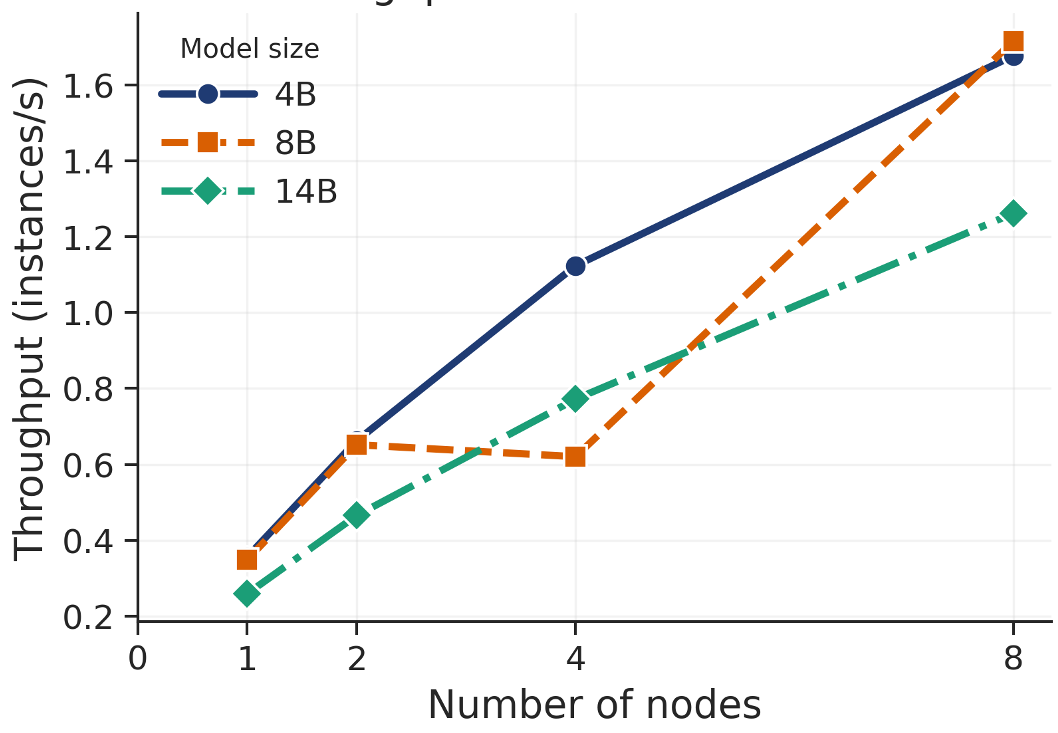
One of the most impressive results is the linear scaling of throughput. As you add more compute nodes, the number of instances processed per second increases proportionally, proving that the infrastructure overhead does not bottleneck the training process.
Critical Insights & Takeaways
- Abstraction is Efficiency: By defining an
AgentHandlerinterface (Init, Run, Eval), the system makes it trivial to swap a Web-browser agent for a SQL-execution agent without touching the GPU training code. - Tool Latency Matters: Optimizations like Persistent IPython kernels and Bash-over-PTY are not just "nice to haves"—at the scale of millions of training steps, they provide the 20-30% throughput boost required to make Agentic RL feasible.
- Integration: As part of NVIDIA NeMo Gym, this work sets a new standard for how industrial-scale agent training should be structured.
Conclusion
ProRL Agent shifts the paradigm from "training with an environment" to "training against a service." This decoupling is the key to moving beyond toy tasks into real-world agentic applications like automated software engineering and complex scientific discovery.