
Pro-Tensor Network: Building a Rigorous Bridge to Many-Many-Body Theory
Pro-Tensor Network
This paper introduces the Pro-Tensor Network, a categorification of traditional tensor networks using profunctors and enriched category theory to study "many-many-body theory." The framework successfully generalizes the Levin-Wen model and the Kitaev-Kong theorem, transcending standard constraints of semisimplicity, finiteness, and rigidity in many-body physics.
TL;DR
The Pro-Tensor Network is a revolutionary categorification of standard tensor networks. By replacing linear maps with profunctors (V-enriched bimodules) and using coends for index contraction, the authors provide a rigorous graphical language for many-many-body theory. This framework effectively generalizes the Levin-Wen model and the Kitaev-Kong theorem to handle non-finite, non-semisimple, and non-rigid systems, offering a "third-quantization" perspective on universal physical properties.
Motivation: From Single Models to Theory Ensembles
Standard many-body physics often studies a specific Hamiltonian. However, the concept of a "phase" refers not to one model, but a collection of theories sharing universal traits like topological order or symmetry. The authors argue for a Global Many-Body Theory (or "Many-Many-Body Theory").
The existing SOTA (e.g., Matrix Product States, PEPS) relies on finite-dimensional Hilbert spaces. When dealing with continuous symmetries (like ) or non-semisimple categories, the traditional diagrammatic calculus often lacks mathematical rigor. The authors' insight is to use profunctors as "categorified tensors," allowing renormalization to be treated as the fundamental "dynamics" in the space of theories.
Methodology: The Core of Pro-Tensors
In a standard tensor network, nodes are linear maps and edges are vector spaces. In a Pro-Tensor Network:
- Edges are assigned V-enriched categories (e.g., , ).
- Nodes are assigned Pro-tensors (profunctors ).
- Contraction is performed via the Coend construction (), which "integrates out" internal categorical degrees of freedom, perfectly mimicking Einstein summation at a higher categorical level.
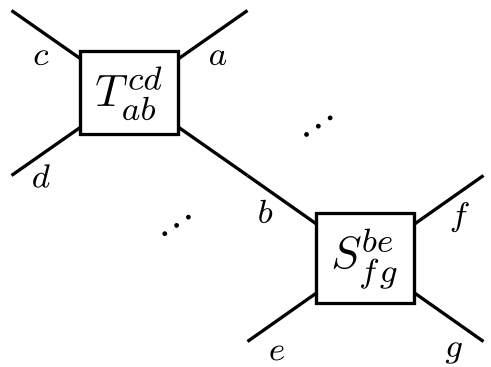
The power of this approach lies in its locality. Changes to a local node (profunctor homomorphisms) propagate through the network in a functorial way, making it ideal for describing local defects and boundaries.
Key Results: Generalizing Kitaev-Kong
A major contribution of this work is the Generalized Kitaev-Kong Theorem.
Theorem 1.2
The authors prove that for any cosmos and -enriched monoidal category , the category of particle-like defects on the junction of two boundaries is equivalent to the category of modules over a promonad .
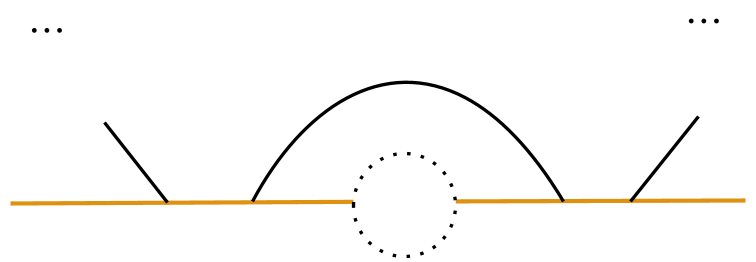
Unlike prior proofs that required finiteness and semisimplicity, this pro-tensor proof uses the "yoga" of adjunctions and transposing, making it:
- Rigorous: Rooted in enriched category theory.
- Intuitive: Computation is performed via "candy-wrapping" and "H-shape" diagrams that physically represent surrounding ground states.
Deep Insights: Topological Holography & U(1) Divergence
The paper applies the framework to symmetry. By enriching over infinite-dimensional vector spaces (), they show that the fixed-point tensors form a category . They observe an "algebraic divergence" (loss of semisimplicity), which they insightfully link to the Mermin-Wagner theorem—suggesting that the inability of continuous symmetries to break in 1D/2D is encoded in the non-semisimple nature of the pro-tensor category.
Conclusion and Outlook
The Pro-Tensor Network moves beyond "What" a specific system does, to "How" theories relate via renormalization.
- Takeaway: It provides the first condensed-matter-friendly toolkit for non-finite symmetries.
- Limitations: Currently, it is mostly a kinematic framework; defining the exact energetic stable points (the actual "physics") in this huge categorical space remains a future challenge.
- Future Work: Exploring "Profunctor Optics" in the context of data transformation patterns in computer science and its structural analogy to renormalization in physics.
This work represents a milestone in the "Third Quantization," shifting the focus from particles (1st) and fields (2nd) to the universe of theories themselves.