
ProbeFlow: Breaking the Latency Barrier in Generative Robotic Control
ProbeFlow: Training-Free Adaptive Flow Matching for Vision-Language-Action Models
ProbeFlow is a training-free adaptive inference framework designed to accelerate Vision-Language-Action (VLA) models using Flow Matching action heads. By dynamically adjusting ODE integration steps based on trajectory curvature, it achieves a 14.8x speedup in action decoding and maintains SOTA success rates on MetaWorld and LIBERO benchmarks.
TL;DR
ProbeFlow is a training-free framework that solves the "iterative bottleneck" of Flow Matching in robotics. By using a lightweight Lookahead Linearity Probe to detect when a robot's planned path is straight, it skips unnecessary computations. It accelerates action decoding by 14.8x and reduces total system latency by 2.8x without losing manipulation accuracy.
Background: The Hidden Bottleneck of VLA Models
Vision-Language-Action (VLA) models like OpenVLA or RT-2 are transforming robotics by allowing models to "reason" through tasks. However, a massive asymmetry has emerged: while the "Vision-Language" brain processes the scene in one shot, the "Action" head (often based on Flow Matching) requires 20 to 50 iterative steps to "pixel-perfect" a single movement.
In the world of real-time physical control, a 200ms delay is the difference between a smooth grasp and a crashed robot. Most efficiency research focuses on compressing the VLM backbone (quantization/pruning), but ProbeFlow targets the actual iterative loop of the action head.
The Core Insight: Not All Steps are Equal
The authors observed that robotic trajectories are not uniformly complex. A "gross motion" (e.g., moving the arm toward a table) is geometrically simple and nearly linear. Conversely, "fine-grained interaction" (e.g., the moment of contact during a grasp) is highly curved and requires precision.
If a path is a straight line, why solve it with 50 tiny steps? You only need one.
Methodology: The Lookahead Linearity Probe
ProbeFlow operates on a simple but elegant geometric principle. At the start of a control cycle, it performs a one-shot "probe":
- It calculates the initial velocity ().
- It takes a "leap of faith" halfway through the timeframe to find a lookahead state ().
- It calculates the velocity at that future point ().
- The Magic Step: It measures the Cosine Similarity between these two vectors.
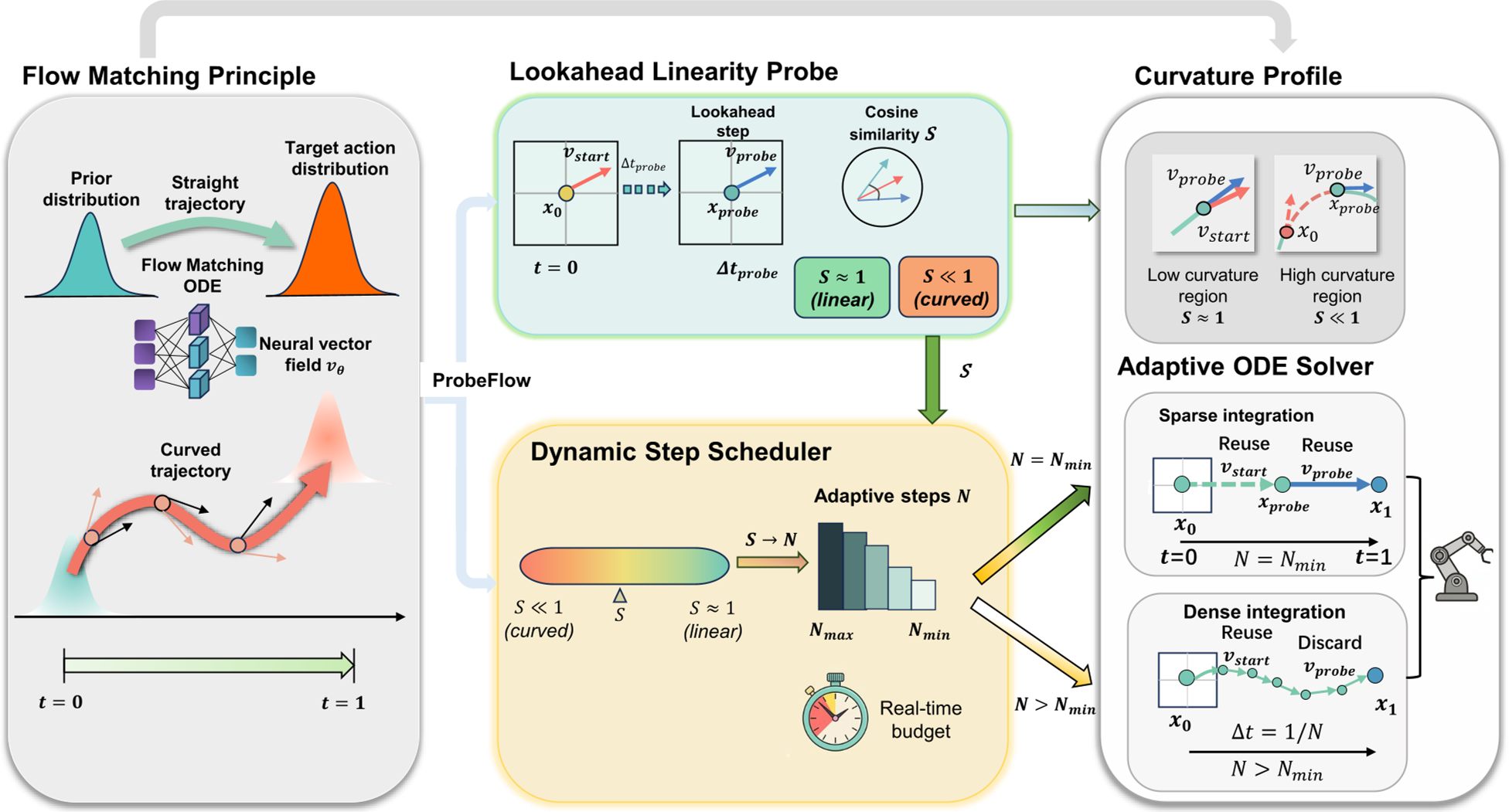
If the vectors align (Similarity ), the path is linear. ProbeFlow then prunes the schedule down to just 2 steps. If they diverge, it knows the "flow" is curving and triggers a dense integration to ensure safety.
Experimental Results: Speed Without Sacrifice
The team tested ProbeFlow across MetaWorld (MT50) and LIBERO benchmarks, as well as real-world hardware.
| Metric | Fixed-Euler (N=50) | ProbeFlow (Ours) | Improvement |
|---|---|---|---|
| Avg. Steps | 50.0 | 2.6 | 19.2x reduction |
| Action Head Latency | 235.7 ms | 15.9 ms | 14.8x faster |
| Success Rate (MT50) | 82.5% | 83.2% | Parity/Slight Gain |

The results show that ProbeFlow isn't just "faster"—it's smarter. By allocating computational "effort" where it matters, it avoids the accuracy drop-off that happens when you simply force a standard solver to run with fewer steps (fixed dropped success to 72.4%).
Real-World Deployment
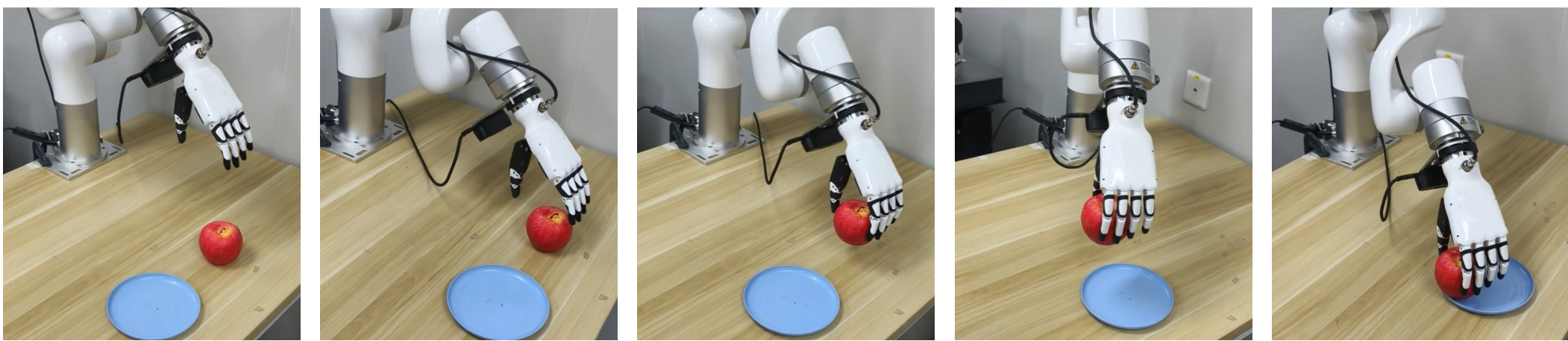
Experiments on a UFACTORY xArm7 demonstrated that ProbeFlow allows the robot to handle contact-rich tasks like "Pick-and-Place" with high responsiveness. By keeping the action decoding under 13ms, the controller can stay within the strict frequency limits required for stable physical interaction.
Critical Perspective: Limits and Future Work
While ProbeFlow is a breakthrough for training-free deployment, it introduces a new hyperparameter: the linearity threshold ().
- Sensitivity: If set too high, the model might miss subtle curves in highly dynamic environments.
- Domain Tuning: The authors noted that while it's training-free, "tuning" the threshold for different domains (e.g., moving from a simulation to a messy kitchen) is still necessary for optimal performance.
Conclusion
ProbeFlow shifts the focus of VLA optimization from "making the brain smaller" to "making the decision loop more efficient." By proving that we can use geometric intuition to skip redundant neural network passes, it paves the way for generative AI that is fast enough for the real, unpredictable world.